How to Know If Your Ads Are Working in 2026
App attribution is the process of connecting a specific ad to the user action that followed: an install, a trial start, or a paid subscription. For subscription apps, simple attribution tracks three events: install, trial start, and subscribe. You don't need an enterprise tool to start. You need the right three metrics and a way to tie them back to your ad spend.
Key Takeaways
-
CPI alone doesn't tell you what's working. Cost per install is a top-funnel metric. The number that matters for subscription apps is cost per paying subscriber — which runs 4–5x higher than CPI on average.
-
82% of trial starts happen on Day 0. If you're not measuring what happens in the first session, you're missing most of your conversion data.
-
A simple setup tracks four channels and three events. Meta, Google, Apple Search Ads, and TikTok — plus install, trial start, and subscription.
-
The median trial-to-paid conversion rate is 34.8% across 75,000+ apps. Knowing where your app stands tells you whether to fix your paywall or your audience targeting.
-
You can start measuring without a complex setup. A basic attribution layer connecting four ad channels and three subscription events is enough to validate your first campaigns.
What App Attribution Actually Means
App attribution answers one question: which ad brought this user here?
Every time a user installs your app, something drove that action — a Meta ad, an Apple Search Ads result, a TikTok video, or organic search. Attribution is the mechanism that connects the install back to that source. Without it, you see installs but not where they came from.
For subscription apps, attribution extends beyond the install. A user who installs and never subscribes costs you money. A user who installs, starts a trial, and converts to a paid plan earns you money. The difference between those two users, and which ad brought which, is what app attribution reveals.
One critical challenge: every data source reports a different number. Your Meta Ads dashboard shows one install count. The App Store shows another. Your analytics tool shows a third. This is what practitioners call the "source of truth war." That is the reason you need a single attribution layer to reconcile them.
Why do numbers never match?
Meta, Google, TikTok, and Apple Search Ads are all Self-Attributing Networks (SANs). Each one claims credit for installs independently, without checking whether another platform already claimed the same user. When your audiences overlap across channels, the same install gets counted two or three times.
This is not fraud. It is how SANs are designed.
There are two ways to fix it:
-
Use a single attribution layer. One tool that sits across all channels picks the winning touchpoint and prevents double-counting.
-
Run incrementality tests. Pause a campaign for two weeks and measure what changes. If installs don't drop, the channel was claiming organic users — not driving new ones.
Why CPI Misleads You — and What to Track Instead
Cost per install (CPI) is the most commonly reported metric in paid user acquisition. It is also the least useful metric for subscription apps.
CPI tells you how much you paid to get someone to download your app. It tells you nothing about whether that person ever opened the app, started a trial, or paid a dollar. Across 75,000+ subscription apps, the median cost per paying user (CPPU) runs 4–5x higher than CPI. That means for every dollar you think you're spending per user, you're spending four to five dollars to get a paying one. (RevenueCat SOSA 2025)
The three metrics that actually matter for subscription apps:
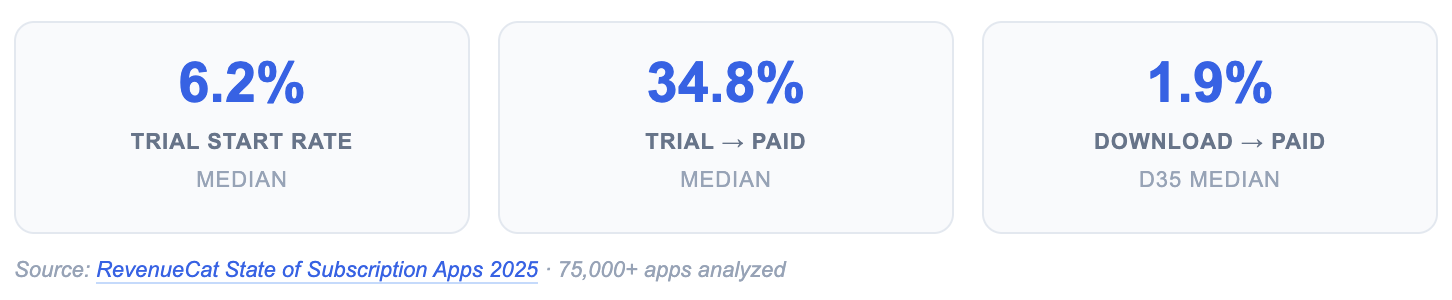
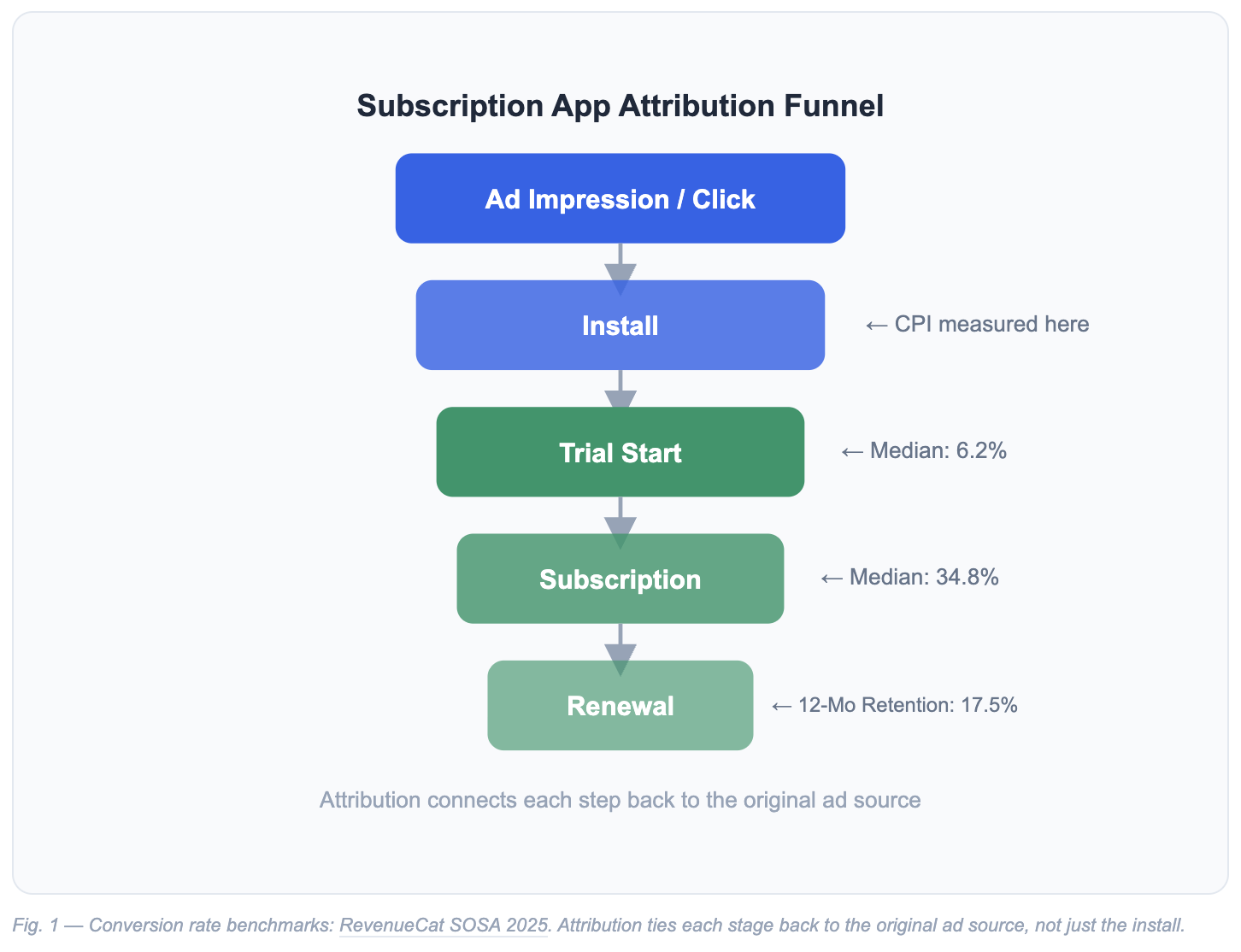
Trial Start Rate — what share of installs reach your paywall and start a free trial. Median across all categories: 6.2%. Health & Fitness apps hit 7.8% at median and 24.1% at the top 10%.
Trial-to-Paid Conversion — what share of trialists become paying subscribers. Median: 34.8%. Top-performing apps clear 51.5%.
Cost per Subscription (CPS) — your total ad spend divided by paying subscribers acquired. This is the metric that tells you whether your unit economics work.
Attribution Window settings determine how long after an ad interaction you'll credit that ad for a conversion. For subscription apps with longer trial periods, 14–30 day windows are standard. Before launching, confirm all platforms (ad networks, attribution tool, app store) report in the same timezone. Mismatched timezones are the most common cause of daily install count discrepancies.
Start measuring what matters — for free
Airbridge Core Plan gives growing teams real attribution, deep linking, and audience tools at no cost.
Start Free for 30 Days →Subscription Attribution Benchmarks
Here's what good performance looks like across the install-to-subscriber funnel:
| Metric | Median | Top Quartile (Q3+) | Top 10% (P90) |
|---|---|---|---|
| Trial Start Rate | 6.2% | 12.4%+ | 20.3% |
| Trial → Paid Conversion | 34.8% | 51.5%+ | 68.2% |
| Download → Paid (D35) | 1.9% | 4.3%+ | 8.5% |
| 1-Year LTV per Payer | $16.27 | $33.91+ | $60.68 |
Source: RevenueCat State of Subscription Apps 2025 · 75,000+ apps, $10B+ revenue analyzed
If your trial start rate is below 6.2%, your paywall is the problem: users aren't reaching it or aren't engaging with it. If your trial-to-paid is below 34.8%, the issue is usually trial length, onboarding quality, or the wrong audience reaching your trial.
On iOS, Apple's AdAttributionKit (AAK) has expanded on SKAdNetwork (SKAN), adding support for alternative app marketplaces and engagement" class="glossary-link" title="Re-engagement">re-engagement tracking. For subscription apps, SKAN's postback windows (0–2 days, 3–7 days, 8–35 days) mean iOS install data can be delayed by days or weeks, making early campaign decisions based on iOS data unreliable. App Tracking Transparency (ATT) prompts also affect your match rates — lower opt-in rates mean more modeled attribution on iOS.
Set Up Simple Attribution in 3 Steps
Most early-stage apps don't need a complex multi-touch attribution model. They need to answer one question: which ad drove a subscriber?
1. Choose your channels - max four
SANs, like Meta, Google, Apple Search Ads, and TikTok, cover the majority of subscription app paid user acquisition spend. Starting with all four creates noise. Most teams do better starting with one or two channels, proving unit economics, then expanding. Tracking more channels than you actively manage creates data you never act on.
2. Track the subscription funnel - not just installs
Configure these events at minimum:
-
Install (app first open)
-
Trial Start (paywall presented + trial activated)
-
Subscribe (first paid transaction)
-
Renewal (subsequent paid transaction)
-
Cancel / Churn (subscription ended)
Tracking cancel and renewal, not just the initial subscribe, tells you which ad sources drive subscribers who stick versus those who refund within the first week. You can also add a "How did you hear about us?" field during onboarding. Self-reported data does not replace technical attribution, but it reveals blind spots: if 30% of users say "App Store search" but your attribution tool shows 10% organic, your probabilistic matching may be over-crediting paid channels.
3. Connect ad spend to subscription revenue
Your ad platform reports installs. Your subscription management tool (RevenueCat, Adapty) reports revenue. Attribution is the layer that connects them. When Meta tells you Campaign A drove 200 installs and your subscription tool shows 40 new subscribers, attribution tells you how many of those 40 came from Campaign A specifically, and at what cost per subscriber.
If you want to connect ad spend to subscription revenue without building a custom data pipeline, consolidated attribution tools like Airbridge let you see cost per subscriber across all four channels in one dashboard.
Frequently Asked Questions
Do I need attribution from day one?
If you're running paid ads, yes. The moment you spend money on a campaign, you need to know whether that campaign drove users who convert, not just users who install. Without attribution from the start, you accumulate ad spend with no way to evaluate which campaigns performed. Basic attribution setup (installing an SDK, connecting your ad channels, configuring three events) typically takes a day, not a week.
What's the difference between installs and paying users?
An install is a download. A paying user is a subscriber. For most subscription apps, only 1.9% of installs become paying subscribers within 35 days (the D35 median across 75,000+ apps). The top 10% of apps reach 8.5%. CPI measures how much you paid per install. What you actually need to optimize is cost per paying subscriber — which is 4–5x higher than CPI on average. These two numbers can look radically different, which is why tracking only installs misleads budget decisions.
How long before I see meaningful attribution data?
Trial periods commonly range from 7 to 30+ days, and some users take additional days after trial expiry to cancel or convert. Plan for a 30-day observation window before making major budget reallocation decisions. Shorter windows will show install and trial data, but won't give you a full picture of which campaigns drive subscribers who actually stick.
Should I track what happens after the subscription?
Yes. First renewal is the biggest drop-off point. 55.5% of monthly subscribers and 66.3% of annual subscribers churn before their first renewal. An ad source that drives 100 subscribers who all churn in Month 1 is worth less than one that drives 50 subscribers with 80% first-renewal retention. Track at least through the first renewal before judging a campaign's true ROAS:
-
Weekly plans: check ROAS at D35. (12-month retention median is 1.8%)
-
Monthly plans: check ROAS at D60. (12-month retention median is 8.9%)
-
Annual plans: check ROAS at D365. (12-month retention median is 18.5%)
What attribution window should I use?
Most platforms default to 7-day click, 1-day view. For subscription apps with longer deliberation cycles, 7-day click is standard. Shorter windows (1-day) are stricter and reduce over-attribution but may miss users who click an ad on Monday and install on Wednesday.
Start Measuring. Stop Guessing.
Running ads without attribution is driving without a dashboard. You feel the speed, but you don't know if you're heading the right direction or running out of fuel.
The setup doesn't have to be complicated. Track the install, the trial start, and the subscription. Connect those three events to your four ad channels. Check your cost per subscriber against the industry median. Adjust from there.
Ready to see what Core Plan can do?
Free attribution, deep linking, and audience tools — built for teams that are ready to grow.