Influencer Attribution Tracking: Promo Codes vs Tracking Links -- Which Actually Works for Mobile Apps?


You gave 10 influencers unique promo codes. Three months later, the codes show 200 redemptions. But your organic installs spiked by 2,000 during the same campaigns. You gave another 5 influencers tracking links. The links show 150 clicks - but you know from App Store Connect that installs were 3x higher than what the links captured.
Neither method is telling you the full story. This is the core challenge of influencer attribution tracking for mobile apps: neither promo codes nor tracking links tell you which influencer's audience converted to paying subscribers.
Key Takeaways
-
Promo codes are deterministic but incomplete. They confirm a user came from a specific influencer - but only a fraction of influencer-driven users actually redeem a code. The rest search the App Store directly and never enter it.
-
Tracking links provide click-through visibility but break on social platforms. Users on TikTok and Instagram rarely click links - they watch content, then search for the app. Click-based attribution misses the majority of influencer-driven installs on these platforms.
-
Neither method captures post-install subscription data. Promo codes tell you who redeemed. Links tell you who clicked. Neither tells you who started a trial, subscribed, or renewed.
-
The real gap is not codes vs links - it is connecting influencer attribution to subscription revenue. That requires deep links, an MMP, and server-to-server billing integration.
-
Airbridge Core Plan bridges this gap with deep links that preserve attribution through the App Store, plus S2S integration with RevenueCat and Adapty to connect installs to subscription events.
Why Influencer Attribution Breaks on Mobile
Influencer attribution tracking is the process of connecting an influencer's content to downstream user actions - installs, trials, and subscriptions - so growth teams can measure which partnerships produce revenue. On the web, this is relatively straightforward: user clicks link, lands on page, converts. Cookies and UTM parameters track the journey. Mobile apps break this model at every step.
Users do not click links. A fitness trainer posts a workout video on Instagram or TikTok. The audience watches, becomes interested, and searches the app name directly in the App Store. They never tap the link in bio, never click a swipe-up, never touch a trackable URL. On social platforms, the dominant user behavior is watch-then-search - not click-through.
Privacy features block cross-app tracking. Even when a user does click a link, iOS App Tracking Transparency (ATT) prevents connecting that click to a later install unless the user opts in. Most decline. The click happens in one app, the install in another, and on most iOS devices those two events cannot be connected.
Delayed conversions fall outside attribution windows. A user discovers a trainer's "12-week transformation" series. They follow along for weeks before installing the recommended app. Standard attribution windows are 7-28 days. By the time they install, the window has closed and the install appears organic - even though the influencer clearly drove it.
The result: most influencer-driven installs show up as organic in your MMP. This is not a tracking bug. It is a structural mismatch between how influencer marketing works - through awareness and trust - and how attribution systems work -- through clicks and cookies.
Promo Codes vs Tracking Links: What Each Method Actually Captures
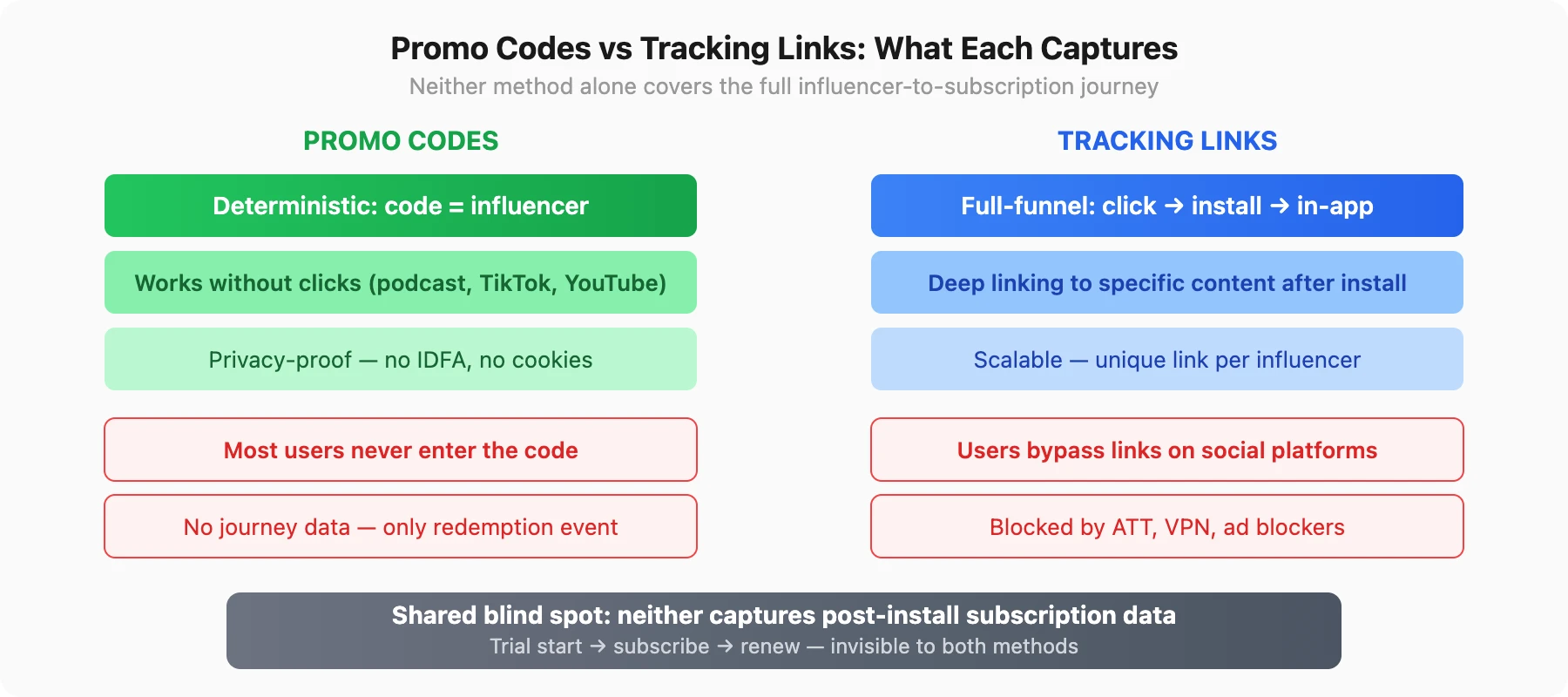
Both methods have real strengths. Both have structural blind spots. Understanding what each one captures - and what it misses - is the first step toward closing the gap.
1. How Promo Codes Work
An influencer shares a unique code - "TRAINER20" - and the user enters it at checkout or during onboarding. The code connects that conversion to the influencer deterministically. No cookies, no click tracking, no device-switching problems.
Where promo codes work well:
-
Podcast and YouTube - audio/video mentions where clicking a link is not natural
-
Cross-device - the code works regardless of which device the user installs on
-
Privacy-proof - no reliance on IDFA, cookies, or cross-app tracking
Where promo codes fail:
-
Most users never enter the code. They hear about the app, search it, install it, and start using it - without remembering or bothering with a code. Promo codes work as clickless tracking but only capture users who actively remember and enter them - a minority of total influencer-driven conversions.
-
No journey data. A code tells you who redeemed. It does not tell you when they first saw the content, how many times they visited the App Store listing, or what they did before converting.
-
Code sharing and fraud. Codes leak to coupon aggregator sites. A "TRAINER20" code intended for one influencer's audience ends up on RetailMeNot, and you attribute conversions to the wrong source.
2. How Tracking Links Work
An influencer shares a unique URL - often placed in their link-in-bio or story swipe-up. When a user clicks, the link routes them through the App Store while preserving attribution data. If the link uses deep linking, it can also route the user to a specific screen after install.
Where tracking links work well:
-
Full-funnel click visibility - you see the click, the install, and the in-app events that follow
-
Deep linking - users land on the relevant content after install, not a generic home screen
-
Scalable attribution - generate unique links per influencer, per campaign, per content piece
Where tracking links fail:
-
Platform restrictions limit link placement. Instagram does not allow clickable links in feed posts. TikTok limits link placement to bio. When comparing coupon codes vs tracking links, links consistently underperform on platforms that restrict or strip URLs.
-
UTM parameters do not survive the App Store redirect. Standard UTM-tagged links lose their parameters when the user is redirected to the App Store. You need deep links with an MMP to preserve attribution through the install flow.
-
Click-to-install connection breaks. Even when a user clicks, iOS ATT, VPNs, and ad blockers can prevent the attribution system from connecting the click to the install. The data trail disappears mid-funnel.
3. Side-by-Side Comparison
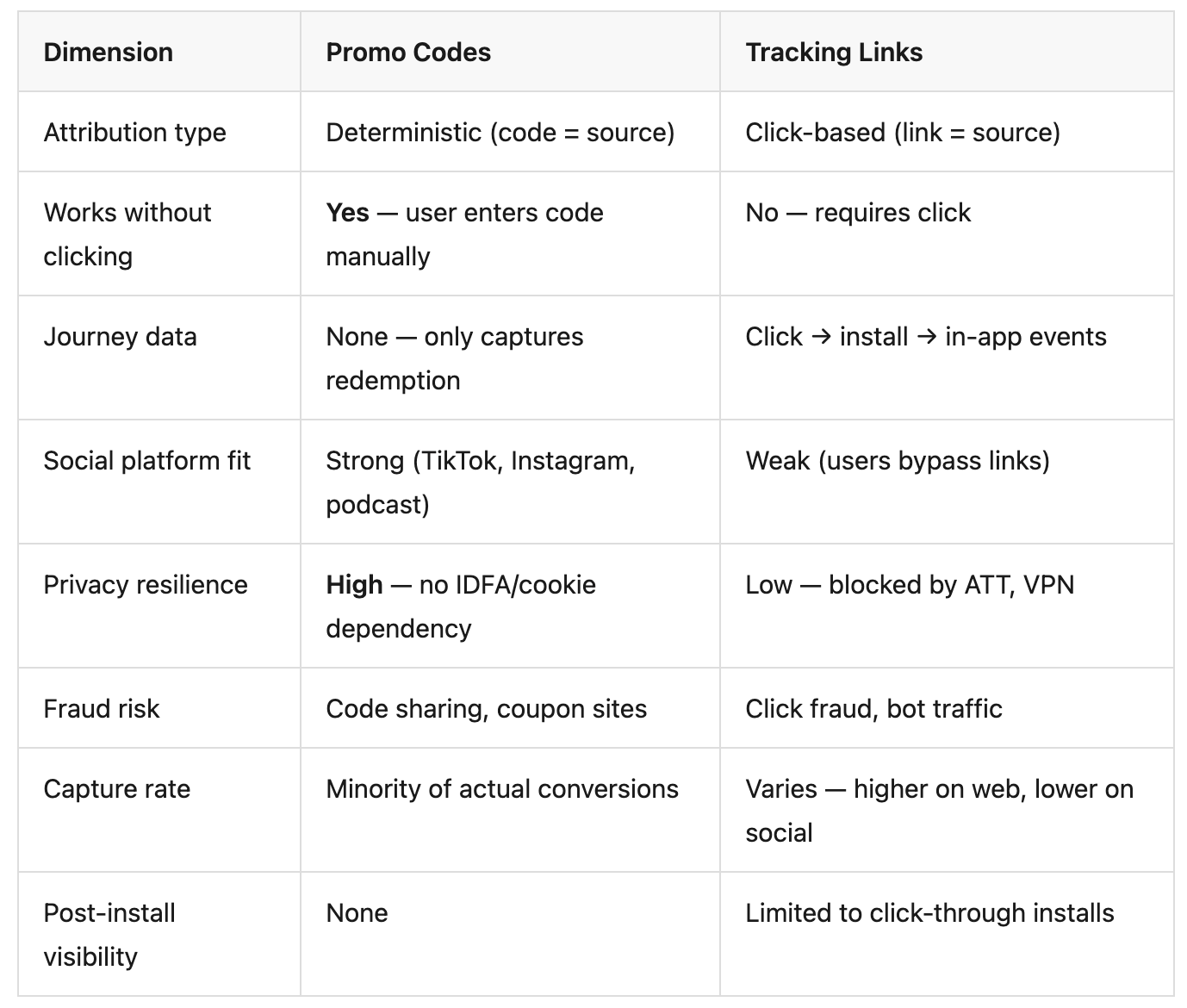
Neither method alone captures the full picture. Promo codes work where links fail - and links work where codes are impractical. But both share the same critical blind spot: **neither tells you what happens after the install.
Want to see how Influencer attribution tracking works with your data?
Get hands-on with Airbridge and see real results.
Try It Free →The Hybrid Approach - And What Is Still Missing
The practical solution is to use both methods together.
Embed promo codes inside deep links. When a user clicks the influencer's link, the deep link routes them to the App Store and preserves attribution data. After install, the app reads the deep link parameter and pre-fills the promo code - so the user does not need to remember or type it. If the user does not click - they search the App Store directly - the promo code still works as a fallback. This creates dual-layer attribution: link for click-through, code for no-click.
Use deep links for journey data, codes for reach. The link captures the users who click. The code captures users who heard about the app through any medium - podcast, live stream, word of mouth - and entered the code without clicking anything.
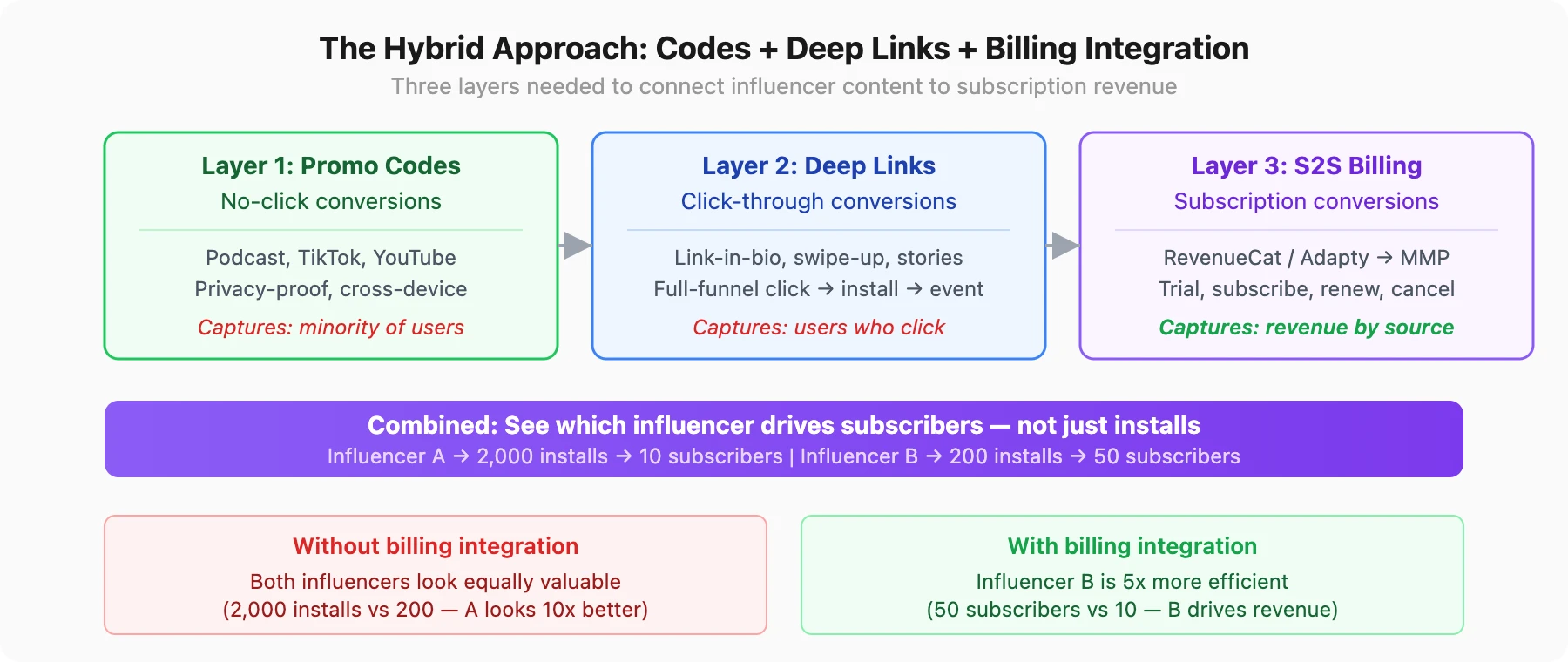
But there is a gap both methods leave open. For subscription apps, the install is not the conversion. The conversion is: trial start → paid subscription → renewal. Without connecting attribution to billing events, you cannot tell which influencer's audience actually generates subscription revenue.
An influencer with 500K followers may drive 2,000 installs and 10 subscribers. A micro-influencer with 30K followers may drive 200 installs and 50 subscribers. Without subscription-level attribution, both look the same in your budget review.
Closing this gap requires connecting attribution data to billing events - trial start, subscribe, renew, cancel - through a server-to-server integration with your billing platform.
How to Connect Influencer Attribution to Subscription Revenue
General Approaches
Regardless of tooling, growth teams can take these steps today:
-
Assign unique deep links AND unique promo codes per influencer. Double coverage captures both click-through and no-click conversions.
-
Measure organic lift during campaign windows. Compare baseline organic installs (before campaign) to installs during the campaign period. The difference estimates influencer-driven organic volume.
-
Track subscription events by attributed source. If your billing platform (RevenueCat, Adapty) supports source tagging, tag subscription events with the influencer attribution data from your MMP.
-
Extend attribution windows for influencer campaigns. Influencer content has a longer conversion cycle than paid ads. Standard 7-day windows miss delayed conversions - configure 14-30 day windows for influencer sources.
How Airbridge Core Plan Connects the Full Journey
Airbridge Core Plan connects influencer attribution to subscription revenue in a single stack - without enterprise contracts or custom implementations.
-
Deep links per influencer, per campaign. Generate unique tracking links that preserve attribution through the App Store redirect. Supports deferred deep linking - users land on the relevant content after install, not a generic home screen.
-
S2S billing integration with RevenueCat and Adapty. Subscription events - Start Trial, Subscribe, Unsubscribe - flow back to the attributed install source. See which influencer's audience converts to paid, which tier they choose, and whether they renew.
-
Unified reporting across influencer and paid UA. Influencer deep link data and GMAT channel data (Google, Meta, Apple Search Ads, TikTok) appear in the same Funnel and Revenue reports. Compare influencer CAC to paid CAC on an equal basis - not in separate spreadsheets.
-
25 subscription-optimized standard events. No custom event schema design needed. Events like Start Trial, Subscribe, and Order Complete are predefined - reducing setup decisions for the subscription funnel.
-
15K free attributed installs, then $0.05/install. All features included from day one - deep links, S2S billing, unified reporting. No tiered feature gates.
Core Plan's limitation is intentional focus: it supports GMAT channels and a maximum of 2 third-party integrations. If you need non-SAN ad networks or raw data export, that is Growth Plan territory. For teams running influencer campaigns alongside Meta, Google, Apple, and TikTok paid UA, Core Plan covers the full attribution-to-subscription stack.
Neither Promo Codes Nor Tracking Links Tell You What Matters Most
The debate between promo codes and tracking links misses the real question for subscription apps. The question is not which method captures more installs - it is which influencer's audience actually becomes paying subscribers.
Codes and links are both necessary inputs. But the output that drives budget decisions - subscription revenue by influencer - requires connecting attribution to billing events.
Until you can see which influencer drives subscribers, not just installs, you are optimizing the wrong metric.

Ready to transform your mobile growth?
Learn how Airbridge helps leading brands measure and optimize every touchpoint.