AI Fitness App Attribution: You Built the App in a Weekend — Why Does MMP Setup Still Take Weeks?

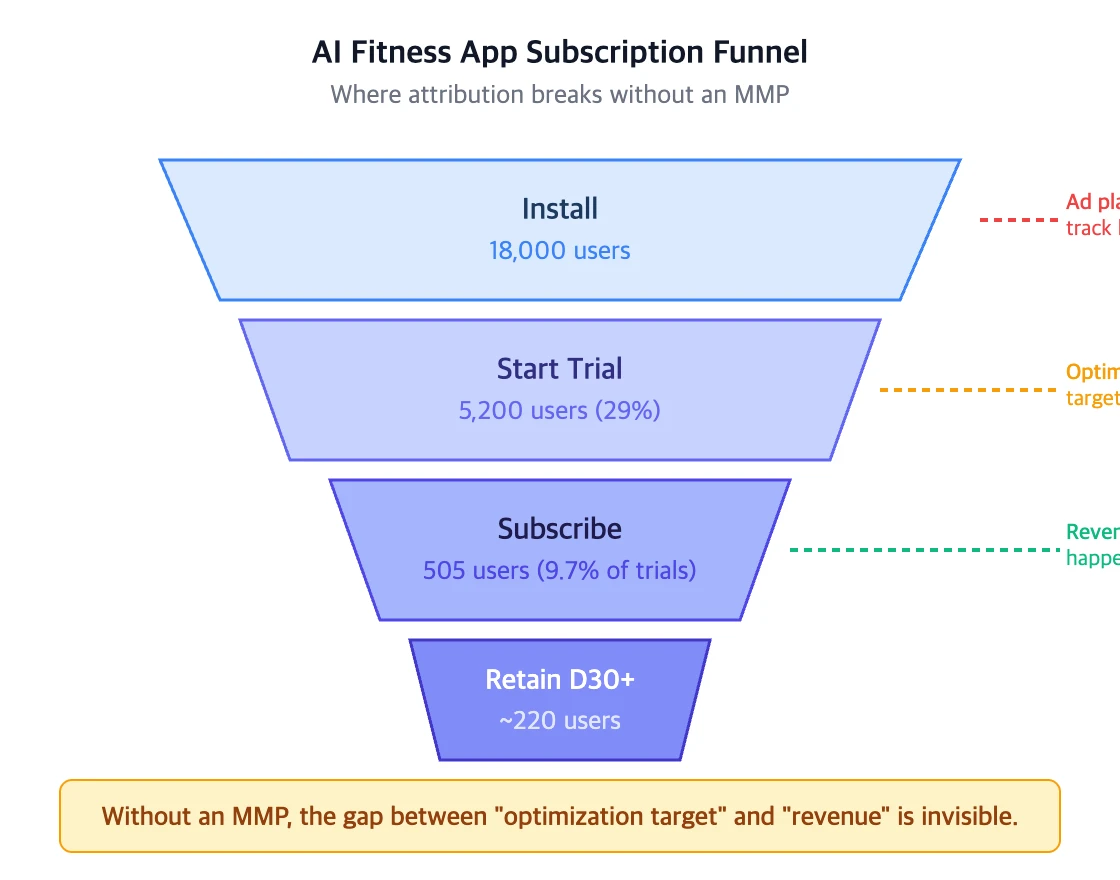
A fitness app team spends $15,000 across Meta and Google Ads in January. Installs triple. Trial starts surge. But when March arrives and half those users have churned, the team cannot answer a basic question: which campaigns brought subscribers who stayed, and which ones brought resolution-season tourists?
Without channel-level subscription attribution, every budget increase is a bet placed without data. For AI fitness apps running trial-to-subscription funnels, this blind spot compounds fast. Health and fitness apps generated over $6 billion in revenue in 2025 (Business of Apps, 2026), with roughly 80% coming from subscriptions. The teams capturing that revenue are the ones that can trace every subscriber back to the campaign that acquired them.
Key Takeaways
- AI fitness apps face unique attribution challenges. Seasonal spikes, long trial-to-paid cycles, and high trial volume make it harder to identify which channels drive lasting subscribers.
- Install counts alone mislead budget decisions. A channel producing 5,000 installs but only 30 subscribers is outperformed by one producing 1,500 installs and 200 subscribers.
- Cost per Subscription (CPS) matters more than CPI for fitness apps. RevenueCat data shows Health and Fitness apps have a median trial-to-paid conversion-rate" class="glossary-link" title="Conversion Rate">conversion rate of 39.9% (RevenueCat State of Subscription Apps 2025), but this rate varies dramatically by acquisition channel.
- Enterprise MMPs price out most growth-stage fitness teams. Minimum contracts of $2K-5K/month consume 20-50% of a team spending $10K-20K on ads.
- Airbridge Core Plan connects ad spend to subscription revenue for AI fitness apps. With RevenueCat integration, GMAT channel attribution, and pay-as-you-go pricing starting with 15K free installs, it is built for growth-stage subscription apps.
Why AI Fitness Apps Lose Revenue Without Channel-Level Attribution
AI fitness apps operate in one of the most competitive subscription categories. The global fitness app market reached $12.12 billion in 2025 (Grand View Research, 2025) and is projected to reach $33.58 billion by 2033. Scaling paid acquisition in this market without attribution is not just inefficient. It is structurally dangerous.
The root cause is a measurement gap between ad platforms and subscription platforms. Meta reports installs. Google reports conversions. RevenueCat reports subscribers. But none of these systems connect to each other by default. A Mobile Measurement Partner (MMP) bridges this gap by deduplicating installs across channels and connecting them to downstream subscription events.
1. Seasonal Spikes Distort Attribution Windows
Health and fitness apps experience extreme seasonality. January traffic surges 2-3x as users set New Year's resolutions, then drops sharply by March. For teams scaling ad spend during these peaks, the question is not whether installs will increase. They will. The question is whether those installs convert into subscribers who survive past the first renewal.
RevenueCat's 2025 data shows that nearly 30% of annual subscribers cancel within the first month. For fitness apps, this churn concentrates in Q1 when resolution-driven users realize they will not sustain their habits. A January campaign that produces 2,000 trial starts looks identical to one that produces 2,000 lasting subscribers in install-level data. Only channel-level subscription attribution separates the two.
Without cohort-level attribution by channel, teams cannot distinguish between a Meta campaign that brought high-retention annual subscribers and a TikTok campaign that brought trial-only users who churned within 14 days. Both campaigns show strong install numbers. Only attribution reveals which one generated lasting revenue.
2. Trial-Heavy Funnels Create a Measurement Gap
Most AI fitness apps use free trials as the primary conversion mechanism. RevenueCat data shows 67% of Health and Fitness subscriptions use yearly plans, often preceded by a 7-14 day trial. This creates a structural delay between the install event (tracked by ad platforms) and the subscription event (tracked by RevenueCat or Adapty).
During this delay, the attribution window may expire. Ad platforms optimize for trial starts, not subscriptions. The result: campaigns optimized for volume, not value.
This matters because AI fitness apps typically have higher trial start rates than average. RevenueCat data shows Health and Fitness apps have a median download-to-trial rate of 7.8%, above the 6.2% category average. High trial volume looks encouraging in platform dashboards. But if 60% of those trials come from one channel with a 15% trial-to-paid rate while another channel converts at 45%, the team is celebrating the wrong metric. A channel producing high trial volume but low trial-to-paid conversion drains budget without generating subscription revenue.
3. The Hidden Cost: Budget Flows to the Wrong Channel
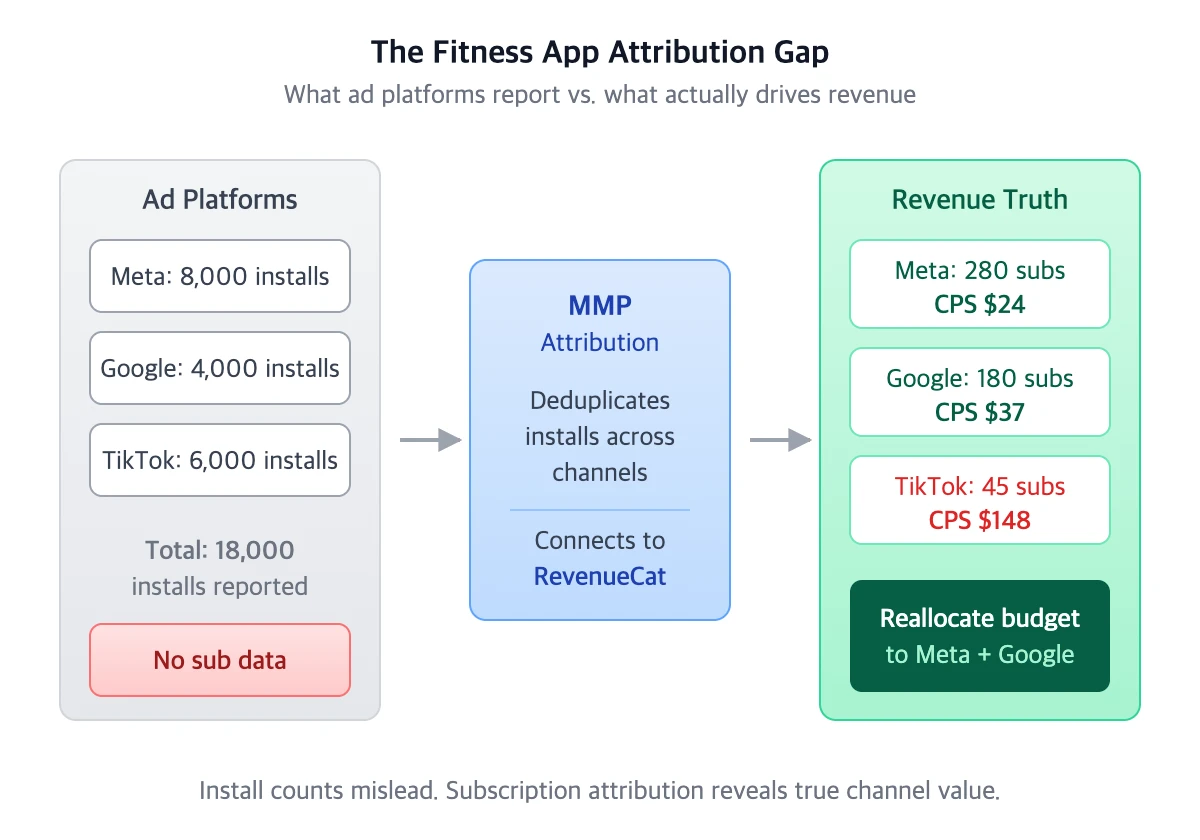
Consider a fitness app spending $20,000/month across three channels:
| Channel | Installs | Trial Starts | Paid Subscribers | CPS |
|---|---|---|---|---|
| Meta Ads | 8,000 | 2,400 | 280 | $24 |
| Google Ads | 4,000 | 1,000 | 180 | $37 |
| TikTok | 6,000 | 1,800 | 45 | $148 |
Without attribution, this team splits budget evenly across all three channels. With attribution, the data is clear: Meta produces the highest subscription volume at the lowest CPS, while TikTok drives high trial volume but minimal paid conversions. A budget reallocation from TikTok to Meta could increase total subscribers by 30-40% at the same spend level.
This is not hypothetical. According to RevenueCat's 2025 benchmark, the gap between top-performing (P90) and median fitness apps in revenue per install is over 6x ($4.19 vs $0.63 at Day 60). Channel-level attribution is what separates these tiers.
%%CTA|Try It Free|https://app.airbridge.io/signin?from=blog-inline|Connect your ad spend to real subscription revenue — setup takes minutes, not weeks.%%
Want to see how App attribution works with your data?
Get hands-on with Airbridge and see real results.
Try It Free →How to Connect Ad Spend to Subscription Revenue for Fitness Apps
General Approaches Any Team Can Apply Today
Before selecting any attribution tool, growth teams can take immediate steps to reduce measurement gaps:
- Align attribution windows across platforms. Set click-through and view-through windows consistently across Meta, Google, and TikTok. Mismatched windows create artificial discrepancies in channel performance data.
- Track CPS alongside CPI. Cost per install tells only part of the story. A channel with a $2 CPI but a $200 CPS is underperforming a channel with a $5 CPI and a $30 CPS.
- Connect your billing platform to your campaign data. If you use RevenueCat or Adapty, export subscription events and match them to install cohorts manually if no automated integration exists.
- Set up UTM parameters for every campaign. This provides a minimal attribution signal for web-to-app flows, even without an MMP.
- Focus on trial-to-paid conversion rate by channel, not aggregate trial volume. A 50% conversion rate on 500 trials beats a 10% conversion rate on 2,000 trials for lifetime value (LTV).
How Airbridge Core Plan Solves This for AI Fitness Apps
The general approaches above work, but they rely on manual data matching that breaks at scale. Airbridge Core Plan automates the connection between ad spend and subscription revenue for fitness apps running paid acquisition on Meta, Google, Apple Search Ads, and TikTok.
Core Plan answers one question: "Which paid channels are driving subscribers, and at what cost?"
Here is how it maps to the specific challenges AI fitness apps face:
| Fitness App Challenge | How Core Plan Addresses It |
|---|---|
| Seasonal attribution confusion | Retention and Funnel reports compare cohort performance by channel across time periods |
| Trial-to-subscription gap | Standard events (Start Trial, Subscribe) connect the full funnel to acquisition source |
| Budget misallocation | Revenue report shows subscription revenue by channel, enabling data-driven reallocation |
| Billing platform disconnect | Native RevenueCat and Adapty integrations connect subscription data to attributed installs |
| Enterprise MMP cost barrier | 15K free attributed installs, $0.05/install after, pay-as-you-go pricing |
What Core Plan tracks for fitness apps:
- 25 standard events including Install, Sign-up, Start Trial, Subscribe, Unsubscribe, and Order Complete. These cover the full subscription funnel without requiring custom event schema design.
- 4 Self-Attributing Networks (GMAT): Meta Ads, Google Ads, Apple Search Ads, TikTok for Business. These channels typically represent 80-90% of early-stage paid acquisition spend.
- 6 built-in reports: Actuals, Trend, Active User, Funnel, Retention, and Revenue.
Intentional design decisions:
Core Plan does not support custom events. For fitness apps tracking the standard subscription funnel (install, trial, subscribe, renew), standard events cover the full journey. Core Plan supports a maximum of 2 third-party integrations (e.g., RevenueCat + Amplitude), keeping the stack focused. Teams needing custom events, additional ad networks, or raw data exports can upgrade to Airbridge's Growth Plan as their operations mature.
Pricing context for growth-stage fitness teams:
Enterprise MMPs typically require minimum annual contracts of $2K-5K/month. For a fitness app team spending $10K-20K/month on ads, this means the measurement tool alone consumes 10-50% of the marketing budget. Core Plan removes this barrier: 15K free attributed installs cover the first months of paid acquisition, and pay-as-you-go pricing at $0.05/install means measurement cost scales with actual growth.
If you are running paid acquisition for an AI fitness app and your GA4 data does not match what RevenueCat reports, the gap is not a reporting error. It is a structural blind spot that an MMP resolves.
FAQ: AI Fitness App Attribution
What events should a fitness app track for attribution?
At minimum, track Install, Start Trial, Subscribe, and Unsubscribe. These four events let you calculate CPS by channel and trial-to-paid conversion rate by campaign. Adding Sign-up and Order Complete provides a more complete funnel view. Core Plan supports all of these as standard events, so no custom schema design is required.
When should a fitness app upgrade from Core Plan to Growth Plan?
Upgrade when your operations outgrow the focused feature set. Common triggers include needing custom events beyond the 25 standard events, requiring more than 2 third-party integrations, wanting raw data exports to a data warehouse like BigQuery, or expanding to ad networks beyond Meta, Google, Apple Search Ads, and TikTok. Most fitness apps reach this point when monthly ad spend exceeds $50K and the team adds a dedicated data analyst.
How does fitness app seasonality affect attribution accuracy?
January and September are peak acquisition months for fitness apps. During these spikes, multiple ad platforms claim credit for the same installs, inflating reported conversions. An MMP deduplicates these claims and assigns each install to one channel. Without deduplication, teams over-credit every channel simultaneously and cannot identify which one truly drove the subscription. This is especially important for annual subscription plans where the revenue event occurs days or weeks after the install.
Every Dollar You Spend Without Attribution Is a Dollar You Cannot Optimize
The gap between fitness apps that scale efficiently and those that burn budget is not creativity or channel selection. It is measurement. With the fitness app market projected to grow from $12 billion to over $33 billion by 2033, the teams that connect every subscriber back to the campaign that acquired them will capture disproportionate share of that growth.
Attribution is not a nice-to-have reporting layer. It is the foundation that turns paid acquisition from a cost center into a growth engine. Every month without it is a month of budget decisions made on incomplete data.
Start free with Airbridge Core Plan and see which channels actually drive your fitness app's subscribers, beginning with 15K free attributed installs.


Ready to transform your mobile growth?
Learn how Airbridge helps leading brands measure and optimize every touchpoint.