How Small App Teams Know Which App Ads Make Money

Small app teams know which app ads make money by connecting three data sources. ad platform spend, app store installs, and billing platform revenue. and measuring cost per subscription (CPS) and cohort ROAS by channel.
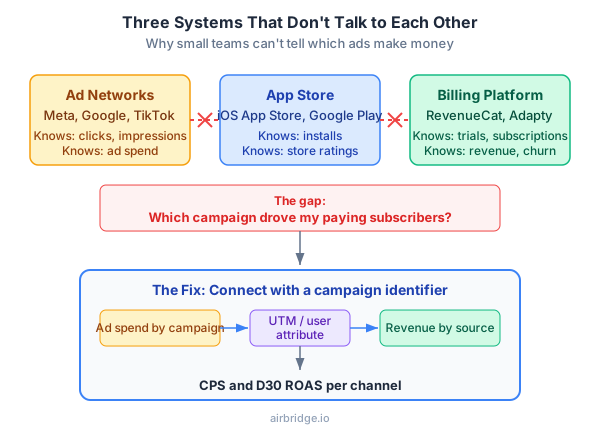
If you are spending your first $3,000-$5,000 a month on Meta or Google and wondering whether any of it is coming back as subscription revenue, you are asking the right question. Most small teams cannot answer it. because the data they need lives in three systems that do not talk to each other.
Among 75,000+ subscription apps, the median download-to-paid conversion is just 1.9% within 35 days. Only 6.2% of downloads even start a trial. The top 5% of subscription apps earn 400x more revenue than the bottom 25%. and that gap is widening. The difference is not bigger budgets. It is knowing which ads produce subscribers and cutting the ones that do not.
If you are new to app marketing in general, that overview gives useful context before diving into paid channels.
Key Takeaways
-
Installs are a vanity metric for subscription apps. Only 1.9% of downloads become paid subscribers at median. install counts tell you almost nothing about which ads make money.
-
Cohort ROAS is the single most useful measurement for small teams. Group users by install week and campaign, then track cumulative revenue over 30-90 days.
-
You need three data sources connected. Ad networks report clicks, app stores report installs, and billing platforms report revenue. none talk to each other by default.
-
Two metrics are enough to start. CPS and D30 ROAS give a small team enough signal to allocate budget.
-
Benchmarks tell you if you are on track. Health and Fitness median D60 revenue per install is $0.63. but hard paywall apps earn 8x more than freemium.
Why Do Installs Tell You Nothing About Which Ads Are Profitable?
Installs are the default metric in every ad dashboard. Meta shows installs. Google shows installs. TikTok shows installs. This creates a dangerous illusion: the channel with the most installs looks like the winner.
But for a subscription app, an install is the beginning of a long funnel. The user has to open the app, hit a paywall or trial prompt, start the trial, survive the trial period, and convert to a paid subscriber. The median trial start rate is just 6.2%. meaning 93.8% of installs never even begin a trial. Top-performing apps (P90) reach 20.3%, but that is still 4 out of 5 users dropping off.
1. The same installs can produce wildly different revenue
High-tier weekly subscription plans generate 5.2x more revenue per install than low-tier plans. Two campaigns can drive identical install counts but produce completely different subscription revenue. depending on user quality and what offer those users see.
This is why CPI alone is misleading. The metric that matters is CPS (cost per subscription). total ad spend divided by the number of paid subscribers from that channel. CPS runs 4-5x higher than CPI. If your CPI is $5.78 for a fitness app on iOS, expect to pay $23-$29 per actual subscriber.
2. Each ad channel attracts fundamentally different users
Meta reaches ~50% of the world's population through social feeds. high volume, but users are browsing, not searching. Apple Search Ads captures users actively looking for an app in the App Store. lower volume, but much higher intent. Google dominates Android and search. strong for intent-based discovery, but iOS campaign optimization is limited to clicks and installs (not purchases).
If you are spending your first $5K on Meta and wonder why trial starts are high but subscriptions are low, the channel might be attracting browsers, not buyers. If you want help choosing, this guide on picking your first channel walks through the tradeoffs.
What Is Cohort ROAS and Why Does It Change Everything?
Cohort ROAS. return on ad spend measured by user groups over time. is the method that connects ad spend to actual subscription revenue.
1. How it works (with a real example)
Group every user by their install week and the campaign that brought them. Then track cumulative revenue from that group at D7, D30, and D90.
Worked example:
| Meta | ||
|---|---|---|
| Monthly spend | $3,000 | $2,000 |
| Installs | 650 | 400 |
| Trial starts | 40 | 32 |
| Paid subscribers (D30) | 14 | 11 |
| CPS | $214 | $182 |
| D30 ROAS | 0.047x | 0.055x |
Both channels look unprofitable at D30. But if Google's subscribers retain at 44% through month 12 (yearly plan median), that cohort reaches 0.66x D365 ROAS. potentially profitable with renewals. Meta's cohort, if retention is lower, might never break even. You cannot see this difference in an install dashboard.
2. Why standard ROAS misleads subscription apps
Standard ROAS divides total revenue by total spend over a time period. This mixes users who installed three months ago. now paying subscribers. with users who installed yesterday. It tells you nothing about which campaign drove the paying users.
The subscription ROAS formula should account for first payment + expected renewals x renewal probability, divided by spend. A one-time ROAS snapshot misses the bulk of lifetime value because subscription profitability depends on retention over subsequent billing periods.
3. The right measurement cadence
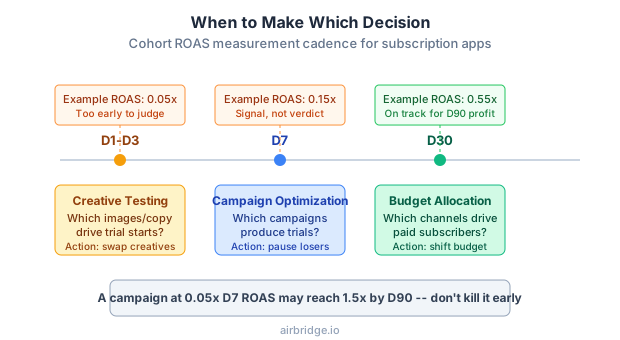
Use D1-D3 for creative testing. which ad images and copy drive trial starts. Use D7 for campaign optimization. pause underperformers. Use D30 for budget allocation. move spend to channels with proven subscriber output.
Your budget should be at least 10x your target CPA to give the ad platform enough signal to optimize. A $40 target CPA means a $400 minimum daily budget. anything less and the algorithm cannot learn.
What Is the Minimum Setup to Know Which Ads Make Money?
If your RevenueCat dashboard says you got 200 trial starts last week but only 12 turned into subscriptions, and you have no idea which campaign those 12 came from. this section is for you.
1. The three-platform data problem
Ad networks know clicks and impressions. App stores know installs. Revenue platforms (RevenueCat, Adapty, or your own billing) know trials and subscriptions. These three do not connect by default. That is why you can spend $5,000 and not know if it made money.
The simplest fix: pass a campaign identifier (UTM parameter or custom user attribute) at install time so your billing platform can group revenue by source.
2. Two metrics are enough to start
You do not need 20 dashboards. You need two numbers per channel:
-
CPS: total ad spend / paid subscribers from that channel
-
D30 ROAS: cumulative revenue from a cohort at 30 days / ad spend for that cohort
Both are calculable with a billing platform export, ad platform cost export, and a spreadsheet.
Start measuring what matters — for free
Airbridge Core Plan gives growing teams real attribution, deep linking, and audience tools at no cost.
Start Free for 30 Days →What Benchmarks Should a Small Team Compare Against?
Without benchmarks, you cannot tell whether your numbers are good, bad, or normal.
1. Cost benchmarks by category
| Category | iOS CPI | Android CPI | Notes |
|---|---|---|---|
| Health and Fitness | $5.78 | $3.06 | Most subscription apps start here |
| Generative AI | $10.58 | $3.60 | Fast-growing, competitive |
| Gaming | $5.99 | $2.56 | High volume, low conversion |
| Business | $14.08 | $11.25 | Highest CPI, highest LTV |
Android paid installs grew 57% YoY versus iOS at 9%. Android is roughly one-third the iOS cost across categories. a real opportunity for budget-constrained teams.
2. Revenue and conversion benchmarks
| Metric | Median | Top 10% (P90) |
|---|---|---|
| Trial start rate | 6.2% | 20.3% |
| Trial-to-paid | 34.8% | 51.5% |
| D60 RPI (all categories) | $0.31 | $1.95 |
| D60 RPI (Health and Fitness) | $0.63 | $4.19 |
| Hard paywall D60 RPI | $3.09 | . |
Hard paywall apps generate 8x higher D60 RPI than freemium ($3.09 vs $0.38). High-priced apps produce $55.21 median Y1 LTV. 7x more than low-priced apps. If your D60 RPI is below $0.31, fix your paywall or trial configuration before scaling ad spend.
Why Do Some Ads Look Good in the Dashboard But Lose Money?
If your Meta dashboard shows 200 trial starts but RevenueCat shows 12 subscriptions from last month's campaigns, here is what is likely happening.
1. First-renewal churn erases campaign revenue
More than half of subscribers churn at the first renewal. 51.8% for weekly plans, 55.5% for monthly, and 66.3% for yearly. After the third renewal, 80%+ of remaining users stabilize. But the damage to cohort ROAS happens in the first billing cycle.
If your ad optimization targets "trial starts," you might be acquiring users who start a trial, cancel on Day 0, and never pay.
2. Every ad platform overcounts conversions
Meta, Google, TikTok, and Apple Search Ads are all Self-Attributing Networks. Each claims credit when a user who saw their ad converts. even if the user saw ads on all four platforms. User overlap is massive: only 1% of YouTube users and 0.2% of Facebook users are unique to a single platform. The result: your dashboards add up to 3x more conversions than you actually have.
This is why first-party billing data. not ad dashboards. must be your source of truth for revenue.
How Does iOS Privacy Change What You Can Measure?
Post-ATT, iOS lost user-level ad tracking for most users. But measurement is not dead.
SKAdNetwork (SKAN) 4.0 gives you 0-63 conversion values with a 24-hour+ delay. This is enough to encode trial starts, subscription events, and revenue tiers. if you configure it. The critical step most small teams skip: mapping those 64 values to revenue events (trial start, first payment, renewal) instead of just installs.
You cannot say "this specific user came from this specific ad." But you can say "this campaign drove approximately this many subscriptions." For a team running 2-3 campaigns on Meta, Google, Apple Search Ads, and TikTok, that is enough signal to allocate budget. If you need a step-by-step walkthrough, this SKAN 4.0 setup guide covers the configuration.
What Should a Small Team Actually Do This Week?
Here is a Monday morning action plan you can finish in one sitting.
1. Pull two exports (30 minutes)
-
Ad platform cost: In Meta Ads Manager, go to Campaigns > select last 30 days > export CSV. Do the same in Google Ads. You need one column: spend by campaign name per week.
-
Billing platform revenue: In RevenueCat, go to Charts > select "Initial Conversion" > group by "Install Date" and filter by the custom attribute you pass at install (campaign name or UTM source). Export CSV. If you use Adapty, the equivalent is Analytics > Cohorts > filter by attribution source.
If you are not passing a campaign identifier at install yet, that is step zero. Add a UTM parameter or custom user attribute to your install link so RevenueCat/Adapty can group revenue by source.
2. Build this spreadsheet (30 minutes)
Open a Google Sheet and create one row per channel per install week:
| Install Week | Channel | Spend | Installs | Trial Starts | Paid Subs (D30) | CPS | D30 ROAS |
|---|---|---|---|---|---|---|---|
| Apr 7-13 | Meta | $750 | 160 | 10 | 3 | $250 | 0.040x |
| Apr 7-13 | $500 | 95 | 8 | 3 | $167 | 0.060x | |
| Apr 14-20 | Meta | $750 | 155 | 11 | 4 | $188 | 0.053x |
| Apr 14-20 | $500 | 100 | 9 | 2 | $250 | 0.040x |
CPS formula: = Spend / Paid SubsD30 ROAS formula: = (Paid Subs x Monthly Price) / Spend
3. Read the table and decide (10 minutes)
Compare CPS across channels week by week. In the example above:
-
Google week 1 had the best CPS ($167). worth keeping.
-
Google week 2 jumped to $250. creative fatigue or audience exhaustion. Check if your ad frequency spiked.
-
Meta is consistent at $188-$250 CPS. stable but expensive. Worth testing new creatives before cutting.
Rule of thumb: If a channel's CPS has been above 2x your monthly subscription price for 3+ weeks, reduce spend. If CPS is below 1.5x your monthly price, scale up.
Connecting the Data Without an Enterprise Stack
The spreadsheet method works for 2-3 channels. But it breaks down when you need real-time trial-to-subscription data by campaign instead of weekly exports.
Airbridge Core Plan solves this for small teams. It connects Meta, Google, Apple Search Ads, and TikTok to your billing platform (RevenueCat or Adapty) and shows cohort ROAS, CPS, and trial-to-subscription rates by channel. The plan includes 15K free installs at $0.05/install after that, pay-as-you-go.
Limitations: 4 ad channels, 2 third-party integrations, no custom events, no Meta CAPI, no raw data export. For a team spending $5K-$20K/month on 2-3 channels, it replaces the spreadsheet without enterprise complexity. If you need more, you will outgrow it.
Common Questions About Ad Measurement for Small Teams
Q1. How long should I wait before deciding if a campaign is profitable?
For apps with 7-day free trials, wait at least D30. Users need time to finish the trial, convert, and make one renewal payment. For annual plans, wait D60-D90 because the first payment is delayed. Cutting campaigns before D30 risks killing channels that are profitable on a lifetime basis.
Q2. Should I use the same click-through window across all ad platforms?
Yes. Mismatched windows are the most common cause of data discrepancies. Set all channels to the same click-through window. 7 days is the standard. and either enable or disable view-through consistently. This does not eliminate discrepancies, but it makes cross-channel comparison valid.
Your Ads Are Already Telling You the Answer
The data to find your profitable campaigns already exists. sitting in three separate systems, waiting to be connected. You do not need a data team. You need a spreadsheet, two metrics, and 30 minutes a week.
Start with last week's data. Calculate CPS by channel. The answer will be obvious.

Ready to see what Core Plan can do?
Free attribution, deep linking, and audience tools — built for teams that are ready to grow.