Your Ad Algorithm Is Learning the Wrong Lesson — How Dirty Signals Drain Subscription App Budgets
Every Monday, the same scene plays out across subscription app growth teams. CPI from Meta looks great. Install counts are climbing. But cost-per-subscriber keeps getting worse, and no one on the team can explain why.
The problem is not your creatives, your targeting, or your budget. The problem is what you are telling Meta and Google to optimize for. Every conversion signal you send teaches the algorithm what a "good user" looks like. If those signals include impulse cancellers, trial-only users, and unverified installs, the algorithm learns the wrong lesson and spends your budget finding more of the same.
Key Takeaways
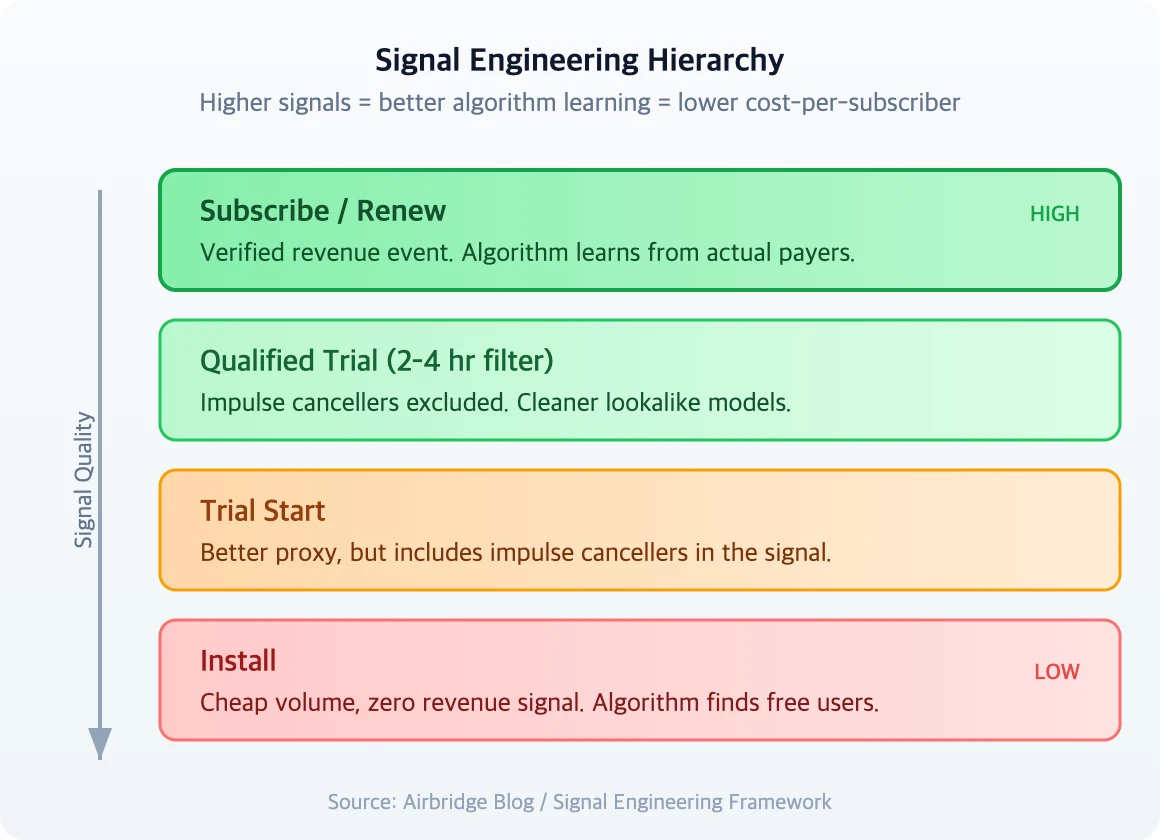
- Ad platform algorithms optimize toward whatever signal you send them. If you optimize for installs, the algorithm finds cheap installs, not paying subscribers.
- Impulse cancellations contaminate your conversion data. Users who subscribe and cancel within minutes still register as successful conversions, teaching the algorithm to target the wrong audience.
- Subscription apps face a structural signal delay. The event that matters most (paid subscription) happens days or weeks after install, often outside the ad platform's optimization window.
- Signal engineering is the systematic fix. Choosing, filtering, and timing conversion events to match actual subscriber value is the practice top growth teams use to improve ad campaign performance.
- Airbridge Core Plan makes signal engineering accessible. Standard subscription events, native RevenueCat and Adapty integration, and GMAT channel connections enable cleaner signals starting with 15K free attributed installs.
Why Ad Campaigns Fail When Your Conversion Signals Are Wrong
Signal engineering is the practice of choosing, filtering, and structuring conversion events to improve how ad platform algorithms learn and optimize (Sub Club / Thomas Petit). The core principle is straightforward: send the ad platform better data, and it produces better results.
For subscription apps, the signals are almost always wrong. Here is why that happens, and what it costs.
1. The Algorithm Learns Whatever You Teach It
Most subscription apps optimize for Install events because installs fire immediately and generate enough volume for the algorithm's learning phase. Meta requires approximately 50 optimization events per ad set per week to exit the learning phase. Subscribe events rarely hit that threshold for early-stage apps, so teams default to installs.
The optimization event you choose determines what the algorithm learns:
| Optimization Event | What the Algorithm Learns | Campaign Outcome |
|---|---|---|
| Install | Find users who download free apps | Low CPI, high cost-per-subscriber |
| Trial Start | Find users who start trials, including impulse cancellers | More trials, low trial-to-paid conversion |
| Subscribe | Find users who actually pay | Higher CPI, lower cost-per-subscriber |
When you optimize for installs, you get exactly what you asked for: cheap installs from users who were never likely to subscribe. The algorithm is working perfectly. Your signal is the problem.
According to a Lunio study analyzing 2.7 billion ad clicks, 8.51% of all paid ad traffic is invalid, costing advertisers an estimated $63 billion globally. For subscription apps, the waste compounds further because even valid installs from low-intent users degrade the optimization signal over time.
2. Impulse Cancellations Poison Your Lookalike Models
Subscription apps see a specific form of signal contamination that most other app categories do not: impulse cancellations.
A user taps "Start Free Trial," gets charge anxiety, and cancels within 10-15 minutes before opening the app a second time. That Subscribe event still reaches Meta or Google as a valid conversion. The algorithm treats this user as a success and builds lookalike models around them.
According to RevenueCat's State of Subscription Apps 2025 report, nearly 30% of annual subscriptions are cancelled within the first month. For weekly plans, the first renewal rate is only 51.8%. A significant portion of those "conversions" are users who never intended to stay.
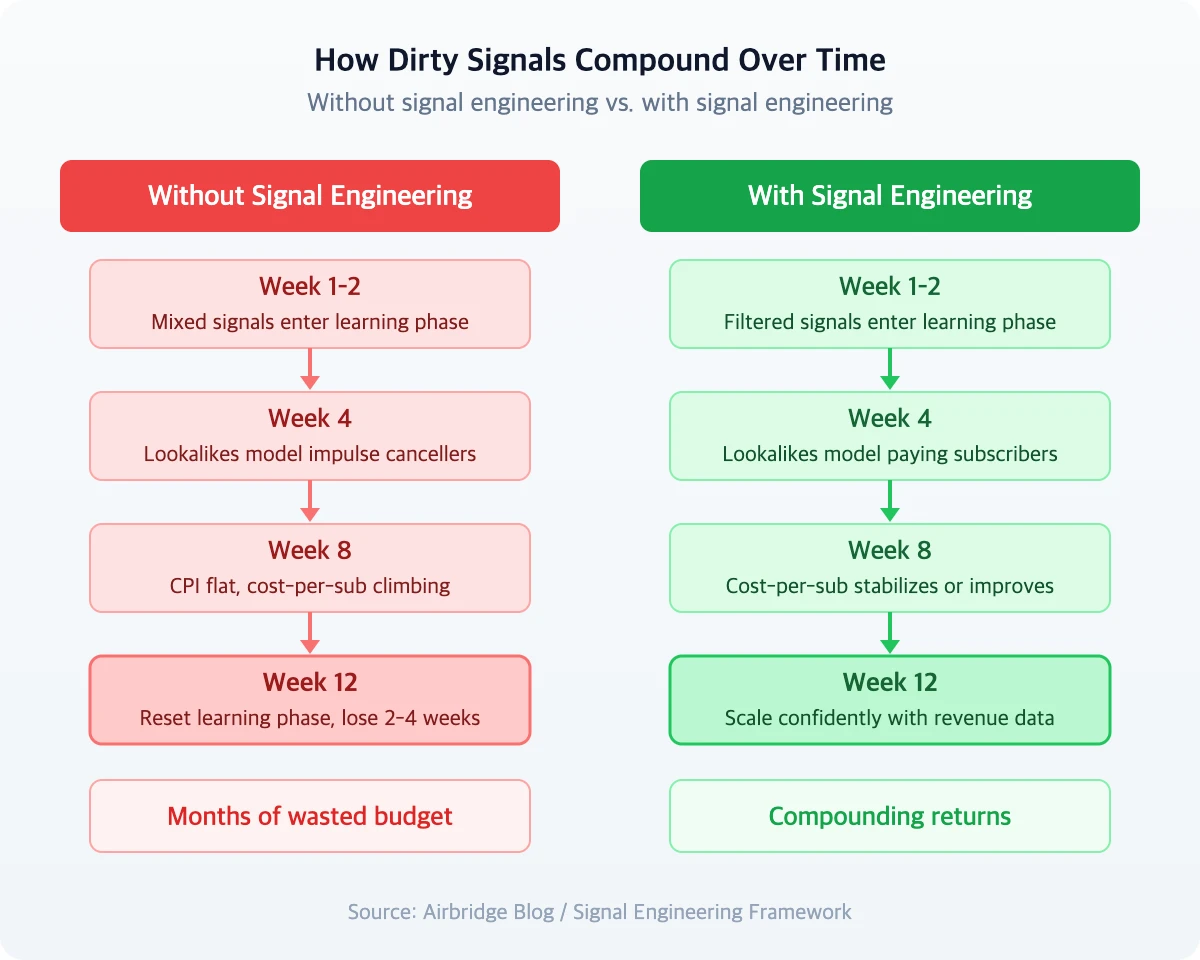
Each optimization cycle compounds the damage:
- Week 1-2: Campaign learns from a mix of real subscribers and impulse cancellers
- Week 4: The algorithm's predictive accuracy for high-LTV users decreases as impulse cancel ratio increases
- Week 8: Cost-per-subscriber climbs, but CPI looks unchanged. The degradation is invisible in the dashboard
- Week 12: Team resets the learning phase, losing another 2-4 weeks of optimization data
3. The Trial Delay Gap Breaks the Optimization Loop
Many subscription apps offer a 7-14 day free trial. If the attribution window is shorter than the trial period, the subscription event never links back to the ad that drove it.
For apps using standard 7-day free trials, the revenue event occurs outside the default optimization window of most ad platforms. These conversions are counted as organic, hiding the true value of paid channels.
Consider a fitness app spending $15K/month across Meta and Google. The app offers a 14-day free trial. With a standard 7-day click-through attribution window, every subscription that converts on day 8 or later is invisible to the ad platform. If 60% of conversions happen after day 7, the algorithm is learning from less than half the actual subscriber data. The campaigns that produce the best long-term subscribers may appear to underperform because their conversions fall outside the window.
On top of the timing gap, server-side payments create an additional delay. When a user subscribes, the payment is processed by Apple or Google, not by the app. Device-side SDKs can detect subscription state changes only when the user opens the app again, creating latency and dependency on user behavior. For real-time, independent signal transmission, the MMP needs a server-to-server connection that most small teams have not built.
Revenue data lives in RevenueCat or Adapty. Ad platforms know nothing about subscription revenue. Without a bridge between billing and attribution, campaigns cannot optimize for what actually drives the business.
Start measuring what matters — for free
Airbridge Core Plan gives growing teams real attribution, deep linking, and audience tools at no cost.
Start Free for 30 Days →How to Engineer Signals That Drive Subscribers Instead of Installs
The good news: signal engineering is a well-defined practice, not a mystery. According to a Funnel.io analysis of internal studies by Meta, TikTok, and LinkedIn, improving signal quality can increase conversions by 24% and lower cost per action by 15% (Funnel.io).
Practical Signal Engineering Steps Any Team Can Apply Today
These steps work regardless of your attribution tooling:
- Move your optimization event closer to revenue. Switch from Install to Subscribe or Start Trial. If subscription volume is too low for the learning phase (50 events/week), Start Trial is the next best proxy.
- Filter impulse cancellations. Define a "qualified trial" window (2-4 hours after trial start). Only fire the conversion event after the threshold passes. Users who cancel before the window closes are excluded.
- Extend attribution windows to cover the full trial period. If your trial is 14 days, configure a 21-30 day click-through window. Every subscription outside the window is counted as organic, hiding the true value of paid channels.
- Connect billing data to attribution. Build a server-to-server integration that matches subscription events to attributed installs and forwards them to ad platforms. Budget at least a week of engineering time for edge cases like billing retries, grace periods, and family sharing.
- Track Cost per Subscriber (CPS), not just CPI. CPS equals total ad spend divided by paid subscriptions attributed to that channel. Evaluate CPS alongside LTV to determine true channel profitability. A channel with high CPS but higher LTV may still be your best source.
- Audit signal accuracy weekly. Compare the conversion counts your ad platform reports against your MMP and billing platform. If discrepancies exceed 10-15%, something in the signal pipeline is broken.
How Airbridge Core Plan Enables Cleaner Signals at Scale
Each of the steps above requires infrastructure that most early-stage subscription app teams do not have. Core Plan was designed to solve this exact problem: getting clean subscription signals into ad platform optimization loops without custom engineering.
Standard subscription events, not custom event schemas. Core Plan supports 25 standard events including Start Trial, Subscribe, Unsubscribe, and Order Complete. These events map directly to the signal engineering hierarchy (install < trial < subscribe < renew). Teams can set their optimization event to Subscribe or Start Trial from day one without designing custom event schemas.
Native billing platform integration. RevenueCat and Adapty integration connects verified subscription status to attribution data. This means the MMP knows the difference between a genuine subscriber and an impulse canceller. Teams get cleaner signal data without building custom backend pipelines.
GMAT channel integrations. Clean signals reach Meta, Google, Apple Search Ads, and TikTok through native Self-Attributing Network integrations. These four channels cover 80-90% of early-stage paid acquisition spend.
Configurable attribution rules. Teams can set attribution windows that cover their full trial period. SKAN Conversion Value Settings optimize iOS signal quality within Apple's post-ATT privacy framework.
Intentional simplicity. Core Plan does not support custom events or more than 2 third-party integrations (e.g., RevenueCat + Amplitude). This is by design. Standard events cover the full subscription funnel without requiring schema planning, and the focused feature set reduces decisions during setup.
| Capability | Enterprise MMP | Airbridge Core Plan |
|---|---|---|
| Subscription event tracking | Predefined + custom events available | 25 subscription-optimized standard events |
| Billing platform integration | Native (included in higher tiers) | Native (included in base) |
| Signal engineering setup | General-purpose, more configuration | Subscription-app focused, fewer decisions |
| Attribution window config | Configurable | Configurable for trial periods |
| Minimum contract | Annual, $10K+ | Pay-as-you-go, 15K free installs |
| Unnecessary features for signal engineering | Fraud detection, raw export, agency access included | Intentionally removed |
Pricing: 15K free attributed installs, then $0.05/install. No annual contract, no add-on pricing for subscription events or billing integrations.
How signal engineering works with Core Plan in practice:
- Install Core Plan SDK and configure standard subscription events (Start Trial, Subscribe, Unsubscribe)
- Connect RevenueCat or Adapty to pipe verified billing data into attribution
- Set attribution windows to cover your trial period (e.g., 21 days for a 14-day trial)
- Choose Subscribe or Start Trial as your ad platform optimization event
- Monitor the Funnel report to track install-to-trial-to-subscription conversion by channel
The entire setup takes hours, not weeks. Once the pipeline is running, clean signals flow to Meta, Google, Apple Search Ads, and TikTok automatically.
FAQ: Ad Campaign Signal Engineering for Subscription Apps
What is signal engineering in mobile marketing?
Signal engineering is the practice of choosing, filtering, and timing conversion events sent to ad platforms to improve how their algorithms optimize campaigns. Instead of sending every event (installs, all trial starts), teams send only high-quality signals (qualified trials, verified subscriptions) that represent actual business value. The term was popularized by Thomas Petit and RevenueCat's Sub Club podcast.
Why can't GA4 handle ad campaign optimization for subscription apps?
GA4 uses a session-based attribution model designed for web analytics. It cannot reliably connect a mobile ad click to an in-app subscription event that occurs days later, across different sessions and devices. For subscription apps running paid acquisition on Meta, Google, and TikTok, an MMP provides the cross-channel, cross-session attribution that GA4 lacks. Read more about GA4 limitations for subscription apps.
How many conversion events does Meta require to exit the learning phase?
Meta recommends approximately 50 optimization events per ad set per week to exit the learning phase. If your subscription volume is below this threshold, optimize for a higher-volume proxy event (Start Trial) and filter impulse cancellations before they reach the ad platform.
Clean Signals Are the Foundation Every Other Ad Campaign Optimization Depends On
Every dollar spent while your signals are dirty is a dollar training Meta and Google's ML models to find users who will never pay. Creative testing, audience targeting, bid optimization: none of these work if the underlying signal tells the algorithm that impulse cancellers are your ideal customers.
Cleaning your signals is not one optimization tactic among many. It is the foundation that every other ad campaign optimization depends on.

Ready to see what Core Plan can do?
Free attribution, deep linking, and audience tools — built for teams that are ready to grow.