Why MMP Pricing Lacks Transparency: 3 Pricing Traps to Avoid

Most Mobile Measurement Partners (MMPs) do not publish pricing on their websites. A startup spending $5,000 to $20,000 per month on paid acquisition has to book a sales call, sit through a demo, and negotiate a custom quote before learning whether the tool fits their budget.
The cost of this opacity compounds quickly. Teams delay attribution adoption by weeks or months while evaluating opaque options, running campaigns without measurement in the interim. Every week of blind spending is a week of budget flowing to channels that may not convert trial users into paying subscribers.
Key Takeaways
- Most MMPs hide pricing behind sales calls. Subscription app teams cannot compare costs or plan budgets without committing to a lengthy evaluation process.
- Hidden add-ons inflate the real cost beyond the base fee. Raw data export, fraud detection, and premium support are often priced separately and disclosed after the initial conversation.
- Annual prepayment is the industry default. Startups are asked to predict 12 months of usage before they have 3 months of campaign data.
- Health and fitness apps face seasonal cost risk. Fixed annual contracts do not accommodate January resolution spikes or summer surges, leading to overpayment during low-volume months.
- Airbridge Core Plan publishes pricing and uses pay-as-you-go billing. 15K free attributed installs, $0.05 per install after, with no annual commitment.
Why MMP Pricing Is Still Opaque in 2026
MMP pricing transparency is one of the biggest evaluation blockers for early-stage subscription app teams. The problem is structural: most enterprise MMPs were built for large advertisers spending millions per year, and their pricing models reflect that origin.
1. The "Contact Sales" Default
This evaluation barrier is not just an inconvenience. For a startup with 2 to 5 people, the cycle stretches from days to weeks while paid acquisition campaigns run without attribution. A growth marketer spending $10,000 per month on Meta and Google cannot wait 2 to 3 weeks for a pricing quote when the cost of misallocated spend compounds daily.
2. Hidden Add-Ons Beyond the Base Fee
Even after the sales call, the initial quote often represents only part of the total cost. Enterprise MMPs typically charge separately for capabilities that early-stage teams may assume are included:
| Add-On | Typical Cost Impact | Do Early-Stage Teams Need It? |
|---|---|---|
| Raw data export (S3, BigQuery) | $500 to $2,000/month | Rarely before Series A |
| Fraud detection | $1,000 to $3,000/month | Rarely at low volume |
| Premium support / CSM | $500 to $1,500/month | Often needed, but priced as upsell |
| Additional ad network integrations | Per-network fees | Only if running beyond Meta/Google/Apple/TikTok |
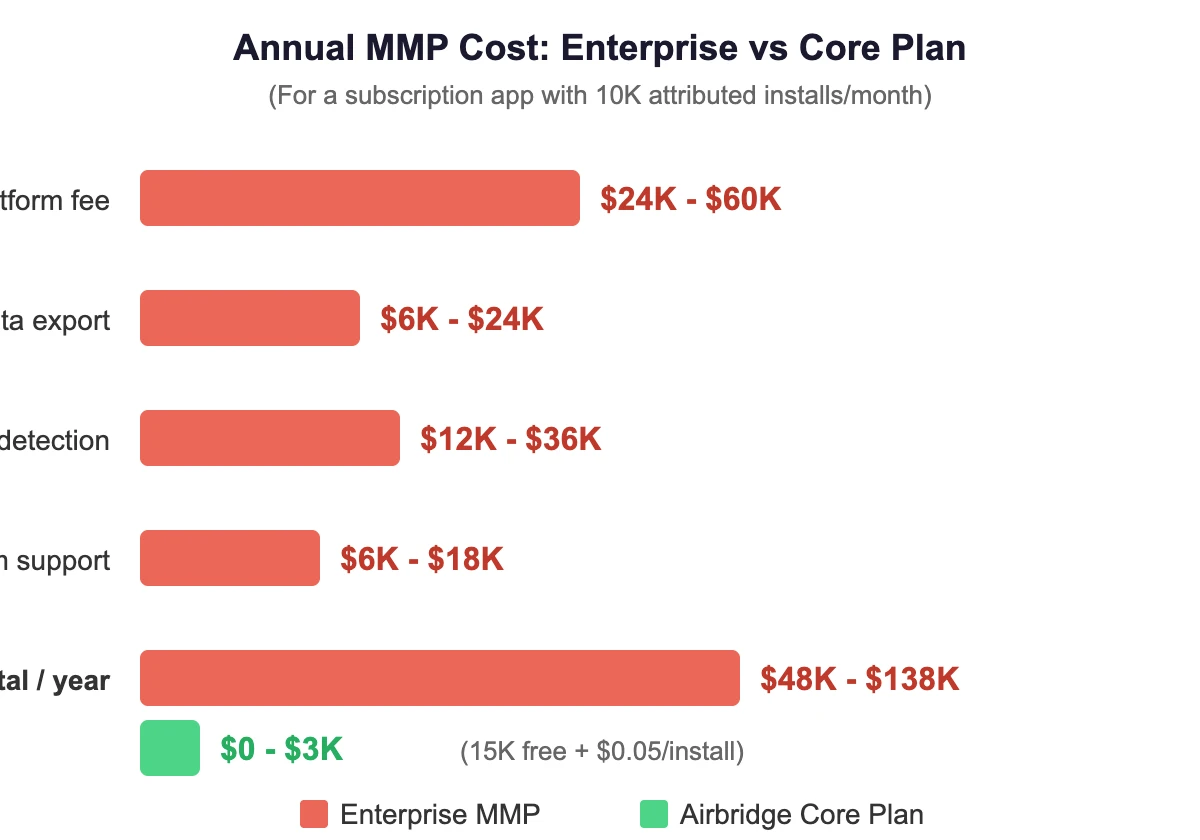
Platform fees for mid-scale subscription apps can reach $7,000 to $10,000 per month before implementation costs and premium add-ons are factored in (Business of Apps, 2026). For teams spending $10,000 to $20,000 per month on ads, MMP costs can consume a significant share of the total budget.
The problem is not that these features lack value. Raw data export matters for teams with data warehouses. Fraud detection matters at scale. The problem is that these costs are disclosed incrementally, making it difficult to calculate total cost of ownership before signing.
3. Annual Lock-In Before You Have Data
Annual prepayment is the industry default for most enterprise MMPs. A startup launching its first paid UA campaigns is asked to commit to 12 months of usage before it has 3 months of campaign performance data.
This creates two problems:
- Cash flow risk. Locking $24,000 to $120,000 per year in an MMP contract limits ad spend flexibility. For health and fitness apps with seasonal install patterns, fixed annual costs mean overpaying 8 to 9 months of the year while underfunding UA during high-season windows like January and summer.
- Switching cost lock-in. Migration to a new provider typically takes 2 to 3 months, during which attribution data has gaps. Teams that signed a mismatched contract often stay not because the product works, but because leaving costs more than staying.
Start measuring what matters — for free
Airbridge Core Plan gives growing teams real attribution, deep linking, and audience tools at no cost.
Start Free for 30 Days →How to Evaluate MMP Pricing for Subscription Apps
The pricing opacity described above is a real obstacle, but it is not unsolvable. Teams can approach the problem from two angles: building a total cost audit before engaging vendors, and choosing providers whose pricing model matches their stage.
1. Build a Total Cost Checklist Before Talking to Sales
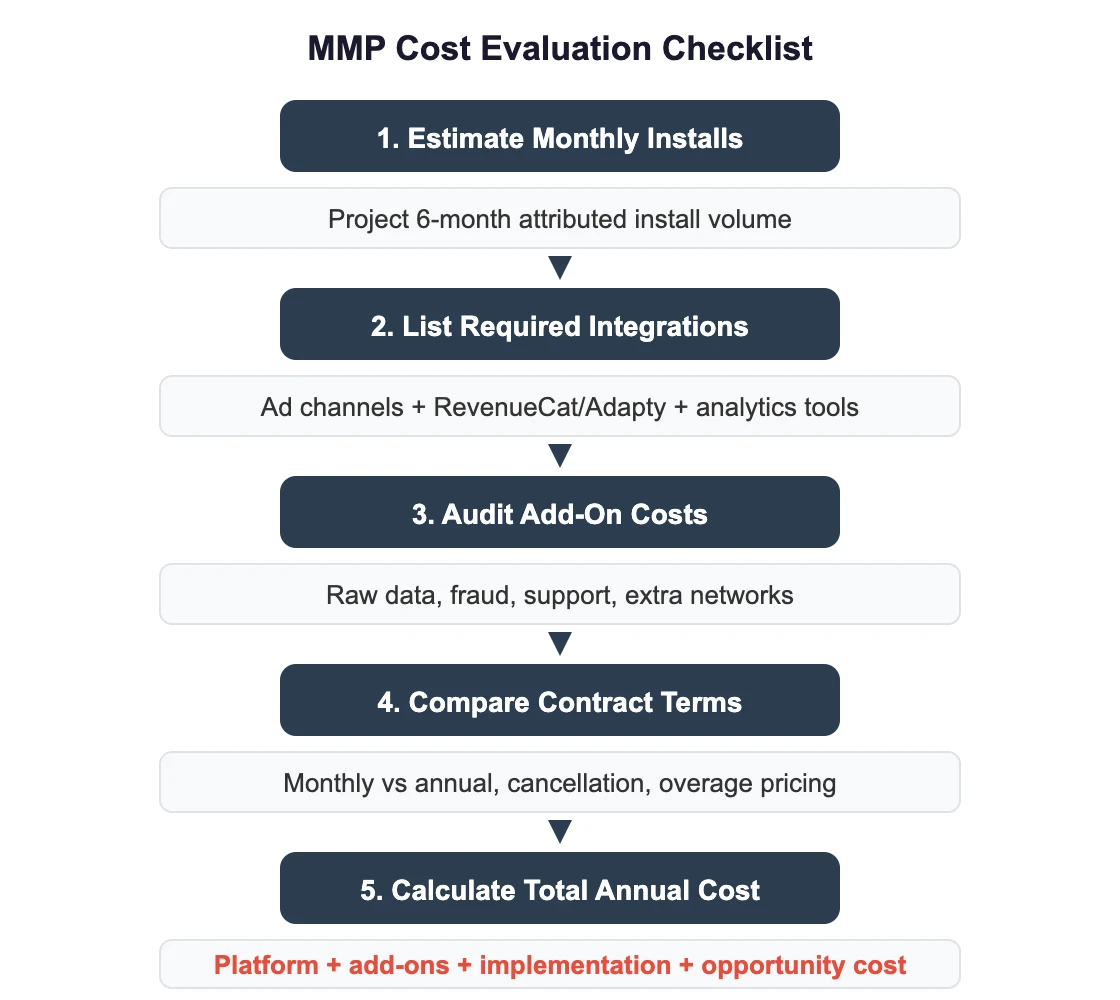
Before any vendor conversation, subscription app teams should document their requirements and map them to a cost checklist:
- Monthly install volume. Estimate your current and projected attributed installs for the next 6 months. Most MMPs price by installs or events.
- Required integrations. List the ad channels you run (Meta, Google, Apple Search Ads, TikTok) and the third-party tools you need (RevenueCat, Adapty, Amplitude). Count how many integrations are included in the base tier versus charged as extras.
- Data access needs. Determine whether you need raw data export. Most pre-Series A teams do not, but if you do, factor the additional monthly cost.
- Contract flexibility. Ask specifically about monthly versus annual billing, cancellation terms, and overage pricing.
- Support model. Clarify whether ticket-based support is included or whether you need to pay for a dedicated CSM.
This checklist turns opaque vendor conversations into structured cost comparisons. The total cost of an MMP for an early-stage subscription app is not just the platform fee. It is the platform fee plus add-ons, implementation time, and the opportunity cost of budget locked in contracts.
If you run paid acquisition for a subscription app and your monthly ad spend is under $20,000, you likely do not need fraud detection, raw data export, or agency access today. Identifying which features to defer saves both cost and implementation time.
2. How Airbridge Core Plan Approaches Pricing Differently
Airbridge Core Plan was built for the stage where most MMP pricing falls short: early-stage subscription apps running their first paid acquisition campaigns across Meta, Google, Apple Search Ads, and TikTok.
Core Plan pricing is public and predictable:
- 15,000 free attributed installs. No credit card required to start.
- $0.05 per install after the free tier. Cost scales linearly with actual usage.
- Pay-as-you-go billing. No annual commitment, no minimum contract.
This pricing model directly addresses the three problems above. There is no sales call required to see the price. There are no hidden add-ons because Core Plan intentionally removes features that early-stage teams do not need (fraud detection, raw data export, agency access). And there is no annual lock-in, so teams with seasonal install patterns pay only for what they use.
What Core Plan includes in the base offering:
| Capability | Enterprise MMP | Airbridge Core Plan |
|---|---|---|
| Pricing visibility | Requires sales contact | Public: 15K free, $0.05/install |
| Billing model | Annual prepayment | Pay-as-you-go |
| Minimum contract | 12 months, $2K to $10K/month | None |
| Ad channels | All networks (dozens) | GMAT: Meta, Google, Apple Search Ads, TikTok |
| Billing platform integration | Native (included in higher tiers) | Native (RevenueCat, Adapty in base) |
| Reports | All (with add-on tiers) | 6 built-in: Actuals, Trend, Active User, Funnel, Retention, Revenue |
| Unnecessary features for startups | Fraud, raw export, agency access included | Intentionally removed |
Core Plan supports 25 standard events including Start Trial, Subscribe, and Unsubscribe. These cover the full subscription funnel without requiring custom event schema design. The trade-off is intentional: no custom events, maximum 2 third-party integrations, and GMAT channels only. For teams running $5,000 to $20,000 per month across 2 to 4 major ad platforms, this scope matches the actual need.
The core question Core Plan answers: "Are paid users converting into subscriptions, and which channels are driving value?" If your team needs that signal first, before building complex analytics infrastructure, transparent pricing means you can evaluate the cost in minutes rather than weeks.
A concrete cost example. A subscription fitness app generating 8,000 attributed installs per month would pay approximately $400 per month on Core Plan. Compare that to enterprise MMP contracts starting at $2,000 to $5,000 per month with annual lock-in. For a team with $15,000 in monthly ad spend, the difference between $400 and $5,000 per month in MMP fees directly impacts how much budget remains for actual user acquisition.
See Core Plan pricing and features
FAQ: MMP Pricing for Early-Stage Subscription Apps
How much does an MMP typically cost for a startup?
MMP pricing for startups varies widely depending on the provider and tier. Enterprise MMPs typically start at $2,000 to $5,000 per month with annual contracts, and total costs can reach $7,000 to $10,000 per month when add-ons like raw data export and premium support are included (Business of Apps, 2026). See the comparison table above for how Airbridge Core Plan compares on pricing and contract terms.
When should a subscription app upgrade from Core Plan to Growth Plan?
Core Plan is designed for teams running paid UA on Meta, Google, Apple Search Ads, and TikTok with standard subscription events. Consider upgrading to Growth Plan when your team needs custom event tracking, additional ad network integrations beyond GMAT, raw data exports to warehouses like BigQuery or S3, or agency and media partner access.
What events does Core Plan track for subscription apps?
Core Plan supports 25 standard events covering the full subscription lifecycle: Install, Sign-up, Start Trial, Subscribe, Unsubscribe, and Order Complete, among others. These predefined event names reduce schema design work compared to custom event implementations. The trade-off: custom events are not supported in Core Plan, so teams with non-standard funnel steps would need Growth Plan.
Stop Budgeting Blind for Attribution
Every month without clear attribution signals is a month where budget flows to channels based on assumptions, not subscription revenue data. Opaque MMP pricing should not be the reason your team delays measurement.
Start Free with Airbridge Core Plan and see which channels actually convert trial users into paying subscribers, starting with 15K free attributed installs.

Ready to see what Core Plan can do?
Free attribution, deep linking, and audience tools — built for teams that are ready to grow.