How to Build a Win-Back Email Sequence for Your Subscription App

You spent real money getting users to subscribe. Some cancelled. Right now, most of those cancellations are sitting in a database, untouched.
That is a recoverable problem. Among apps tracked across more than 75,000 subscription products (State of Subscription Apps 2025), the natural reactivation rate for monthly subscribers reaches 13.7% within 12 months without any win-back effort. Acquiring a new subscriber costs 5-25x more than retaining an existing one (Harvard Business Review). A structured subscription app win-back sequence captures that opportunity systematically.
Key Takeaways
-
Not all churned users are worth pursuing. Cost-related churners and billing-failure churners (28% of Google Play cancellations) respond well to win-back. "Found a better app" churners typically do not. Segment before you send.
-
The first message needs to go out fast. The most effective first win-back touchpoint goes out within 24 hours of cancellation, while the user is still in the mental frame of your product.
-
Lead with value, arrive at the discount last. Opening with a coupon trains users to wait for the deal, then churn again at full price once the promotion ends. Non-discounted resubscribers stay 2.6x longer than discount-acquired ones.
-
Monthly churners are your best starting audience. They reactivate at 13.7% within Year 1 and have the shortest commitment cycle. Annual churners reactivate at only 4.6%.
-
A win-back sequence is a series, not a single email. A 4-email escalation sequence achieves approximately 14.7% cumulative reactivation (Klaviyo, 2025).
Why Win-Back Campaigns Outperform New Subscriber Acquisition
Win-back offers can add 10-25% to your bottom line, making it one of the highest-ROI activities in your lifecycle stack. A subscription app win-back sequence is a timed series of messages sent to churned subscribers, typically spanning 30 to 60 days after cancellation, triggered automatically when a subscriber's status changes to cancelled.
1. The ROI Case for Targeting Churned Users
The baseline reactivation data from 75,000+ subscription apps shows the opportunity by plan type:
| Plan Type | Natural Reactivation Rate (Year 1) | Win-Back Priority |
|---|---|---|
| Monthly | 13.7% | High |
| Weekly | 9.4% | Medium |
| Yearly | 4.6% | Low |
Monthly subscribers reactivate at more than three times the rate of yearly subscribers without any outreach. For an app with 500 monthly churners over a year, that baseline represents 68 users returning with zero effort. A targeted sequence can add meaningfully to that number.
Apps with high-price tiers see 11.9% reactivation versus 9.4% for low-price apps. These were users willing to pay a premium once. They are worth contacting again.
2. Which Churned Users Should You Skip?
Segments to deprioritize:
-
"Found a better app" churners (9.5% of Google Play churners). Their decision was comparative. You cannot run a product demo in three email paragraphs against a competitor they are now using daily.
-
Annual subscribers who cancel in month one. Nearly 30% of annual subscriptions cancel within the first month. A 4.6% reactivation ceiling means the ROI on a full sequence for early annual churners rarely pencils out.
-
Users with zero sessions in their last 30 days before cancelling. Without behavioral data to personalize around, win-back messaging turns generic and performs below baseline.
Concentrate your first sequence on monthly subscribers who had some engagement before cancelling. They represent the highest-probability cohort and are the right starting point for learning how to win back churned app users at scale.
How to Diagnose Churn Before Writing a Single Email
The churn reason determines both the message and the offer. It is the single most important variable in knowing how to win back churned app users effectively.
Data from 75,000+ subscription apps shows that the two most common churn reasons, "not enough usage" at 37.2% and "cost-related" at 34.6%, require fundamentally different win-back approaches. Usage-driven churners need value re-education. Price-driven churners need a concrete financial offer.
1. The 5 Churn Types and What They Mean for Win-Back
| Churn Type | Share of Cancellations | Win-Back Suitability | Best Approach |
|---|---|---|---|
| Not enough usage | 37.2% | Medium | Feature education, re-activation prompt |
| Cost-related | 34.6% | High | Discount or lower-tier plan offer |
| Technical issues | 7.1% | High (if fixed) | Resolution confirmation + reactivation offer |
| Found better app | 9.5% | Low | Differentiation message (low success rate) |
| Other / unspecified | 11.6% | Varies | Requires exit survey data |
"Not enough usage" signals that users never reached the habit loop your product needs to retain subscribers long-term. Win-back for this group is not about price. It is about showing them something specific they missed: a feature they never tried, a workflow that directly solves the problem they came in with, or the outcome they originally signed up to achieve.
Cost-related churn is the most actionable segment. These users valued the product enough to pay. They left because the value-to-price ratio stopped making sense. A time-limited offer, a paused subscription option, or a lower-tier plan can recover them.
Technical churn (7.1%) tends to convert at high rates when the message is timed against the fix announcement. A direct note confirming the fix, paired with an offer to return, is the most targeted type of win-back message you can send.
2. How to Build Your Churned User Segments
If you lack exit survey data, use behavioral proxies to approximate churn type:
-
Recency. Users who churned within the last 30 days are warmest. Extend outreach to 90 days. Beyond 90 days, reactivation drops to roughly 10-12%, and beyond 180 days to 2-4% (Validity).
-
Plan type. Monthly churners are the starting point. Shorter commitment cycles make them easier to re-engage with a one-cycle offer.
-
Session activity in the final 14 days. Users who were logging sessions before cancelling are usage-disengaged, not value-disengaged. They are more winnable than users who had been completely inactive.
-
LTV history. Prioritize users in the top quartile. Their resubscription value justifies a stronger offer.
Build at minimum three segments before your first sequence: recent monthly churners with activity, recent monthly churners without activity, and annual churners. Sequence one targets the first group only.
Want to see how Win-back email sequence works with your data?
Get hands-on with Airbridge and see real results.
Try It Free →How to Build Your Win-Back Email Sequence: A Practical Guide
1. When to Send Each Email in Your Win-Back Sequence
The first win-back touchpoint goes out within 24 hours of cancellation. Not three days later. Not at the end of the billing period. Within 24 hours.
At that moment, the user is still in the mental frame of your product. They have not fully committed to an alternative. They have not deleted the app. Outreach within the first 30 days is roughly 3x more effective than later attempts (Validity).
After the first message, space out the remaining touchpoints:
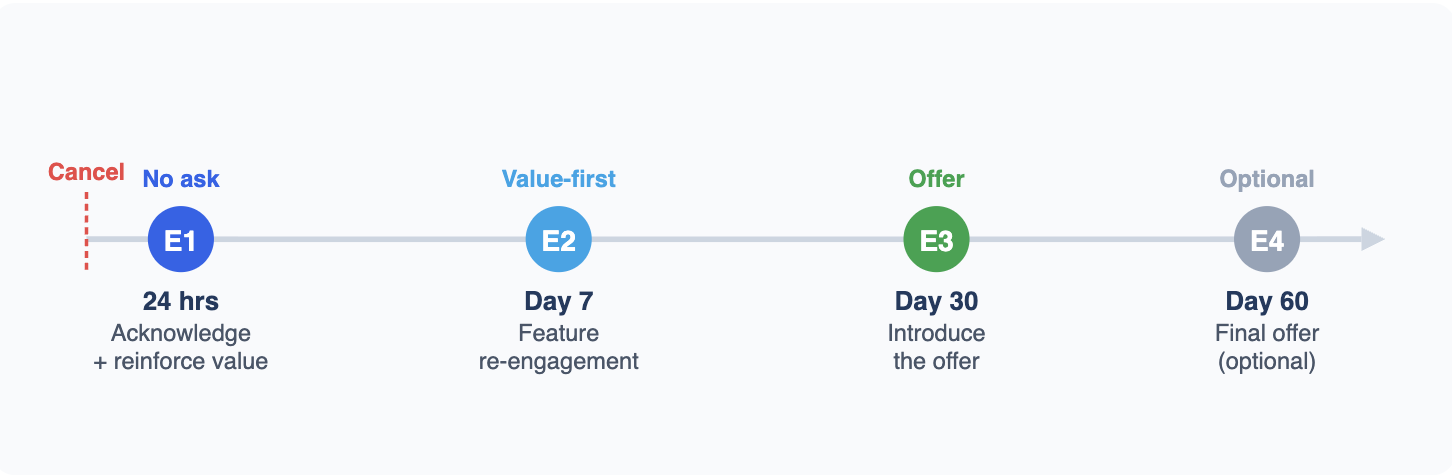
Win-back email sequence timeline: 4 touchpoints over 60 days
Three emails cover the majority of the reactivation window for monthly churners. A fourth email makes sense only for users who opened at least one prior message.
2. What to Write in Each Win-Back Email
Email 1 does not ask for anything. It acknowledges the cancellation, references one or two outcomes the user actually experienced in the product, and keeps the return path low-friction.
> Subject: Your progress is still saved.
"You completed onboarding and unlocked \Feature]. It's still here whenever you're ready to come back."
"Your progress is still saved" works better than "We miss you." The first is about the user. The second is about you.
Email 2 focuses on something the user did not fully explore. This requires behavioral data: which features did they try, which did they skip, what goal did they set during onboarding and never finish.
> Subject: You never tried [Feature X].
"Most users who reach [outcome] used [Feature X] first. You set it up but never activated it. Here's how it works."
Email 3 is where the offer arrives. The most effective options for subscription apps:
-
An extended [free trial (14-30 days) for users who cancelled early and likely did not hit their aha moment. A second trial reframes the decision without requiring a financial commitment.
-
A one-cycle discount (20-40% off the next billing period) for cost-driven churners identified through exit surveys or behavioral signals.
-
A lower-tier plan offer if your pricing structure supports one. A stripped-down version that retains them is better than no revenue at all.
> Subject: Come back for 30 days at half price.
"Here's 50% off your next billing cycle. No commitment beyond that."
3. How to Structure Your Win-Back Offer
Discounting immediately is the most common win-back mistake. Users who resubscribe only because of a coupon tend to churn a second time when the promotional period ends, a pattern practitioners call "post-promo churn." Non-discounted resubscribers stay 2.6x longer than discount-acquired ones (Phoenix Strategy Group).
The three-email structure above addresses this by placing the offer in Email 3, after two rounds of value-first messaging. If a user resubscribes before Email 3 arrives, you did not need to spend the discount.
iOS Native Win-Back Offers (and Why They Do Not Replace Your Sequence)
Apple introduced native win-back offers for auto-renewable subscriptions at WWDC 2024, with general availability from September 2024 (Apple Developer). These promotional offers appear across the App Store, in iOS Settings (Manage Subscriptions), and inside your app, without any push or email required.
This makes them especially effective for churned subscribers who have opted out of notifications. Treat them as a parallel recovery surface, not a replacement for your sequence. Configure them in App Store Connect under the Subscriptions section. The in-app sheet requires iOS 18 or later; the Manage Subscriptions display works on iOS 14.3 and later.
Google Play offers a comparable mechanism through Subscription Offers and personalized pricing, scoped to Android subscribers.
The Win-Back Mistake That Undermines Everything
Even a well-structured subscription app win-back sequence underperforms if the cancellation exit experience is broken. If your churn flow is a single button press with no acknowledgment, no recap of what the user built, and no "your data is still here" signal, you are losing users who were still deciding.
A pause option, a brief reminder of saved progress, or a low-friction downgrade path reduces involuntary loss and creates a more receptive audience for win-back messaging later. Fix the exit before optimizing the re-entry.
How to Launch Your First Win-Back Campaign (Start Small)
Take monthly subscribers who churned in the last 30 days with at least one session in their final two weeks. Build three emails: within 24 hours, at day 7, at day 30. Measure retention benchmarks and revenue recovered per email. Iterate from there.
Win-back is not a one-time campaign. It is an ongoing channel within your lifecycle marketing stack. Every month that passes without a sequence running is a month of recoverable subscribers who move further out of reach.
Ready to transform your mobile growth?
Learn how Airbridge helps leading brands measure and optimize every touchpoint.