Which Ad Campaign Drives Subscriptions? Your MMP Won't Admit

A Meta campaign reports 4,200 installs. Google Ads claims 2,800. Apple Search Ads logs another 900. RevenueCat shows 310 paid subscribers for the month. But when you try to match those subscribers back to the campaigns that acquired them, the data trail goes cold.
This is not a reporting glitch. It is a structural gap between install attribution and subscription revenue that costs subscription apps thousands of dollars in misallocated ad spend every month. When budget decisions rely on install counts instead of channel-level subscription data, growth teams systematically overfund low-converting channels and starve the ones that actually produce paying subscribers.
Key Takeaways
-
Subscription app attribution breaks at the install-to-revenue boundary. Most attribution setups track installs by channel but lose visibility once users enter the subscription funnel.
-
Ad platforms optimize for installs and trials, not paid subscriptions. Self-Attributing Networks each claim credit for conversions, inflating reported numbers without deduplication.
-
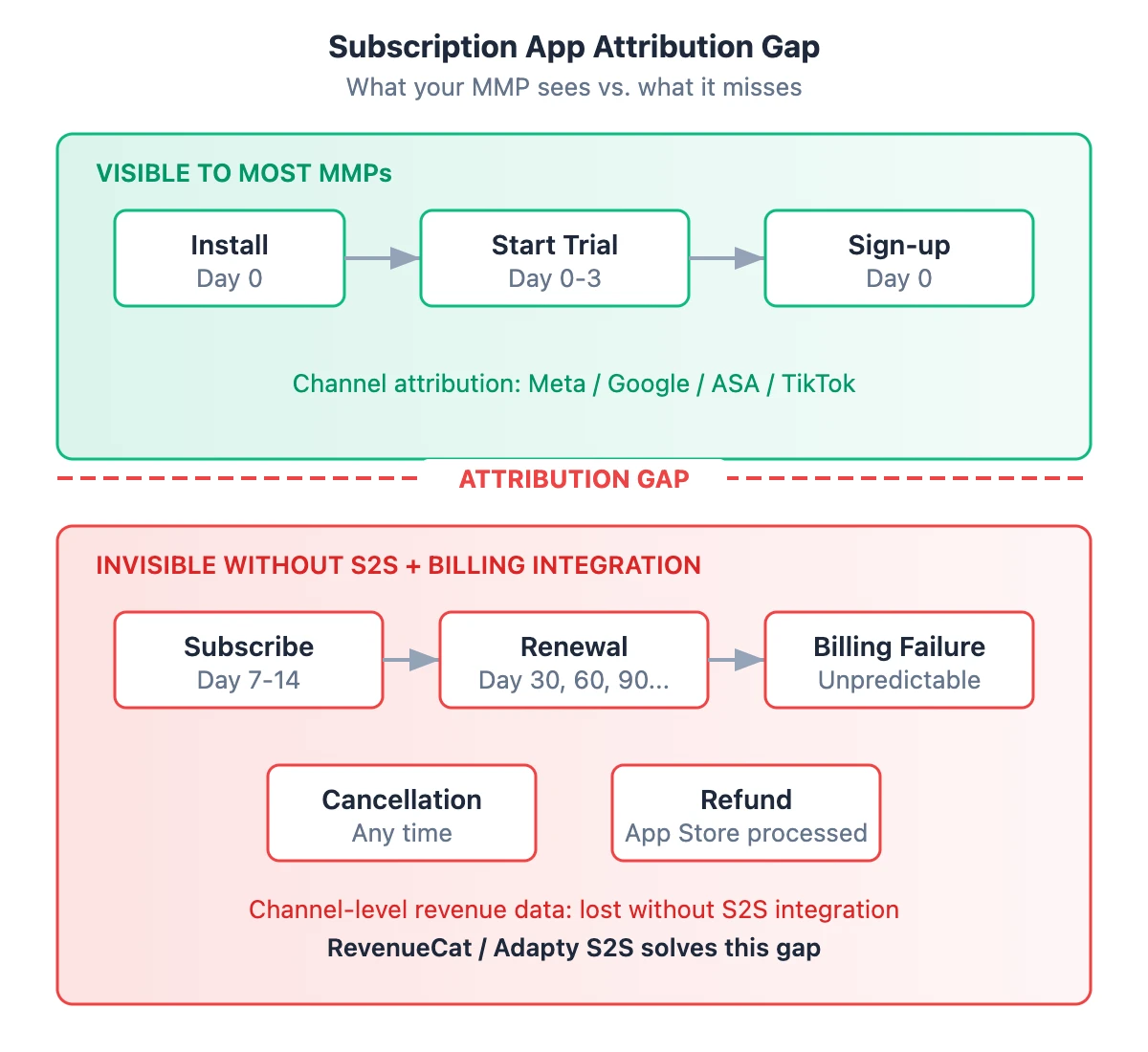
SDK-only setups miss subscription events that happen outside the app. Renewals, billing failures, and refunds occur server-side, creating blind spots in channel-level LTV data.
-
Misattributed subscription revenue compounds over time. Every month without accurate channel data adds another layer of budget misallocation that becomes harder to unwind.
-
Airbridge Core Plan connects install attribution to subscription revenue. With native RevenueCat and Adapty integration, it maps the full funnel from ad click to paid subscriber across Meta, Google, Apple Search Ads, and TikTok.
Why Subscription App Attribution Breaks Between Install and Revenue
Subscription app attribution is fundamentally different from single-purchase attribution. A user who installs your app today might start a free trial on day 3, convert to a paid subscription on day 10, and renew (or churn) on day 40. The revenue event that matters most happens weeks after the install, long after most attribution windows have closed.
This creates a structural problem: the tools that track installs are disconnected from the tools that track subscription revenue.
1. Ad Platforms Optimize for Installs, Not Subscriptions
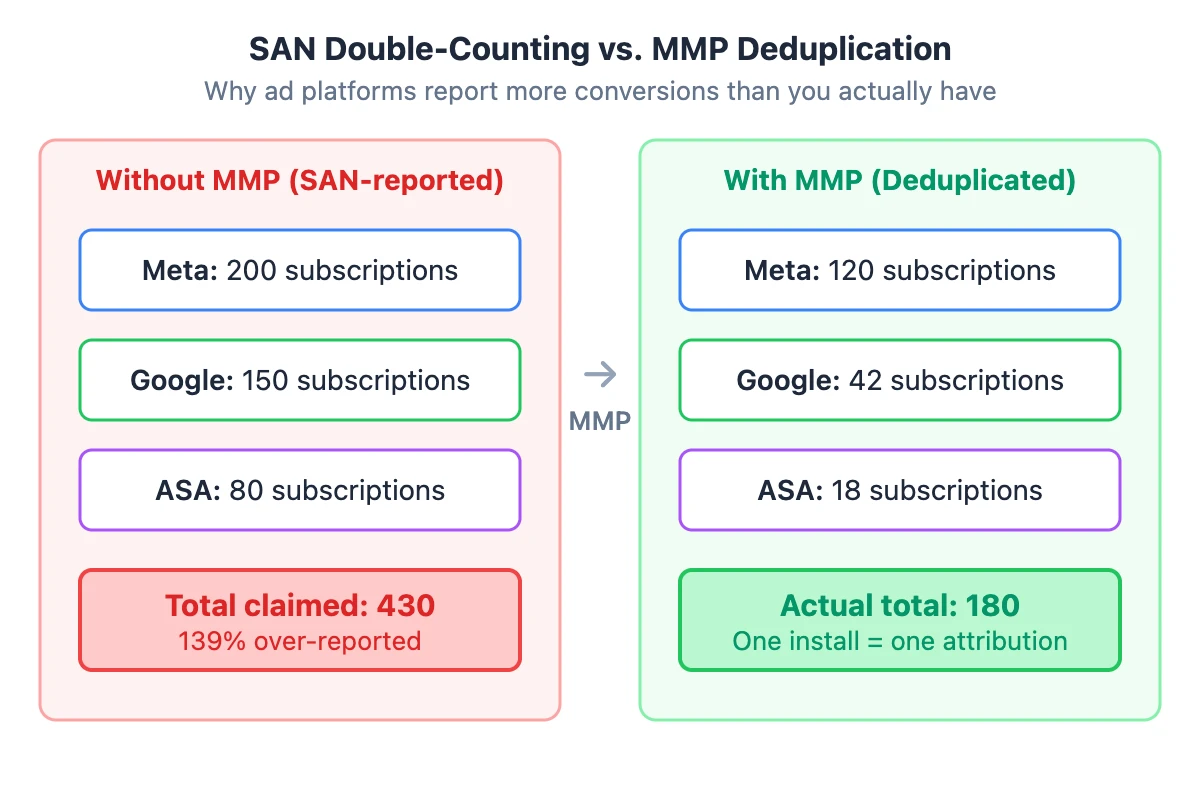
Self-Attributing Networks (SANs) like Meta, Google, TikTok, and Apple Search Ads each run their own attribution. Each platform claims credit for conversions based on its own rules and lookback windows.
The result is predictable: Meta reports 200 subscriptions, Google claims 150, but your billing platform logs only 180 total. Without a neutral Mobile Measurement Partner (MMP) to deduplicate these claims, you cannot determine which channel actually drove the paying subscriber.
This is especially damaging for subscription apps where the same user often interacts with ads across multiple platforms before installing. A user might see a TikTok ad, later click a Meta retargeting ad, then search for the app on Apple Search Ads. All three platforms claim credit for the eventual subscription. Only a neutral MMP referee can attribute that subscriber to a single originating source.
For subscription apps using standard 7-day free trials, the problem deepens. The revenue event (Subscribe) often occurs at the boundary of or beyond most ad platforms' default view-through optimization windows. Ad algorithms optimize for the signal they can see (installs, trial starts) rather than the outcome that matters (paid subscriptions).
2. The SDK-Only Gap: Revenue Events That Never Reach Your MMP
Many subscription apps rely on SDK-based event capture for attribution. The problem: SDK detects subscription state changes only when the user opens the app, creating latency and dependency on user behavior.
Subscription lifecycle events do not follow this pattern:
-
Renewals happen server-side on a fixed billing cycle, regardless of whether the app is open
-
Billing failures occur when a payment method expires or gets declined, often without the user knowing
-
Refunds are processed through the app store, not through the app itself
For events like renewals or billing failures that occur while the app is closed, SDK capture is unpredictable or absent if the user never reopens. This means your attribution data reflects the initial conversion but not the ongoing revenue reality of each channel.
According to RevenueCat's State of Subscription Apps 2025 report, the median trial-to-paid conversion rate for Health and Fitness apps is 39.9%. That means roughly 60% of trial users churn before paying. Without channel-level data on which trials actually convert, you cannot distinguish a channel that generates curious trialers from one that generates committed subscribers.
3. The Cost of Flying Blind on Channel-Level Subscription Data
Consider a fitness subscription app spending $15,000/month across three channels:
| Channel | Installs | Trial Starts | Paid Subscribers | Cost per Subscriber |
|---|---|---|---|---|
| Meta Ads | 4,200 | 840 | 210 | $24 |
| Google Ads | 2,800 | 420 | 168 | $30 |
| Apple Search Ads | 900 | 180 | 18 | $278 |
Without subscription app attribution, this team would see three channels all producing installs and trials. The budget might get split proportionally by install volume. With channel-level subscription data, the picture changes: Meta and Google produce subscribers at $24 and $30, while Apple Search Ads costs $278 per subscriber in this scenario.
Without channel-level CPS data, the team cannot identify which source to scale or cut, leaving LTV on the table.
For a team spending $15,000/month, even a 20% misallocation toward the wrong channel adds up to $36,000 per year in wasted spend. For subscription apps where D60 revenue per install varies dramatically by channel, the compounding effect of bad attribution data is one of the largest hidden costs in early-stage paid UA.
%%CTA|Try It Free|https://app.airbridge.io/signin?from=blog-inline|Connect installs to subscription revenue and find your best-performing campaigns.%%
Start measuring what matters — for free
Airbridge Core Plan gives growing teams real attribution, deep linking, and audience tools at no cost.
Start Free for 30 Days →How to Fix Subscription App Attribution
1. Practical Steps Any Team Can Take Today
If you are trying to figure out how to track subscription attribution by ad channel for mobile apps, these process-level fixes can reduce the gap immediately:
-
Align attribution windows across all ad platforms. Set the same lookback window (click and view-through) on Meta, Google, Apple Search Ads, and TikTok. Mismatched windows are the simplest source of discrepancies to fix.
-
Connect your billing platform to your analytics stack. If you use RevenueCat or Adapty, ensure subscription events (Start Trial, Subscribe, Renewal, Cancellation) flow into the same system that receives install data.
-
Define "subscriber" consistently. A trial start is not a subscription. Standardize your definition of a paid subscriber across all reporting tools before comparing channels.
-
Tag campaigns with UTM parameters for web-to-app funnels. If you run web acquisition alongside app campaigns, UTM tracking provides deterministic attribution that bypasses many iOS privacy restrictions.
-
Review SAN-reported conversions against your billing source of truth. Export subscription data from RevenueCat or the App Store and compare it to what each ad platform claims. The delta reveals your attribution gap.
2. How Airbridge Core Plan Connects Installs to Subscription Revenue
The process fixes above close some gaps, but connecting installs to subscription revenue at the channel level requires an MMP built for subscription apps.
Airbridge Core Plan was designed around one question: "Are paid users converting into subscriptions, and which channels are driving value?"
Here is how it solves the specific attribution problems described above:
-
Deduplicated attribution across GMAT channels. Core Plan integrates with Meta, Google, Apple Search Ads, and TikTok (the four SANs that represent 80-90% of early-stage paid acquisition spend) and provides a single, deduplicated source of truth for each install.
-
Native RevenueCat and Adapty integration. Subscription events flow directly into Core Plan via S2S connection. This enables real-time, independent signal transmission that does not rely on the user manually opening the app. Renewals, billing failures, and cancellations are captured regardless of app state.
-
25 subscription-optimized standard events. Core Plan's standard events include Install, Start Trial, Subscribe, Unsubscribe, and Order Complete. These cover the full subscription funnel without requiring custom event schema design.
-
6 built-in reports for subscription metrics. Actuals, Trend, Active User, Funnel, Retention, and Revenue reports surface channel-level subscription data without additional setup.
| Capability | Enterprise MMP | Airbridge Core Plan |
|---|---|---|
| Billing platform integration | Native (included in higher tiers) | Native (included in base) |
| Subscription event tracking | Predefined + custom events | 25 subscription-optimized standard events |
| Setup decisions | General-purpose onboarding | Subscription-app-focused onboarding |
| Minimum contract | Annual, $10K+ | Pay-as-you-go, 15K free installs |
| Unnecessary features | Fraud, raw export, agency access included | Intentionally removed |
| Ad channel coverage | All networks supported | GMAT channels |
Core Plan does not support custom events or raw data export. These are intentional design decisions: standard events cover the subscription funnel, and pay-as-you-go pricing keeps costs aligned with early-stage budgets. For teams that need custom events, additional ad networks, or raw data warehouse exports, Airbridge's Growth Plan provides the full measurement stack.
If your current MMP shows installs but leaves you guessing about which channels drive subscribers, the problem is not your team. It is the gap between install attribution and subscription revenue that most tools were not designed to bridge. Core Plan was built specifically for this gap.
The pricing model reflects this focus: 15K free attributed installs with $0.05/install after the free tier. For a subscription app generating 5,000 installs/month, the first three months cost nothing. Compare this to enterprise MMPs where minimum annual contracts start at $10,000 or more, regardless of how many features the team actually uses.
FAQ: Subscription App Attribution
What events should a subscription app track for proper attribution?
At minimum, track the full subscription funnel: Install, Sign-up, Start Trial, Subscribe, Unsubscribe, and Order Complete. These events let you measure cost per subscription by channel, trial-to-paid conversion rates, and channel-level LTV. Billing events (renewal, billing failure) are also critical for understanding true subscriber retention by acquisition source.
How does subscription app attribution differ from standard app attribution?
Standard app attribution focuses on the install event. Subscription app attribution must extend beyond that to track the full lifecycle: trial start, paid conversion, renewal, and churn. The key difference is timing. Revenue events often happen days or weeks after the install, requiring server-to-server connections with billing platforms like RevenueCat or Adapty to maintain the link between acquisition source and subscription outcome.
When should a subscription app upgrade from Core Plan to a full MMP?
The upgrade signal is usually complexity, not scale. When your team needs custom event tracking beyond standard subscription events, support for ad networks beyond Meta, Google, Apple Search Ads, and TikTok, or raw data exports to a data warehouse, Growth Plan provides those capabilities.
The Revenue You Cannot Attribute Is Revenue You Cannot Scale
Every dollar of ad spend without channel-level subscription attribution is a dollar allocated on instinct, not evidence. Growth teams that cannot see which channels produce paying subscribers do not just waste budget. They systematically underfund their best-performing channels while overinvesting in channels that generate installs but not revenue.
Start free with Airbridge Core Plan and see which ads actually drive your subscriptions, starting with 15K free attributed installs.


Ready to see what Core Plan can do?
Free attribution, deep linking, and audience tools — built for teams that are ready to grow.