Billing Failures, Refunds, Renewals: The Subscription Events Your MMP Never Shows You

Your MMP tracks the install, attributes the trial start, and records the first payment. After that, the subscription lifecycle continues for months. Your MMP does not follow it.
Renewals, billing failures, grace periods, refunds, cancellations. These events decide whether a subscriber is profitable. But none of them reach your attribution system. RevenueCat or Adapty shows you aggregate totals. Your MMP shows you acquisition channels. No system connects both, which means your LTV-by-channel calculation is built on incomplete data.
Key Takeaways
-
Your MMP stops tracking after the first payment. Subscription lifecycle events happen server-side and never connect back to the acquisition channel.
-
Billing errors account for 28% of Google Play subscription cancellations. Most MMPs cannot show which channels have higher billing failure rates (RevenueCat, 2025).
-
LTV-by-channel without lifecycle data is a guess. First-payment revenue multiplied by an average retention curve hides real differences between channels.
-
Full lifecycle tracking requires S2S integration with your billing platform and channel-level attribution for every post-payment event.
-
Airbridge Core Plan provides subscription-optimized standard events with native RevenueCat/Adapty integration, connecting billing events to acquisition channels. Start free with 15K attributed installs.
The Post-Payment Blind Spot That Breaks Your LTV Calculations
If you run paid UA for a subscription app, your MMP's attribution engine answers one question well: which channel drove this install? For apps with 7-14 day trials, it also tracks trial starts and first payments. After that, every event that determines real subscriber value is invisible to your attribution system.
1. What Your MMP Tracks vs What It Misses
| Event | Your MMP | RevenueCat / Adapty |
|---|---|---|
| Install | Attributed to channel | -- |
| Trial Start | Attributed to channel | ✓ |
| First Payment | Attributed to channel | ✓ |
| Renewal (Month 2+) | Not tracked | ✓ |
| Billing Failure | Not tracked | ✓ |
| Grace Period Entry | Not tracked | ✓ |
| Refund | Not tracked | ✓ |
| Cancellation | Not tracked | ✓ |
Everything below the first payment line is invisible to your attribution system. Your billing platform knows exactly what happened. Your MMP has no idea.
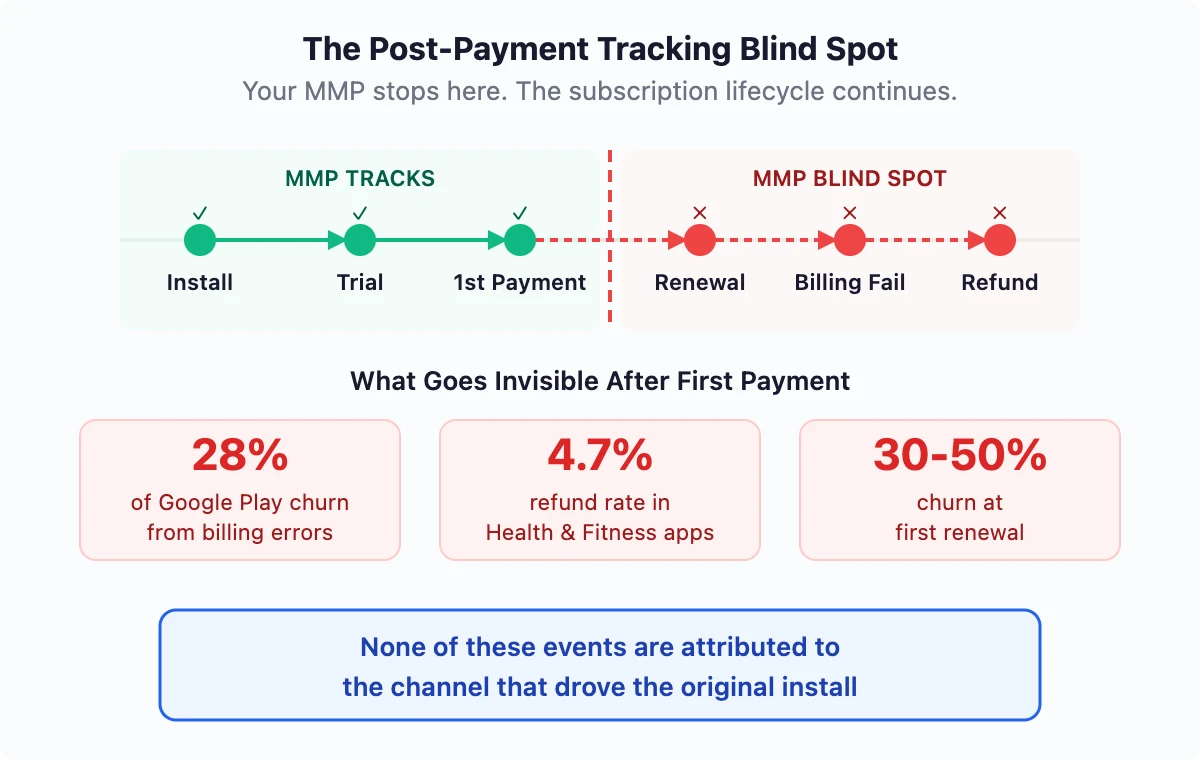
Why? Subscription billing events are processed server-side by Apple and Google, not by the app itself. A device-side SDK can only detect subscription state changes when the user opens the app. For events like renewals or billing failures that happen while the app is closed, the signal is unpredictable or absent entirely. Without a server-to-server (S2S) connection between your billing platform and your MMP, these events remain disconnected from the channel that drove the original install.
Consider a subscriber acquired through Meta in January. They renew in February, hit a billing failure in March (expired card), enter a grace period, and recover in April. That entire revenue journey is invisible in your MMP dashboard. The subscriber shows as one first-payment conversion in January and nothing after. Multiply this across thousands of subscribers and dozens of campaigns. The gap between what your billing platform knows and what your MMP reports grows every month.
2. Billing Failures Are a Bigger Problem Than Most Teams Realize
RevenueCat's State of Subscription Apps report shows billing errors account for 28% of Google Play subscription cancellations. On iOS, the rate is lower at 15%, but still significant. These are not users who chose to leave. They are users whose payments failed silently.
The same report shows Health & Fitness apps face an additional challenge: a 4.7% refund rate, the second highest across all app categories. Apps using hard paywalls see refund rates of 5.8% compared to 3.4% for freemium models, suggesting that aggressive monetization without sufficient value demonstration creates more post-purchase regret.
If your MMP cannot track billing failures and refunds by channel, you cannot tell which acquisition sources have higher involuntary churn rates. A channel that looks efficient by CPS might have a 15% billing failure rate at month 3, but that data point does not exist in your attribution system. You would continue scaling spend on a channel that is quietly leaking subscribers after the first payment.
3. Average Retention Curves Hide Channel Differences
Most teams fill the lifecycle data gap by applying a single average retention curve across all channels. This assumes every channel's subscribers retain at the same rate, which is almost never true.
RevenueCat data shows the first renewal is the biggest churn point. Depending on plan type, 30-50% of subscribers churn at their first renewal. Annual subscriptions retain at 66% past the first renewal, while weekly plans retain only 52%. These rates vary significantly by acquisition channel, but without renewal data attributed to channels, the variance is invisible.
Consider this hypothetical scenario for a fitness app running $30K/month across three channels:
| Channel | CPS | Month-2 Renewal | Month-6 Renewal | 6-Month LTV |
|---|---|---|---|---|
| Meta Ads | $45 | 70% | 35% | $85 |
| Google Ads | $55 | 85% | 65% | $180 |
| Apple Search Ads | $60 | 90% | 70% | $210 |
Meta has the lowest CPS but the lowest 6-month LTV. Apple Search Ads costs more per subscriber but produces 2.5x more value over 6 months. A CPS-only budget decision would scale Meta and cut ASA. The lifecycle data recommends the opposite.
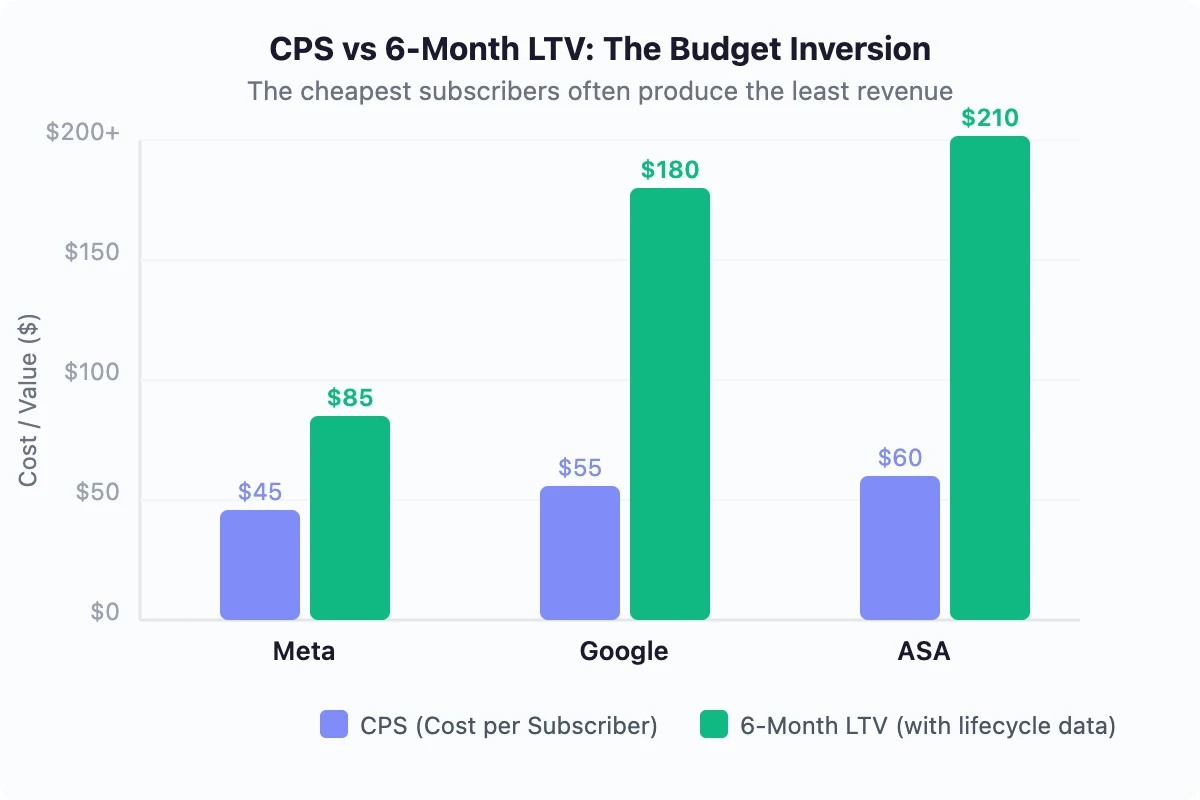
But without post-payment tracking by channel, this team would never see the difference. They would continue optimizing for the cheapest acquisition, not the most profitable.
Start measuring what matters — for free
Airbridge Core Plan gives growing teams real attribution, deep linking, and audience tools at no cost.
Start Free for 30 Days →How to Close the Post-Payment Tracking Gap
1. What Full Lifecycle Tracking Requires
Closing the post-payment blind spot requires three capabilities that most MMP setups lack:
-
Standard events beyond first payment. Tracking the subscription lifecycle means defining events for every major transition: Subscribe (first paid conversion), Unsubscribe (voluntary cancellation), Order Complete (renewal payment processed), and Order Cancel (refund or involuntary cancellation). Without standardized event definitions, teams build custom events with inconsistent naming across channels, making cross-channel comparison unreliable.
-
S2S integration with your billing platform. Post-payment events happen server-side. The only reliable way to capture them is through a server-to-server connection between your billing platform (RevenueCat or Adapty) and your MMP. This ensures every renewal, billing failure, and refund reaches the attribution system regardless of whether the user has the app open. Apps that implement billing grace periods can recover subscribers who would otherwise churn to billing failures, but these recovery events are only actionable if they reach your attribution data.
-
Channel-level attribution for every lifecycle event. Aggregate lifecycle data tells you total renewals increased by 200 this month. Channel-level data tells you which campaigns drove those renewals, which ones drove the billing failures, and which channels produce subscribers who renew past month 6. Every lifecycle event must connect back to the original attributed install to be actionable for budget decisions.
See which channels drive subscribers who actually renew. Start free with 15K attributed installs.
2. How Airbridge Core Plan Connects Billing Events to Channels
Airbridge Core Plan is an MMP built for subscription apps running paid UA on Google, Meta, Apple Search Ads, and TikTok. It closes the post-payment blind spot by connecting billing platform data to channel-level attribution.
Core Plan provides 25 subscription-optimized standard events (including Start Trial, Subscribe, Unsubscribe, Order Complete, Order Cancel) with native RevenueCat and Adapty integration. Lifecycle events flow from your billing platform into the attribution system automatically via S2S, with no custom backend required.
The Actuals Report attributes subscription events to channels and campaigns, so you can see billing failure rates and refund rates by acquisition source. The Retention Report shows which channels retain subscribers beyond the first payment, broken down by cohort. Together, these reports replace first-payment LTV guesswork with actual lifecycle data by channel.
| Capability | Enterprise MMP | Airbridge Core Plan |
|---|---|---|
| Post-payment event tracking | Native integrations available (included in higher tiers) | Standard events via native billing integration (included in base) |
| Billing failure attribution | Available with standard reporting | Channel-level via Actuals Report |
| Renewal tracking by channel | Available (standard reporting) | Automatic via S2S integration |
| Lifecycle LTV by channel | Available (premium tiers) | Retention Report (included in base) |
| Event configuration | Predefined + custom events | 25 subscription-optimized standard events |
| Minimum contract | Annual, $10K+ | Pay-as-you-go, $0.05/install |
| Free tier | Limited or none | 15K free attributed installs, all features included |
Subscription Revenue You Cannot See Is Revenue You Cannot Optimize
Every month, your billing platform processes renewals, catches billing failures, issues refunds, and logs cancellations. Every month, none of that data reaches your attribution system. The subscriber who renewed six times and the subscriber who churned to a billing failure at month 2 look identical in your MMP: one first-payment conversion.
That invisible gap is where your budget decisions go wrong. Without lifecycle event tracking by channel, you cannot tell which channels produce $85 subscribers and which produce $210 subscribers. You optimize for CPS because it is the only post-install metric you can see, and you scale channels that look cheap but churn fast.
Connect billing events to acquisition channels. Start free with Airbridge Core Plan.


Ready to see what Core Plan can do?
Free attribution, deep linking, and audience tools — built for teams that are ready to grow.