Influencer Marketing Fraud: How Fake Clicks Drain App Budgets

A fitness app spends $8,000 on three influencer partnerships. The campaign dashboard reports 12,000 link clicks, 2,400 installs, and a 4.2% engagement rate. RevenueCat logs 11 new subscribers. Two of the three influencers generated zero revenue.
Without per-influencer conversion data, most teams have no practical way to know whether those 2,400 installs came from real users or bot traffic -- and they typically discover the gap months too late. Influencer marketing fraud is not a fringe risk. It is a structural problem in how mobile app teams measure influencer performance, and it drains budgets quietly.
Key Takeaways
-
74% of marketers have experienced influencer fraud (AMRA & ELMA, 2025). The problem spans every vertical, but subscription apps are especially vulnerable because fraud hides behind top-of-funnel vanity metrics.
-
Fake followers, bot clicks, and engagement pods inflate the metrics that most teams use to evaluate influencer ROI. Each fraud type creates a different distortion in your funnel.
-
Standard analytics tools measure engagement, not subscription revenue. GA4 and UTM links track clicks and installs but cannot connect those installs to downstream subscription events.
-
The most reliable fraud signal is post-install conversion data. If 500 installs from one influencer produce $0 in subscription revenue, you have your answer -- no dedicated fraud tool required.
-
Airbridge Core Plan provides per-influencer attribution from install to subscription revenue -- giving small teams conversion-level visibility without enterprise pricing.
The Scale of Influencer Marketing Fraud in Mobile Apps
Influencer marketing fraud is the deliberate inflation of performance metrics -- followers, clicks, installs, or engagement -- to extract payment for results that never occurred. Industry data puts the annual cost between $1.3 billion (AMRA & ELMA, 2019 baseline) and $4.6 billion (SociaVault, 2025) globally. The problem is concentrated among mid-to-large influencer tiers, where the financial incentive to inflate metrics is highest.
For subscription app teams, the risk is amplified because the gap between a fraudulent install and a real subscriber is wide -- but invisible without conversion-level data.
A 2025 fake follower study found that 37.2% of influencer followers are fake across major platforms. Macro-tier influencers - those with 100K to 500K followers -- showed the highest fraud rate at 48.3% (SociaVault). For subscription app teams paying per-install or per-click, nearly half the reported reach may be artificial.
1. Fake Followers and Inflated Reach
Purchased followers inflate an influencer's apparent audience size. A fitness influencer with 250K followers and 15K fake accounts looks identical to one with 250K real followers -- until you measure downstream behavior. Fake followers never install, never start trials, never subscribe.
2. Bot-Generated Clicks and Installs
Bot traffic goes beyond fake followers. Sophisticated click farms generate real-looking clicks and even app installs that pass basic analytics filters.
TrafficGuard data indicates 31% of iOS app installs are fraudulent, and 15-25% of ad spend is lost to invalid traffic annually (TrafficGuard). These bot installs appear in your dashboard as legitimate acquisition - they just never convert.
3. Engagement Pods and Manufactured Social Proof
Engagement pods are groups of accounts that artificially like, comment, and share each other's content. For app marketers evaluating influencers by engagement rate, pods make fraudulent influencers indistinguishable from legitimate ones.
The common thread across all three fraud types: top-of-funnel metrics look healthy while downstream conversions collapse. If your evaluation stops at clicks or engagement rate, fraud remains invisible.
Why Standard Analytics Miss Influencer Fraud
Most influencer platforms and analytics tools measure what happened on the platform - impressions, clicks, engagement. They do not measure what happened after the install.
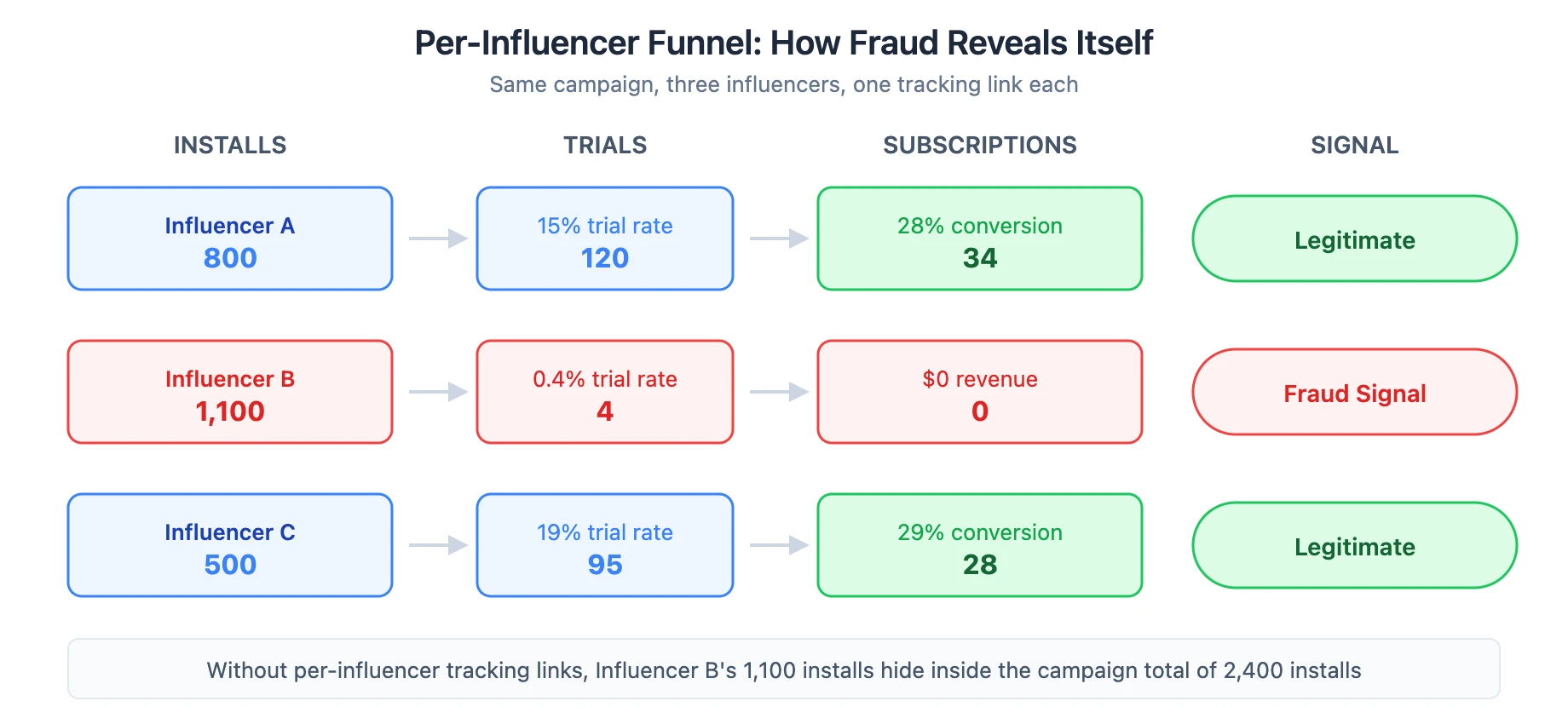
GA4 and UTM-based tracking can attribute an install to a specific link. But for subscription apps, the critical question is not "did they install?" - it is "did they subscribe?" UTM parameters break at the app store boundary. GA4 cannot connect a web click to an in-app subscription event without additional attribution infrastructure.
This creates a blind spot that fraudulent influencers exploit. Without post-install conversion visibility, a channel that drove 500 real users looks identical to one that drove 500 bots. Same install count. Completely different revenue outcome.
Influencer platforms report engagement. Ad networks report clicks. Your billing platform reports revenue. Nothing connects these layers per influencer - unless you build that connection deliberately.
Per-influencer attribution from install to subscription. 15K free installs. Start Free.
Want to see how Influencer marketing fraud works with your data?
Get hands-on with Airbridge and see real results.
Try It Free →How Per-Influencer Attribution Exposes Fraudulent Traffic
If you are asking how to detect influencer marketing fraud - fake clicks, bot installs - in a mobile app, the answer is simpler than most vendors suggest.
You need per-influencer conversion data from install to subscription revenue. When the data is transparent, fraud reveals itself.
The Attribution Approach: One Tracking Link Per Influencer
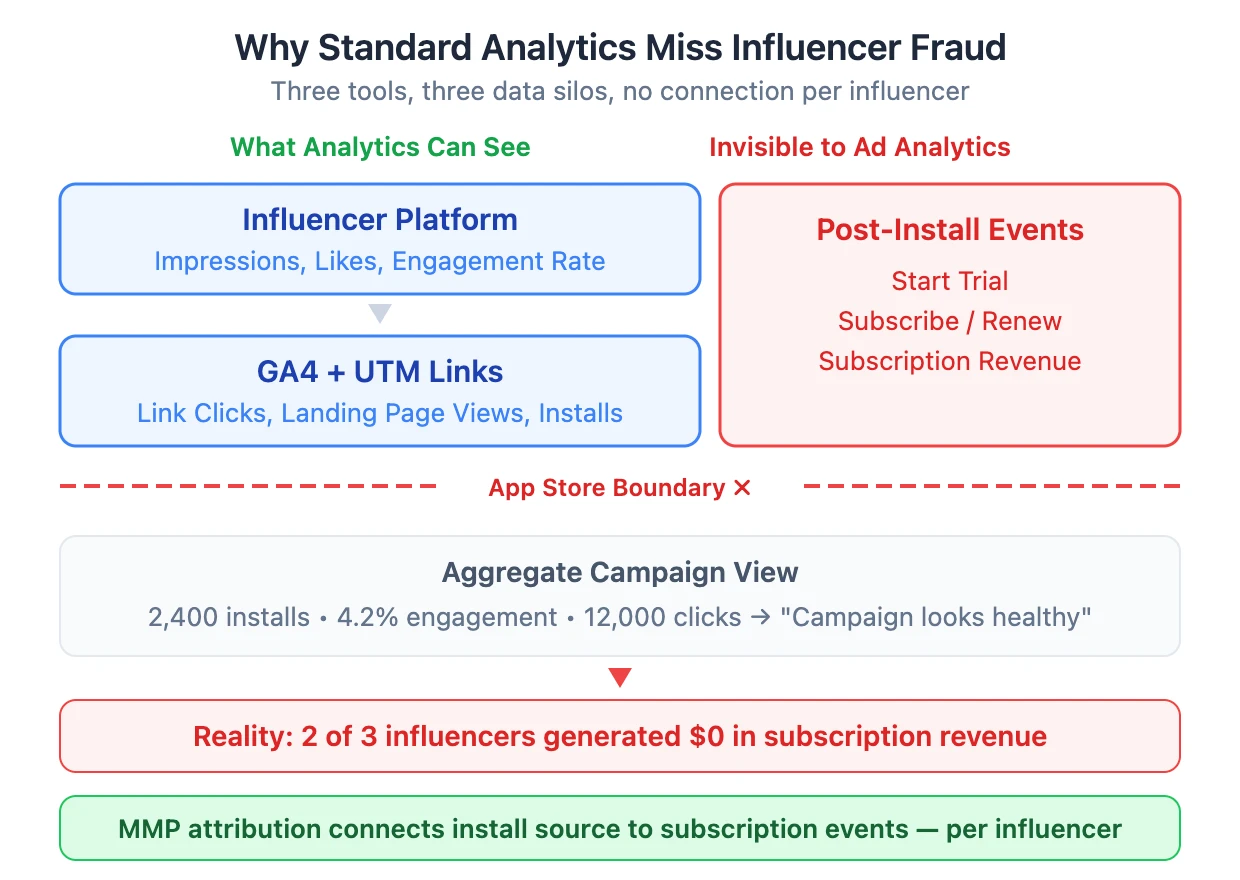
The foundation is simple: assign a unique tracking link to each influencer. Not one link for the campaign - one link per partner. This lets you measure every step of the funnel individually:
-
Influencer A: 800 installs, 120 trials, 34 subscriptions
-
Influencer B: 1,100 installs, 4 trials, 0 subscriptions
-
Influencer C: 500 installs, 95 trials, 28 subscriptions
Influencer B's pattern - high installs, near-zero trials - is a strong fraud signal. No engagement metric or follower audit would surface this. Only post-install conversion data does.
The revenue test is binary: if hundreds of installs produce $0 in subscription revenue, the traffic is either fraudulent or so low-quality that it has the same effect on your budget.
How Airbridge Core Plan Makes This Practical for Small Teams
Dedicated fraud detection tools often cost $500-$2,000+/month and target enterprise buyers. For a small subscription app team, that price point is hard to justify.
Airbridge Core Plan provides the attribution layer that makes influencer fraud visible - not through fraud detection algorithms, but through conversion-level transparency.
Here is what the setup looks like:
-
Custom domain tracking links - create one per influencer. Each link feeds into the same attribution pipeline, so you can compare performance side by side.
-
25 standard subscription events - including Start Trial, Subscribe, and Unsubscribe. Customers log these events in their app code using predefined event names, reducing schema design work.
-
RevenueCat or Adapty S2S integration - S2S enables real-time signal transmission independent of app state. Renewal, cancellation, and billing events flow into Airbridge without depending on the user opening the app.
-
Funnel and Revenue reports - see Install to Start Trial to Subscribe per tracking link. When one influencer's funnel drops to zero at the trial step, you know where the problem is.
A Mobile Measurement Partner (MMP) connects these layers. Core Plan focuses on the four ad channels that cover 80-90% of typical spend - Google, Meta, Apple Search Ads, and TikTok - plus up to 2 third-party integrations like RevenueCat.
The pricing removes the barrier. 15K free attributed installs, then $0.05 per install. Pay-as-you-go, no annual contract. For most early-stage teams, the free tier covers initial influencer testing.
FAQ: Influencer Marketing Fraud Detection for App Marketers
What percentage of influencer followers are fake?
37.2% on average, rising to 48.3% for macro-tier influencers with 100K-500K followers (SociaVault). Nano and micro influencers (under 50K) tend to have lower fraud rates, which is one reason small-audience partnerships often outperform larger ones on a cost-per-subscriber basis for subscription apps.
Can I detect influencer fraud without a dedicated fraud tool?
Yes. Dedicated fraud platforms use device fingerprinting and bot-pattern algorithms - useful, but expensive ($500-$2,000+/month). For subscription apps, a simpler proxy works: compare install-to-trial and trial-to-subscription rates across influencers. If one partner's conversion rate is 10x lower than the campaign average, the signal is clear enough to act on - drop the partner or demand an explanation before the next payment. The data you need is Lifetime Value (LTV) per influencer, not a fraud score.
What is the most reliable signal that an influencer partnership is fraudulent?
The install-to-trial ratio, measured per influencer - not per campaign. Legitimate influencer traffic typically converts 5-15% of installs to trial starts. An influencer with a 0.3% trial rate against a campaign average of 12% is a statistical outlier that warrants immediate investigation.
The critical mistake is measuring in aggregate. A campaign with three influencers might show a healthy 10% overall trial rate - but that average can hide one partner at 15%, one at 14%, and one at 0.4%. Only per-influencer measurement surfaces the outlier.
Fake Clicks Cost Money - Conversion Data Saves It
Influencer marketing fraud persists because most teams stop measuring at the install. Engagement looks real. Installs look real. The divergence only appears downstream - at the trial step, at the subscription step, at the revenue line.
The fix is not more tools. It is connecting the data you already have - installs, trials, subscriptions - per influencer, in one view.

Ready to transform your mobile growth?
Learn how Airbridge helps leading brands measure and optimize every touchpoint.