How to See Which Marketing Channel Brings Paying Subscribers

You're running campaigns on Meta and Google. Installs are coming in. Some users start trials. But when you look at your ad dashboard, you see cost per install (CPI), not paying subscribers. You have no idea which marketing channel is actually making you money.
This is one of the most common data problems in subscription app marketing. CPI tells you nothing about revenue. Among subscription apps analyzed across 75,000+ apps, the cost per paying user (CPPU) runs 4 to 5 times higher than CPI. Most of what you see in your ad dashboard is the wrong number to optimize for.
Key Takeaways
-
Ad platforms report installs. Subscriptions happen server-side, days or weeks later. The gap between these two events is where most teams lose visibility.
-
CPI is a vanity metric for subscription apps. The number that matters is CPPU: how much it costs you to acquire one paying subscriber per channel.
-
Each channel has a different funnel shape. A channel with cheap installs may produce almost no paying subscribers, while a more expensive channel often converts at a significantly higher rate.
-
Connecting your billing data to your acquisition data is a one-time technical setup that unlocks permanent channel-level subscription reporting.
-
D30 return on ad spend (ROAS) and channel-level lifetime value (LTV) are the two metrics that tell you which channels to scale and which to cut.
Why Your Ad Dashboard Shows Installs but Not Paying Subscribers
Every major ad platform (Meta, Google, Apple Search Ads, TikTok) tracks the moment a user taps your ad, attributes the install to your campaign, and reports it back to you in real time.
The problem is what happens next. When a user starts a free trial, upgrades to a paid subscription, or renews, those events happen inside Apple's or Google's billing infrastructure. They happen completely outside your ad platform's view. A subscription confirmation is a server-side transaction. The ad network cannot see it unless you send that data back explicitly.
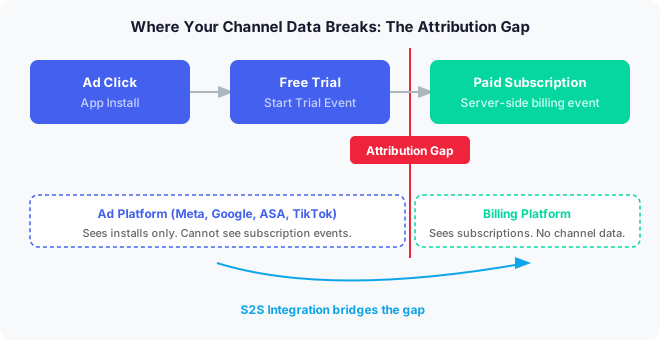
1. The billing gap between ad platforms and billing platforms
Your ad platform stops tracking the moment the install is attributed. Your subscription platform (RevenueCat, Adapty) starts tracking when billing events occur. These two systems do not talk to each other automatically.
The result: your Meta dashboard shows 1,000 installs. Your RevenueCat dashboard shows 200 new subscribers. You have no idea which of the 1,000 installs became those 200 subscribers, or which campaign drove them.
2. The source-of-truth conflict across tools
Even when you do connect data sources, Meta, Google, your subscription platform, and your analytics tool will each report different conversion numbers. This is not a bug. It is a structural feature of how mobile attribution works. Here is why each tool produces a different count:
-
Meta attributes a subscription if it occurred within its attribution window: for example, up to 7 days after a click.
-
Google applies its own, separate attribution window, often producing a different count for the same user action.
-
Billing platforms (RevenueCat, Adapty) use first-party transaction data: the most accurate and complete view of what actually happened.
-
Ad networks rely on probabilistic or deterministic matching, which can over- or under-count depending on signal quality.
This creates what practitioners call a "source of truth conflict" across ad networks, billing platforms, and app stores. Your job as a marketer is to pick one source of truth for decision-making and build your reporting around it. The common practice is to use your billing platform as the revenue source of truth and your attribution tool as the channel-attribution source of truth.
3. CPI vs CPPU: the metric that determines profitability
CPI measures install cost. CPPU measures the cost to acquire a paying subscriber.
For subscription apps, CPPU is the number that determines whether a channel is profitable. CPPU typically runs 4 to 5 times higher than CPI. At that 4–5x multiplier, a $4 CPI channel lands at roughly a $20 CPPU. The cheaper channel by installs is often the more expensive channel by paying subscribers.
If your current reporting only shows CPI, you are optimizing for the wrong metric.
Subscription Funnel Benchmarks by Marketing Channel: Install-to-Paid Conversion Rates
Every acquisition channel has a different conversion profile through the subscription funnel. The install-to-trial rate, the trial-to-paid rate, and revenue per install vary significantly depending on where users came from.
Here is what benchmark data across billions of subscription app installs shows:
| Category | Install to Trial | Trial to Paid | D60 Revenue / Install (Median) |
|---|---|---|---|
| Health & Fitness | Medium (71% no-trial) | ~39.9% | 0.63 |
| Education | Medium | ~42% | 0.40 |
| Lifestyle | 3.9% (lowest) | 41% | Varies |
| Gaming | 12.2% (highest) | 19% (lowest) | 0.13 |
Gaming is the clearest example of the "cheap install, no subscriber" trap. The install-to-trial rate is the highest of any category at 12.2%, making campaigns look efficient on an install basis. But only 19% of those trialists ever convert to paid. Users install, explore, and leave without subscribing.
Education shows the opposite pattern: moderate install-to-trial rates, but once a user starts a trial, 42% convert to paid. A user who starts a trial in an education app has already made a decision to commit.
The "cheap install, no subscriber" trap in channel terms
This dynamic plays out at the channel level too. TikTok historically delivers lower CPI than Meta or Apple Search Ads, but top-of-funnel discovery traffic carries lower purchase intent. A user who finds your app through a TikTok video may install out of curiosity. A user who searches for your app on Apple Search Ads already knows what they want.
How to Connect Billing Data to Acquisition Channels (Step-by-Step)
This is a one-time technical setup.
1. What data you need
You need three data streams connected:
-
Install attribution data: which user came from which channel, campaign, and ad (from your attribution tool)
-
Subscription event data: Start Trial, Subscribe, Renew, Cancel (from your billing platform such as RevenueCat or Adapty)
-
A connection between them: so subscription events carry the original acquisition source for each user
Without all three, you can measure each piece but not connect them.
2. Connect your billing platform via server-to-server
The most reliable way to send subscription events back to your attribution layer is through a server-to-server (S2S) connection, not just an in-app SDK.
SDK-based tracking detects subscription state changes when a user opens the app. If a user subscribes after closing the app (for example, when Apple processes a deferred payment), the SDK may not capture that event.
S2S integration sends billing events directly from your backend to your attribution tool in real time, regardless of whether the user has the app open. For subscription apps, this distinction matters: renewal events, failed payments, and resubscriptions often happen while the app is closed. Most major billing platforms have built-in S2S integrations with attribution tools.
3. Define your events consistently
Once the connection is live, you need consistent event naming across all your tools.
Set a single naming convention and apply it everywhere:
-
start_trial: when a user begins a free trial -
subscribe: when a user converts to paid -
renew: when a subscription auto-renews -
cancel: when a user cancels
Want to see how Marketing channel works with your data?
Get hands-on with Airbridge and see real results.
Try It Free →3 Metrics That Reveal Which Marketing Channel Is Driving Paid Subscribers
Once your data is connected, here is what to measure.
1. Cost per paying user (CPPU)
CPPU = total ad spend for a channel divided by the number of paying subscribers acquired from that channel.
Read more about Cost per Trial and Cost per Subscription: two companion metrics that break down where exactly your funnel cost is accumulating.
2. D30 ROAS
D30 ROAS measures how much subscription revenue a channel generated within 30 days of an install, relative to what you spent acquiring those users.
For subscription apps targeting a 12-month payback period, D30 ROAS will be well below 100%. A D30 ROAS of 1.5x or more is a strong positive signal. A D30 ROAS below 0.5x often indicates a channel or creative that is not producing users with purchase intent, and may need restructuring before scaling.
3. Channel-level LTV
The most important long-term metric is lifetime value (LTV) per paying subscriber by channel. Health and Fitness apps see a median D60 revenue per install of 63 cents across all channels. But that varies by acquisition source. Users acquired through Apple Search Ads (high intent, actively searching) consistently show higher LTV and retention rates than users from broad awareness campaigns, reflecting the intent difference between search-based and discovery-based channels.
Tracking LTV by channel tells you not just which channel delivers paying subscribers, but which one delivers paying subscribers who stay.
| Metric | What It Tells You | When to Use |
|---|---|---|
| CPPU | Cost efficiency per paying subscriber | Channel comparison, daily optimization |
| D30 ROAS | Early revenue signal | Weekly campaign review |
| Channel LTV (D60/D90) | Long-term subscriber quality | Monthly budget allocation |
Meta vs. Google vs. ASA vs. TikTok: Subscription App Performance by Channel
Each of the four major paid channels has a distinct profile for subscription app marketing.
1. Meta (Facebook and Instagram)
Meta is the highest-scale marketing channel available for most subscription app marketers. Its strength is audience targeting: you can reach users by interest, behavior, and lookalike audiences built from your existing subscribers.
Meta campaigns optimized for subscription events (not just installs) tend to find users more likely to convert. Key things to know before running Meta for subscriptions:
-
If your weekly Subscribe volume can't hit ~50 per ad set (common for early-stage apps), optimize for Start Trial instead and track downstream conversion separately.
-
Start with Advantage+ campaigns and broad targeting for the first 4 to 6 weeks. Meta's algorithm needs ~50 optimization events per week per ad set to exit the learning phase.
-
Meta's reporting is self-attributed: its conversion count will differ from your attribution tool. Pick one source of truth and stick to it.
2. Apple Search Ads (ASA)
Apple Search Ads reaches users who are actively searching for apps like yours in the App Store. This intent-based targeting typically produces higher trial-to-paid conversion rates than discovery channels. What to expect from ASA:
-
Higher purchase intent than Meta or TikTok. Users are already searching, not just browsing.
-
Smaller audience and higher CPIs than Meta or Google, but conversion rates often compensate.
-
Works well as an intent-capture layer on top of Meta's scale for iOS-first subscription apps.
-
Good for establishing LTV baselines: many teams start with ASA to set benchmarks, then use those benchmarks to guide Meta campaign targets.
3. Google App Campaigns
Google App Campaigns run across Google Search, YouTube, Google Play, and the Display Network. Unlike Meta, you cannot manually segment placements. The algorithm allocates budget automatically. What drives performance on Google:
-
Creative variety matters most: provide video, static, and copy variations to give the algorithm more to learn from.
-
Optimize for subscription events, not installs: Google's algorithm is strongest when it has clear revenue signals.
-
No manual placement control: trust the algorithm to allocate across Search, YouTube, Play, and Display based on conversion data.
4. TikTok
TikTok works best as a top-of-funnel discovery channel for subscription apps. Its CPI tends to be lower than Meta or ASA, but the users it attracts are often in exploration mode rather than purchase mode. What to know before running TikTok:
-
Creative fatigue hits fast: at typical spend levels, refreshing hooks and opening variations every 7 days maintains performance.
-
Lower purchase intent than search-based channels: expect higher install volume but lower trial-to-paid rates versus ASA.
-
Validate on Meta first before expanding to TikTok. Add a new channel only after your primary channel is producing consistent CPPU results you can explain and repeat.
-
Use TikTok for awareness, not conversion: pair it with retargeting or ASA to recapture high-intent users further down the funnel.
The Attribution Setup That Connects Ad Spend to Subscription Revenue
If you are running paid campaigns on Meta, Google, Apple Search Ads, or TikTok and want to see which channels and creatives drive paid subscribers, Airbridge Core Plan connects your subscription revenue events from RevenueCat or Adapty directly to your acquisition channels. It covers Meta, Google, Apple Search Ads, and TikTok, with channel-level funnel reports and LTV data out of the box. Core Plan supports up to 2 billing platform integrations (RevenueCat and Adapty are both included), with 15,000 free attributed installs and no annual contract.
Stop Optimizing for Installs. Start Measuring What Pays.
Most subscription app marketers know their CPI. Few know their CPPU. Even fewer can tell you which specific marketing channel produced their highest-LTV subscribers.
The gap is not a lack of effort. It is a missing data connection. Close that connection, watch CPPU and channel LTV instead of CPI, and budget decisions stop being guesses.
Want to go deeper on subscription app marketing? Explore more guides.

Ready to transform your mobile growth?
Learn how Airbridge helps leading brands measure and optimize every touchpoint.