Subscription App Funnel Not Converting? How to Find the Bottleneck Before You Fix Anything

You updated the creative. Installs improved. Trials barely moved. So you rebuilt the onboarding flow. Trials climbed slightly. Trial-to-paid stayed flat. Three months later, the subscription app funnel looks almost identical to where it started.
The issue was not any one of those three layers. The issue was that you optimized before you diagnosed. When you change creative, onboarding, and paywall simultaneously, every experiment adds noise and nothing compounds. Identifying the subscription app funnel bottleneck, and fixing only that layer, is what makes every subsequent experiment count.
Key Takeaways
-
Fixing the wrong layer costs more than fixing nothing. Each simultaneous change resets your baseline and destroys your ability to learn what moved the needle.
-
82% of trial decisions happen on the same day as install (RevenueCat State of Subscription Apps 2025). If users leave during onboarding, no paywall test will ever reach them.
-
Trial start rate below 6.2% means onboarding is the bottleneck. That is the median across 75,000+ subscription apps analyzed.
-
Trial-to-paid below 34.8% means the paywall is the bottleneck. Better creative and stronger onboarding will not fix it.
-
Prioritization is the highest-leverage skill in funnel optimization. Fewer experiments on the right layer beat more experiments spread across all three.
Why Changing Creative, Onboarding, and Paywall at the Same Time Backfires
1. How running parallel tests destroys your ability to learn
Every change in your funnel resets your baseline. When you change creative, onboarding, and the paywall in the same sprint, you cannot determine which change moved which metric. You run more experiments to untangle the noise. You fall further behind while burning through budget and engineering time.
Good funnel work is sequential. Fix the loudest leak first. Measure cleanly. Then move to the next layer.
2. Why most subscription app teams diagnose the wrong bottleneck first
Most early-stage teams treat creative as the primary suspect because it is the most visible part of the funnel. Ad spend is measurable. Creative output is tangible.
But creative is only the bottleneck when it is limiting your install volume. If you are already getting enough installs to observe downstream behavior, creative is not your problem. The question becomes whether those installs convert into trials, and whether trials convert into paying subscribers. Those are onboarding and paywall problems, and they live in activation data that most teams never look at first.
How to Measure Your Subscription App Funnel Conversion Rates
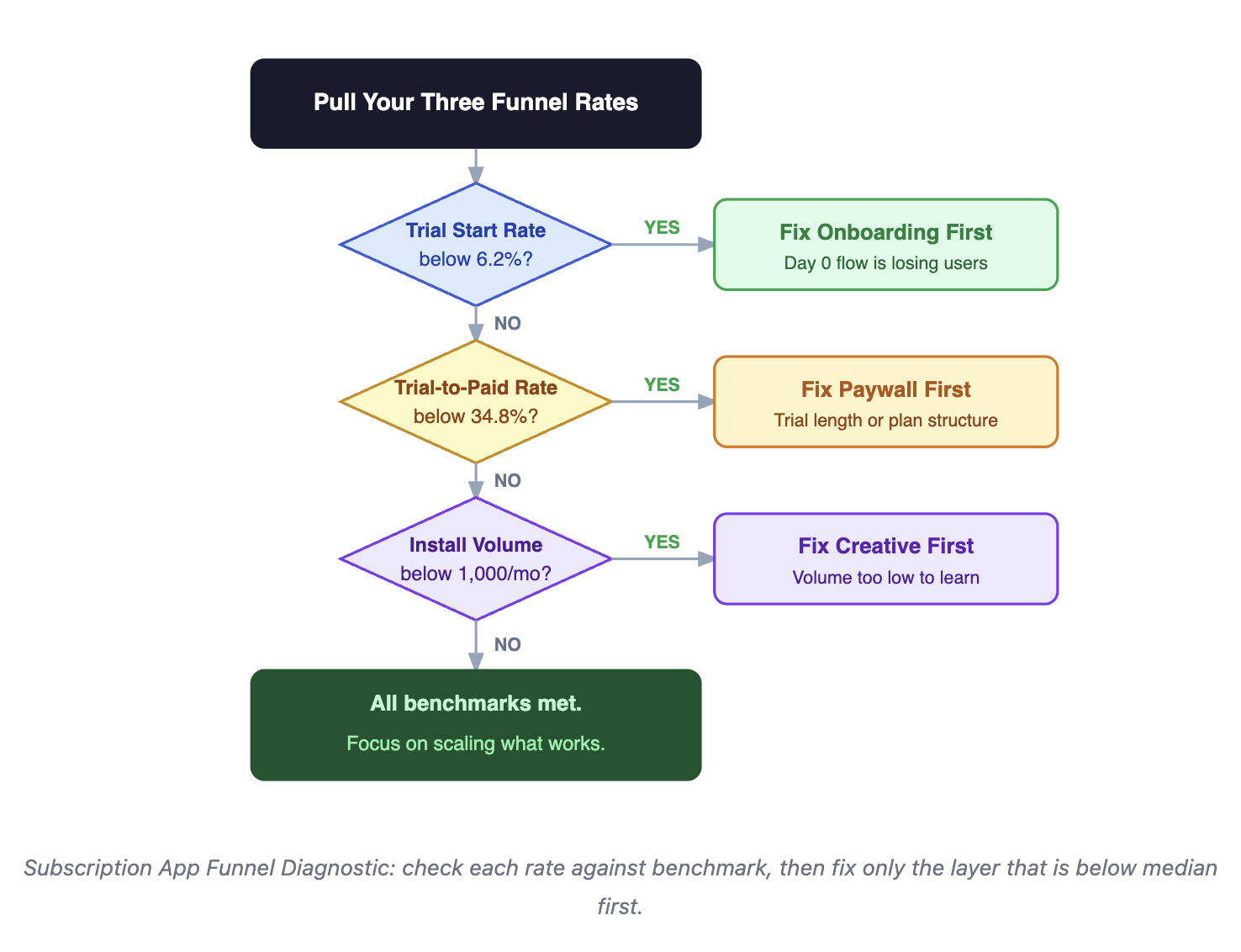
Break your funnel into three rates. Each points to a different fix. The rates that matter are install-to-trial, trial-to-paid, and the timing of trial starts.
1. The three subscription funnel conversion rates that reveal where users drop
Compare your current numbers against these benchmarks, drawn from analysis of 75,000+ subscription apps (RevenueCat SOSA 2025):
| Metric | Median | Top 10% (P90) | Upper Quartile |
|---|---|---|---|
| Trial Start Rate (install to trial) | 6.2% | 20.3% | 12.4%+ |
| Trial-to-Paid Rate | 34.8% | 68.2% | 51.5%+ |
| Download-to-Paid (Day 35) | 1.9% | 8.5% | 4.3%+ |
2. How to read your conversion gaps and decide where to focus
If your trial start rate falls below 6.2%, users are installing and leaving before they reach your paywall. This is an onboarding problem. Paywall improvements will not reach these users because they never saw it.
If trial start rate is above 6.2% but trial-to-paid sits below 34.8%, users are hitting your paywall but not converting. This is a paywall problem. Creative and onboarding changes will not fix it.
If both rates are within or above benchmark range but total revenue remains flat, the constraint is install volume. This is where creative work matters. You need more qualified installs entering the funnel to drive meaningful subscription growth.
How to Tell If Low Install Volume Is Killing Your App Funnel
Creative is the top-of-funnel input. Its job is to drive installs from users likely to start a trial and eventually pay. But it is also the layer teams optimize first by default, often before knowing whether the installs they already have are converting downstream.
The risk of fixing creative when onboarding is the real problem: A documented case study showed a client cutting cost per install by over 80% through improved targeting and creative. Installs went up. But trial conversion did not move because the onboarding flow was leaking users before they ever reached the paywall. The cheaper traffic flowed in and flowed straight back out (RevenueCat blog, 2025).
1. Three signals that identify creative as your bottleneck
Three signals point clearly to creative as the primary constraint:
-
Monthly install volume is under 1,000. A common heuristic: below this threshold you lack sufficient data to detect meaningful conversion patterns.
-
Trial start rate is at or above benchmark, even with low absolute numbers.
-
Installs from different creative sets show similar downstream behavior, regardless of which ad drove them.
If you are getting 300 installs a month but an 8% trial start rate, you do not have an onboarding problem. You have a volume problem. Fix the creative.
2. How to measure creative quality beyond cost per install
Focus tests on the hook (the first three seconds) and problem framing, not production quality. In split tests, how you frame the problem drives trial starts more than polish level. Track trial start rate per creative cohort, not just install cost, or you risk scaling the wrong campaigns.
The metric that matters from creative is downstream conversion quality, not just install cost. A campaign with a higher cost per install but a 10% trial start rate is more valuable than a cheap campaign that drives users who install and leave immediately. Track cohort LTV per creative from day one.
Want to see how Subscription app funnel works with your data?
Get hands-on with Airbridge and see real results.
Try It Free →Low Trial Start Rate? How to Fix Your App Onboarding First
1. Why onboarding is a Day 0 decision
Across all subscription apps analyzed, 82% of trial starts happen on the same session as install (RevenueCat SOSA 2025). Users flow through onboarding, reach the paywall, and make a decision. They rarely come back the next day.
This means onboarding is not a warmup act. It is the pitch. Every screen before your paywall either builds intent or drains it. If users exit before reaching the paywall, no optimization further down the funnel will recover them. Fix the funnel before building lifecycle campaigns. Lifecycle marketing has a limited ceiling when the activation rate is broken.
What top subscription apps do differently: Flo Health, the period-tracking app with over 420 million users, reaches roughly one in five US women of reproductive age. A key lever is a commitment screen placed before the paywall: a moment where users affirm their intent ("I'm ready") before seeing any pricing. Flo runs hundreds of concurrent A/B tests on onboarding alone, not to add features, but to refine how users feel in those first two minutes. The result is one of the highest conversion rates in the health app category (RevenueCat blog, 2025).
A similar pattern holds at smaller scale. QUITTR, a habit-breaking app, found that longer onboarding increased trial conversion, not reduced it. Founder Alex Slater observed that the more time users invested in onboarding, the more likely they were to convert, because they wanted a return on the time they had already spent. QUITTR reached $250K in monthly recurring revenue within four months of launch (Startup Spells).
2. Three onboarding changes that increase trial start rate
The fastest way to locate your onboarding leak is to map screen-by-screen completion rates. Where does the drop happen? That screen is the problem, not the paywall.
-
Add a commitment screen before the paywall. A single screen asking users to affirm intent ("I'm committing to [goal]") creates self-identification before the payment ask. QUITTR's onboarding reported a 99% completion rate (Startup Spells): most users who start the flow, finish it.
-
Move the paywall to the right moment. Not before users have experienced the core value promise, and not buried behind 15 steps. The paywall should appear right after users complete a goal-setting action that makes the value feel personal and earned.
-
Personalize the paywall headline using the user's stated goal. A headline that reflects what the user just told you, such as "Build your [goal] habit in 21 days", outperforms generic feature-benefit copy because it confirms the app understood their specific goal.
Low Trial-to-Paid Rate? How to Fix Your App Paywall Before Anything Else
1. The trial-to-paid rate benchmark that reveals paywall underperformance
As shown in the benchmark table above, the median trial-to-paid rate is 34.8%, with upper-quartile apps hitting 51.5% or better. If your trial start rate is at or above benchmark but trial-to-paid sits below that median, your paywall is the specific constraint.
Data across 16,000+ apps shows that teams running structured paywall experiments achieve up to 40x more revenue than teams that do not experiment (Adapty State of In-App Subscriptions 2026). And the highest-impact experiment type is not visual design: changing plan structure, trial duration, or pricing has a higher probability of LTV improvement than copy or image changes alone (Adapty 2026).
2. Three paywall experiments to run before you redesign
Before testing anything, define a single objective for the paywall: trial start rate, paid conversion rate, or average revenue per user. Without one objective, every test result will be contested.
-
Test a longer trial duration. Trials of 17 to 32 days convert at a median of 45.7%, compared to 26.8% for trials of 3 to 7 days (RevenueCat SOSA 2025). If you are running a 3-day trial, test a 7-day or 14-day version before touching the design.
-
Add a decoy plan. A mid-tier option without a trial, such as a 3-month plan, makes the annual plan appear more attractive by comparison. Adapty's 2026 data shows number-of-plans experiments win on LTV 57.1% of the time, the highest win rate of any paywall experiment type.
-
Build a second offer. Most users do not convert on their first paywall view. A second offer at a lower price point or shorter commitment captures users who were interested but not ready for the primary plan.
Start With Your Subscription App Funnel Data, Then Fix One Layer
The mistake is not running experiments. The mistake is running experiments without knowing what you are trying to fix.
Pull your three conversion rates. Compare them to benchmark. Fix the layer furthest below median first. That single prioritization step compounds more than any combination of creative refreshes, onboarding redesigns, and paywall tests run simultaneously.

Ready to transform your mobile growth?
Learn how Airbridge helps leading brands measure and optimize every touchpoint.