MMP SDK Setup Takes Longer Than Your First Campaign — Something Is Wrong

A three-person fitness app team launches Meta and Google campaigns on Monday. By Friday, installs are climbing. But the Mobile Measurement Partner (MMP) SDK is still stuck in QA. The developer is debugging event callbacks. The marketer is waiting for attribution data. And the campaigns that needed measurement the most are running completely blind.
For growth-stage subscription apps spending $5,000 to $20,000 per month on paid acquisition, every week without attribution is a week of budget allocated by guesswork. According to RevenueCat's State of Subscription Apps 2025, the median subscription app earns just $92/month in revenue after one year. At that scale, two weeks of misallocated ad spend can consume an entire month of subscription revenue.
Key Takeaways
- MMP SDK setup typically takes 2 to 3 weeks for small teams. The delay comes from event schema design, cross-platform testing, and marketer-to-developer handoff gaps.
- The bottleneck is decisions, not code. Choosing which events to track, mapping subscription states, and configuring channel postbacks require coordination between marketing and engineering.
- Health and fitness apps face an added timing penalty. Seasonal spikes like January resolutions create narrow acquisition windows where setup delays mean missed attribution for the highest-spend period.
- Campaigns running without attribution produce unreliable data. Budget decisions based on platform-reported installs rather than actual subscription conversions lead to scaling the wrong channels.
- Airbridge Core Plan reduces setup decisions with 25 subscription-optimized standard events and guided onboarding. Growth-stage teams get first attribution signals in hours rather than weeks.
Why MMP SDK Setup Time Is a Growth Blocker for Subscription Apps
MMP SDK setup time is the elapsed time from starting SDK integration to receiving reliable attribution signals in a dashboard. The problem is structural: the setup process requires coordination across marketing and engineering that small teams are not equipped to handle quickly.
1. Event Schema Design Stalls the Process Before Code Is Written
Before a developer writes a single SDK call, someone needs to decide what events to track. For subscription apps, this means defining events for installs, sign-ups, trial starts, subscriptions, renewals, cancellations, and billing failures. Each event needs parameters: revenue amount, currency, plan type, trial duration.
Enterprise MMPs support both predefined and custom events, which gives flexibility but requires schema design upfront. A growth marketer knows they need to track "trial start to subscription" conversion by channel. But translating that into an event schema with correct parameter names, data types, and validation rules requires engineering input.
This handoff between marketing intent and technical implementation is where most setup timelines stretch from days to weeks. The marketer writes a brief: "I need to see which Meta ad sets produce subscribers." The developer responds: "What event name? What parameters? Should revenue be gross or net? Should I include currency conversion?" These questions are valid, but each one stalls progress until both sides agree.
For fitness apps using billing platforms like RevenueCat or handling in-app purchases through StoreKit, the subscription state machine adds another layer. Events like "billing retry," "grace period started," and "voluntary vs. involuntary churn" all need definitions. Most teams spend 3 to 5 days on schema design alone.
2. Cross-Platform Testing Multiplies the Timeline
A subscription app supporting iOS and Android needs separate SDK integrations for each platform. After implementing events, the team must verify that:
- Events fire correctly on both platforms
- Attribution data matches between the MMP dashboard and the billing platform
- Attribution windows are configured consistently across channels
- Postbacks to Meta, Google, and Apple Search Ads return accurate data
A task that takes a dedicated engineer 2 to 3 days stretches to 1 to 2 weeks when SDK integration is not the only priority. For a three-person team where the developer also handles product work, MMP setup competes with feature releases and bug fixes.
The GA4 vs MMP comparison adds another dimension: teams that relied on GA4 for initial analytics often discover that session-based web attribution does not map cleanly to mobile subscription funnels. Migrating from GA4 to an MMP introduces a second round of event mapping, extending the timeline further.
3. The Cost of Setup Delay Is Not Theoretical
For health and fitness subscription apps, setup timing is especially critical. January resolution-driven campaigns generate the year's highest install volume. A team that starts MMP setup in early January and finishes in late January has already missed two weeks of its most expensive acquisition period with zero attribution.
The real cost is not the setup itself. It is the budget decisions made without data during the setup window.
| Scenario | Ad Spend During Setup | Attribution Data | Budget Optimization |
|---|---|---|---|
| 2-week setup delay | $5,000 to $10,000 | None | Guesswork |
| 3-week setup delay | $7,500 to $15,000 | None | Guesswork |
| Attribution from Day 1 | $0 (pre-launch) | Full visibility | Data-driven |
Growth-stage teams typically spend $5,000 to $20,000 per month on paid UA. Two to three weeks of blind spending is not a minor inconvenience. It is the difference between identifying your best channel in Week 1 and discovering it in Month 2.
Consider the economics: enterprise MMP contracts often start at $2,000 to $5,000 per month with annual commitments. For a team spending $10,000/month on ads, adding $3,000/month for an MMP means paying for attribution tooling before receiving any attribution data. The financial mismatch compounds the operational delay.
Start measuring what matters — for free
Airbridge Core Plan gives growing teams real attribution, deep linking, and audience tools at no cost.
Start Free for 30 Days →How to Reduce MMP SDK Setup Time
General Approaches Any Team Can Take Today
Reducing MMP SDK setup time does not require switching tools. These steps help any growth team move faster:
- Define events before touching the SDK. Create a shared document listing every event name, parameters, and expected values. Get marketing and engineering sign-off before implementation starts.
- Prioritize the subscription funnel first. Track install, trial start, and subscribe events on Day 1. Add secondary events like "add to cart" or "view product" in a later phase.
- Use your billing platform as the source of truth. If you already use RevenueCat or Adapty for subscription management, route subscription events through their server-to-server integrations rather than reimplementing them in the MMP SDK.
- Test one platform first. Run the full setup on iOS or Android first, verify it works, then replicate. Parallel testing introduces debugging complexity that slows both platforms.
- Block dedicated engineering time. MMP setup that competes with sprint tasks stalls at every context switch. Allocate 2 to 3 focused days to complete integration.
These steps help significantly, but the fundamental constraint remains: setup speed scales inversely with the number of configuration choices the team must resolve.
How Airbridge Core Plan Reduces Setup Decisions
Airbridge Core Plan was designed around a specific question: "Are paid users converting into subscriptions, and which channels are driving value?" That focus shapes every setup decision by removing it.
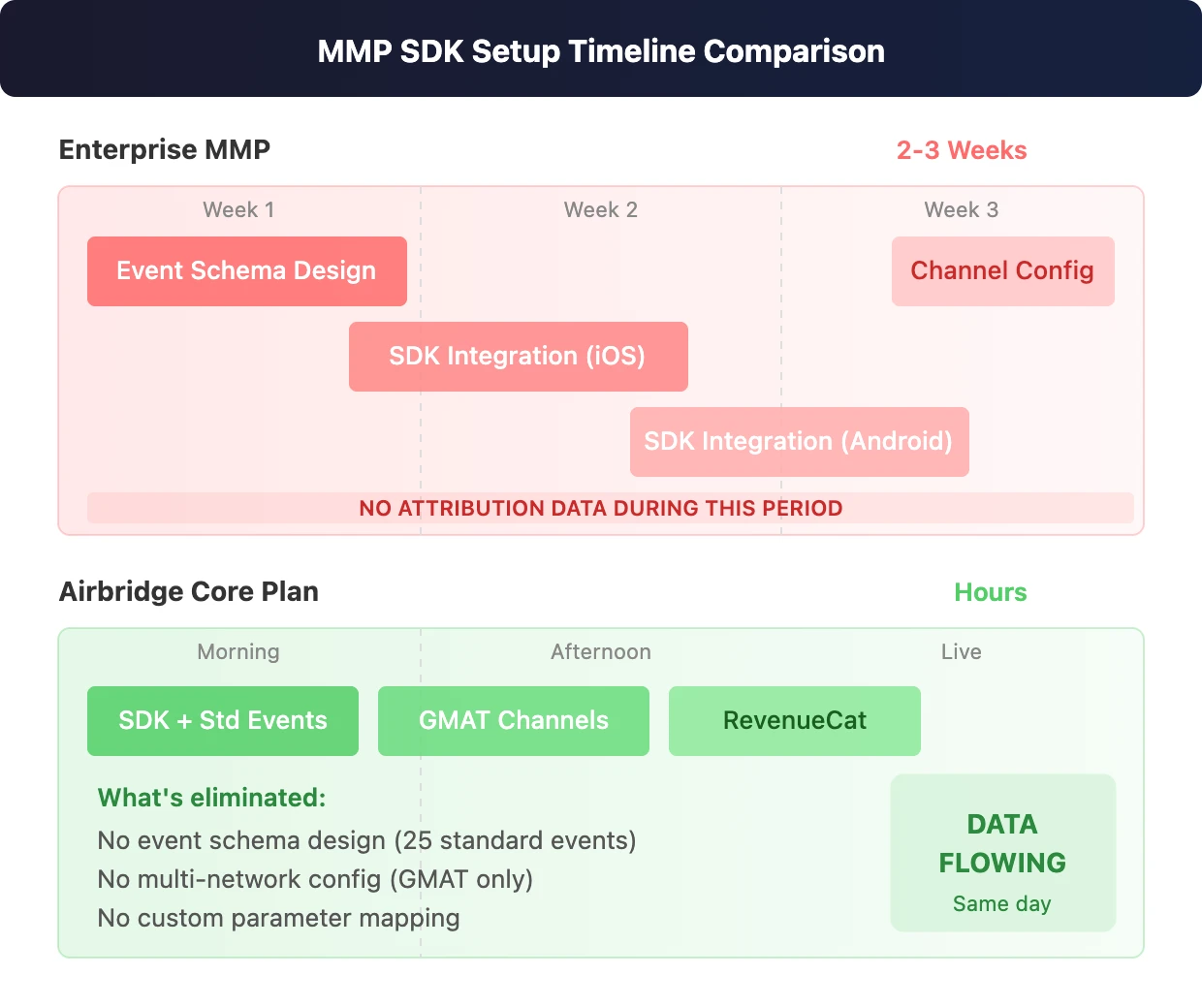
Predefined subscription events eliminate schema design. Core Plan includes 25 standard events optimized for subscription apps: Install, Sign-up, Start Trial, Subscribe, Unsubscribe, Order Complete, and more. Event names and parameters are predefined by Airbridge, which means the team skips the event naming, parameter mapping, and schema review cycle that typically consumes the first week of setup.
GMAT channel integrations cover 80 to 90% of early-stage ad spend. Core Plan supports four Self-Attributing Networks: Meta Ads, Google Ads, Apple Search Ads, and TikTok for Business. These typically account for the majority of growth-stage paid acquisition spend, eliminating the need to configure dozens of additional ad network integrations.
Built-in billing platform integrations reduce backend work. Core Plan integrates natively with RevenueCat and Adapty, the two most common subscription management platforms for early-stage apps. Subscription revenue events flow directly into attribution reports without requiring custom server-side implementation.
| Setup Dimension | Enterprise MMP | Airbridge Core Plan |
|---|---|---|
| Event configuration | Predefined + custom events | 25 subscription-optimized standard events |
| Channel integrations | All networks supported | GMAT (80 to 90% of spend) |
| Billing platform | Native (included in higher tiers) | Native (included in base) |
| Minimum contract | Annual, $10K+ | Pay-as-you-go, 15K free installs |
| Setup guidance | General-purpose | Subscription-app focused onboarding |
Core Plan intentionally limits scope to accelerate time-to-value. No custom events, maximum two third-party integrations (e.g., RevenueCat + Amplitude), and GMAT channels only. These constraints are deliberate: they match the actual needs of growth-stage subscription apps without the configuration overhead of a full enterprise platform.
The result: growth teams get subscription revenue attribution and funnel analytics running in hours, not weeks. Six built-in reports (Actuals, Trend, Active User, Funnel, Retention, Revenue) surface which channels drive subscribers from the moment data starts flowing.
Pricing removes the financial barrier during setup. Core Plan starts with 15,000 free attributed installs and $0.05 per install after that. Pay-as-you-go pricing means teams pay for actual usage, not for attribution capacity they have not set up yet. There is no annual contract, no $2,000/month minimum, and no cost during the days before attribution data starts flowing.
For growth-stage teams evaluating their first MMP, this pricing structure eliminates the scenario where you pay for an enterprise tool while spending weeks configuring it. Attribution cost scales with your actual install volume, not with a sales team's contract terms.
FAQ: MMP SDK Setup Time for Subscription Apps
How long does MMP SDK setup actually take for a small team?
The time splits roughly into event schema design (3 to 5 days), SDK integration and testing per platform (3 to 5 days each), and channel configuration and verification (2 to 3 days). When the developer also handles product work, each phase stretches further. Teams using predefined standard events rather than custom schemas can compress this to under a week.
When should a team upgrade from Core Plan to a full MMP?
Growth teams typically upgrade when they need custom event tracking beyond the subscription funnel, additional ad network integrations beyond GMAT, raw data exports to a data warehouse, or advanced capabilities like fraud detection and agency access. Until then, Core Plan's focused attribution covers the install-to-subscription funnel that matters most for growth-stage teams.
The Campaigns Running Right Now Need Attribution Right Now
Every day of MMP SDK setup is a day of ad spend without measurement. For growth-stage subscription apps, the question is not whether you need attribution. It is whether you can afford to wait weeks for it.
Start Free with Airbridge Core Plan and get subscription attribution running in hours, with 15K free attributed installs.

Ready to see what Core Plan can do?
Free attribution, deep linking, and audience tools — built for teams that are ready to grow.