What Is Freemium and How Is It Different From a Free Trial?

Every subscription app founder hits this question early: should I let users in for free forever, or put a clock on it? The wrong choice doesn't just affect sign-ups. It reshapes your entire conversion economics, your payback period, and how much each user is actually worth over time.
Freemium gives users a limited version of your app permanently. A free trial gives full (or near-full) access for a fixed window, then asks them to pay or leave. Both feel like "free," but they create very different user journeys and very different businesses.
Which model you choose will determine how fast revenue comes in, what kind of users you attract, and whether your onboarding actually converts. Here is what the data says.
Key Takeaways
-
Freemium gives permanent access to a limited product. Free trials give full access on a countdown clock.
-
Freemium converts 2–5% of users to paid. Free trials convert 8–25%+ depending on setup, with opt-out trials reaching 48.8%.
-
Free trial users generate up to 64% higher LTV than direct buyers in categories like Health and Fitness.
-
Adding a free trial to a weekly subscription can raise 12-month LTV from $7.40 to $54.50, a 636% increase.
-
82% of free trial starts happen on the day of install. Your first-session onboarding determines almost everything.
-
Freemium works best for massive-TAM consumer products like Spotify or Duolingo. Free trials work better for most subscription apps.
What Freemium Actually Means
Freemium is a permanent free tier. Users get real access to your app with no expiration date, but certain features, content, or capacity are locked behind a paid plan.
There are three common ways apps gate the premium experience:
-
Feature-gating: Core features are free; advanced features require payment (Notion, Slack)
-
Capacity limits: Basic usage is free; higher volume costs money (Dropbox storage, Spotify skips)
-
Ad-supported: The product is free, but paying removes ads or unlocks more (Duolingo, Spotify free tier)
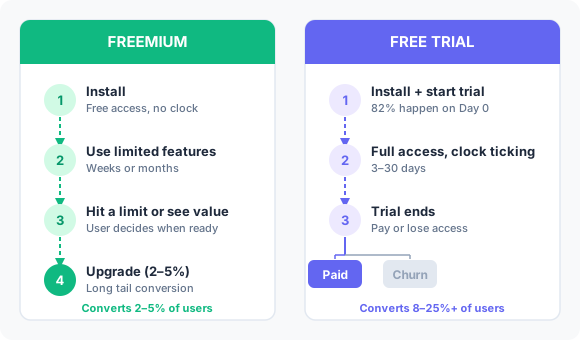
The economics of freemium are a volume play. Industry data puts freemium conversion at 2–5% for most products (RevenueCat's aggregate median sits at 2.1%), with exceptional products reaching 7–10%. That means you need a very large top of funnel to generate meaningful paid subscribers.
Freemium captures late converters better than any timed model. About 23% of freemium conversions happen six or more weeks after download. Users who would never start a timed trial may gradually hit a limit, see the value, and upgrade on their own schedule.
There is also a less obvious risk. Free users have different expectations than paying users, and optimizing for their engagement can pull your roadmap away from what actually drives revenue. If usage metrics go up but no one upgrades, you may be building the wrong thing.
How Free Trials Work
A free trial gives users access to the full (or substantially full) product for a limited time. When the window closes, they either pay or lose access.
The first decision that shapes trial performance is whether you require a credit card upfront.
-
Opt-out trials (credit card required at signup): 48.8% trial-to-paid conversion
-
Opt-in trials (no credit card required): 18.2% trial-to-paid conversion
Opt-out trials convert much higher, but the gap isn't explained by friction alone. It comes down to which fear the user brings to the paywall.
Users who are unsure the product will work for them benefit from a trial. It removes the need to believe upfront. But users worried about forgetting to cancel are more anxious with a trial than without one, and that anxiety reduces conversion. And users who simply don't want to commit will postpone the decision rather than make it, which is what drives high trial starts but low trial-to-paid conversion in some categories.
Trial length matters less than most founders assume. RevenueCat research across 115,000+ apps found that trials between 5 and 32 days show roughly equal median conversion (44–46%).
What changes with longer trials is drop-off before conversion: 30-day trials see 51% pre-conversion cancellation, compared to just 26% for 3-day trials. Shorter trials often work just as well, and they bring revenue in faster.
The right trial length is as long as it takes for a user to experience your core value, and no longer. Not what competitors do. Not what feels safe.
Timing matters more than trial length. 82% of trial starts happen on Day 0, the same day as install. Top-performing apps (P90) achieve a 20.3% trial start rate versus a 6.2% median.
That gap is almost entirely determined by first-session onboarding. If users do not start a trial during their first session, most never will.
Start measuring what matters — for free
Airbridge Core Plan gives growing teams real attribution, deep linking, and audience tools at no cost.
Start Free for 30 Days →Freemium vs Free Trial: The Key Differences
| Dimension | Freemium | Free Trial |
|---|---|---|
| Access level | Limited features or capacity | Full (or near-full) access |
| Time limit | None | Fixed window (3–30 days typical) |
| User psychology | "I can use this forever" | "I need to decide before time runs out" |
| Conversion rate | 2–5% (exceptional: 7–10%) | 8–25%+ depending on setup |
| Best for | Large-TAM consumer products | Most subscription apps |
| Revenue speed | Slow (long tail) | Fast (convert or churn quickly) |
| Examples | Spotify, Duolingo, Notion | Most fitness, productivity, health apps |
The fundamental tradeoff is breadth versus speed. Freemium casts a wide net and waits. Free trials create urgency and filter for users who are genuinely interested.
Free trials suit apps where value is visible quickly and the audience is defined. Freemium suits products that need time, scale, or virality to work.
Which One Converts Better?
When you look at the aggregate numbers, free trials win clearly. Hard paywall apps (trial-first) convert at 10.7% versus 2.1% for freemium, based on RevenueCat data across 115,000+ apps analyzed.
The LTV story is similarly compelling. Adding a free trial to a weekly subscription plan raises 12-month LTV from $7.40 to $54.50, a 636% increase. In Health and Fitness specifically, trial users show a 63.6% LTV premium over direct buyers, with a 35% trial-to-paid conversion rate.
But the category matters. In Productivity apps, direct buyers generate higher LTV ($56.95) than trial users ($49.13).
Trials underperform there because productivity tools have a longer time-to-value. Users who do not see the benefit during the trial do not convert, and those who do are willing to pay without the prompt.
The Tettra case study illustrates this nuance. Tettra, a B2B SaaS knowledge management tool, tripled its upgrade rate and sustained 70%+ monthly retention after switching from a 15-day trial to a freemium model. For a product where value accumulates over weeks of team collaboration, putting a clock on it was counterproductive.
The answer to "which converts better" depends on two things: how quickly a new user can experience real value, and whether your product's value is better felt in breadth or in time.
How to Pick the Right Model
Before choosing, answer three questions.
How fast can a new user experience core value? If a user gets meaningful value in the first 10 minutes, a free trial works. If value builds over weeks of data, habits, or collaboration, freemium may fit better.
How large is your addressable market? Freemium needs volume. A 2–5% conversion rate only works if your top of funnel is enormous. If you are targeting a specific vertical or ICP, free trials are more efficient.
Does your app rely on habit formation over weeks? Apps where users need to build a routine before seeing results (journaling, meditation, language learning) may find freemium more forgiving. Trials cut off users before the habit sticks.
Use a free trial if:
-
Your core value is visible within a single session
-
You are in a vertical with clear outcomes (fitness, language learning, health)
-
You need faster revenue signal to optimize onboarding
-
Your market is specific rather than mass-market
Use freemium if:
-
Value compounds over time (collaboration, habit, data accumulation)
-
Your addressable market is very large (consumer, horizontal SaaS)
-
You want to build product-led growth through viral sharing or team invites
-
Your product competes on distribution, not conversion speed
One option worth testing: a hybrid model. Start users with a free trial. If they do not convert when the trial ends, offer a freemium fallback instead of cutting them off entirely. You keep the user in your ecosystem while removing the time pressure. Some apps have seen meaningful late conversions from users who re-engaged weeks after a failed trial.
Start Simple, Then Test
For most subscription app founders, the right starting point is a free trial. The conversion data is stronger, the revenue signal comes faster, and the onboarding feedback loop is cleaner.
Once you launch, track two numbers: trial start rate (what percentage of installs start a trial) and trial-to-paid conversion. Top-performing apps hit 20%+ trial start rates. If you are well below that, the problem is in your first-session onboarding, not your pricing.
If you find that users consistently fail to convert within your trial window but remain engaged afterward, that is a signal to explore freemium or a longer trial. Let the data tell you which model fits your product.
Want more on subscription app growth? Read our paywall optimization guide at /blog.
Ready to see what Core Plan can do?
Free attribution, deep linking, and audience tools — built for teams that are ready to grow.