What App Marketing Actually Means for a Subscription App

Most subscription app founders treat marketing as running ads. Spend money, get installs, watch the numbers.
But ads are only one of five things that determine whether your app grows. App marketing covers the full journey, from getting discovered in the App Store to keeping subscribers from canceling. Most of the work happens after the install.
This guide breaks down all five parts, the benchmarks to measure them against, and the order to build them.
Key Takeaways
-
App marketing is much broader than ads. ASO, onboarding, paywall design, and lifecycle campaigns are all part of it.
-
Subscription apps optimize for LTV, not downloads. A user who installs and churns after one month is a loss. A user who renews annually for two years is the goal.
-
The median trial start rate across 75,000+ apps is 6.2%. The top 10% hit 20.3%, more than 3x higher. The gap is driven by onboarding and paywall design, not ad spend.
-
Annual subscribers retain at 3x the rate of monthly subscribers. The 12-month retention median is 44.1% for annual vs. 17.5% for monthly. How you design your subscription plan shapes your marketing economics.
-
Fix your funnel before you run ads. Pouring budget into a leaking funnel just makes the losses bigger.
Most Founders Treat Marketing as Just Ads — Here's What They're Missing
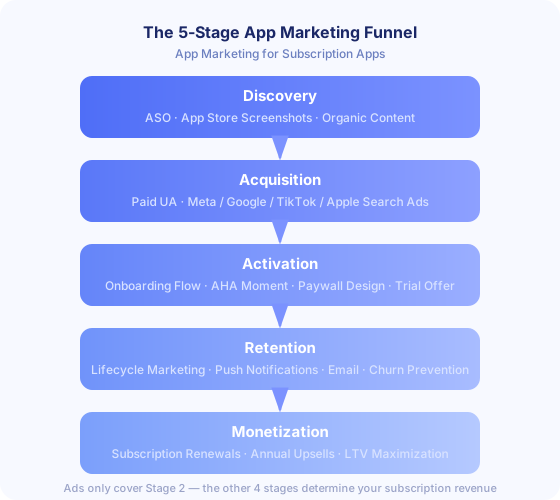
What gets missed is everything between the install and the renewal. App marketing spans five stages, and paid ads cover just one:
-
Discovery — ASO and organic content get users to find your app
-
Acquisition — Paid UA (Meta, Google, TikTok, Apple Search Ads) drives installs
-
Activation — Onboarding delivers the first moment of real value
-
Conversion — Paywall design turns trial users into paying subscribers
-
Retention — Lifecycle marketing prevents cancellation and drives renewals
Subscription apps also have a fundamentally different revenue structure than games or e-commerce apps. A one-time purchase delivers immediate revenue. A subscription delivers revenue month after month, but only if the user sticks around.
In Health & Fitness, for example, the median CPI (cost per install) on iOS is $5.78. But the actual cost to acquire one paying user (the CPPU) runs $23–$29, roughly 4–5x higher. That gap exists because only a fraction of installs ever subscribe.
Here's what that means in practice: if it costs $25 to acquire a paying user and that user cancels after one month of a $12 subscription (about $8.40 after the app store's 30% cut), you've lost $16.60 on that customer.
If that same user converts to annual and stays for two years, the math looks completely different. The goal is LTV optimization, not download count.
What App Marketing Actually Includes (Beyond Ads)
Here's what subscription app marketing covers beyond paid ads. The order below follows the user journey, not the sequence in which you should build them. That comes in the last section.
1. ASO: The free installs you're probably leaving on the table
ASO is the work of making your app rank higher when users search the App Store or Google Play. It covers your app title, keyword field, screenshots, ratings, and review responses.
It's the most cost-efficient way to drive organic installs. No ad spend required. And it needs to be in place before you launch paid UA.
Users who click your ads also see your App Store page before installing. Weak screenshots and a poor description waste paid traffic.
2. Paid UA: The amplifier (but only if the funnel is ready)
Paid user acquisition is running ad campaigns to drive installs. Subscription app UA spend has grown +24% year-over-year, with Android paid installs up +57%.
Each channel has different characteristics. Early-stage apps do better by concentrating budget on one channel first rather than spreading thin.
Apple Search Ads (ASA) targets users who are already searching the App Store for apps like yours. Because intent is already present, conversion rates tend to be higher relative to other channels. Setup is also simpler than Meta or Google, making it the right starting point for teams new to paid UA.
Build baseline data from ASA first, then expand to Meta and Google once your funnel is validated.
3. Onboarding: The part that actually drives trial starts
Onboarding is the path from a user's first app open to the moment they commit to a trial. The mistake most teams make is treating it as a single moment to optimize — a search for the one "aha moment" that makes users pay. High-converting apps engineer a sequence: get the user set up, deliver a real first result, then start building a habit. Each step has a different job.
The median trial start rate is 6.2% across all subscription apps. The top 10% hit 20.3%. For Health & Fitness specifically, the median is 7.8% and the top 10% reach 24.1%.
That gap is not driven by ad targeting. It's driven by onboarding design.
4. Paywall: A marketing asset, not just a checkout screen
Your paywall is not just a checkout screen. It's a marketing asset that needs to be optimized. The four dimensions to work on: layout design, pricing structure, when and where the paywall appears, and what offers you show.
The median trial-to-paid conversion rate is 34.8%. Apps offering longer trials (17–32 days) convert at 45.7%, 70% higher than short-trial apps (26.8%).
82% of trial users start their trial on Day 0. The first session determines whether a user starts a trial at all. Paywall timing and first-session design are not separate problems.
5. Lifecycle marketing: The last layer, not the first
Once a user is a paying subscriber, lifecycle marketing works to prevent cancellation and drive renewals. User lifecycle has four stages: Potential → Active → Drifting → Churned. Each stage needs a different message.
Annual subscribers retain at a 44.1% 12-month median, compared to 17.5% for monthly and just 3.4% for weekly.
Lifecycle marketing's revenue contribution ceiling is roughly 10%, even when done well. Investing in lifecycle campaigns before your onboarding and paywall are working is a common mistake. Sequence matters.
Start measuring what matters — for free
Airbridge Core Plan gives growing teams real attribution, deep linking, and audience tools at no cost.
Start Free for 30 Days →How to Tell Which Part of Your Funnel Is Broken
You can't know where to focus unless you're tracking the right numbers. For each metric, the question to ask when you're below the median is listed alongside.
| Metric | Median | If you're below median, check... |
|---|---|---|
| Trial Start Rate (install → trial) | 6.2% | Onboarding flow, first session experience |
| Trial → Paid conversion rate | 34.8% | Paywall layout, trial length, pricing |
| 12-month retention (annual subscribers) | 44.1% | Annual plan positioning, upsell timing |
| 12-month retention (monthly subscribers) | 17.5% | Lifecycle messaging, churn intervention |
| CPI (Health & Fitness, iOS) | $5.78 | Ad creative, audience targeting |
| CPPU (cost per paying user) | $23–$29 | Trial start rate, trial→paid conversion |
Based on analysis of 75,000+ subscription apps
Category-level patterns reveal something important. Gaming apps have the highest Install→Trial rate at 12.2%, but the lowest Trial→Paid rate at 19%.
Lifestyle apps flip that: Install→Trial is just 3.9%, but Trial→Paid hits 41%. Education reaches 42% Trial→Paid.
High trial volume isn't automatically good. It can signal poor ad targeting or a paywall that isn't converting. Quality matters more than quantity.
The Right Order to Build Your Marketing (Sequence Matters More Than You Think)
The five activities above all matter, but they don't all matter at the same time.
1. Before you spend on ads, check these two numbers
Ask yourself two questions before spending a dollar on ads: "What is the trial start rate for my organic users right now?" and "Of users who start a trial, what percentage convert to paid?"
If those numbers are below the benchmarks above, adding ad spend will just amplify the losses. Fix the funnel first.
2. Get organic installs flowing before you open your wallet
Optimize your App Store title, keyword field, and screenshots. When organic installs start flowing in, you can accumulate funnel data without burning ad budget.
This data becomes the baseline you'll need to evaluate paid channels.
3. When you're ready for paid, start with the simplest channel
Once your organic funnel shows acceptable conversion, start paid UA with ASA. Use a small budget. Measure Trial Start Rate and Trial→Paid conversion.
If those numbers hold up, increase budget and expand to Meta and Google.
4. Retention is the last thing you build, not the first
After onboarding, paywall, and paid UA are stable, layer in lifecycle marketing. Send engagement" class="glossary-link" title="Re-engagement">re-engagement push notifications to Drifting users. Offer annual upsells to monthly subscribers.
The sequence isn't optional. Lifecycle campaigns on top of a leaking funnel produce almost nothing.
Where to Go From Here
App marketing isn't about running more ads. It's about knowing which of the five stages is underperforming and fixing that first.
If installs are growing but revenue isn't, the answer is in your funnel data, not your ad creative. Check your Trial Start Rate, Trial→Paid conversion, and 12-month retention against the benchmarks above. The number furthest below median tells you exactly where to start.
Ready to see what Core Plan can do?
Free attribution, deep linking, and audience tools — built for teams that are ready to grow.