Deferred Deeplink After iOS 17: How to Fix Your Match Rate

Your deferred deeplink match rate dropped and you did not misconfigure anything. The ground shifted under you.
Apple's App Tracking Transparency (ATT) framework, the iOS 17 privacy manifest enforcement (May 2024), and the fundamental architecture of SKAdNetwork have together dismantled the IDFA-based matching that made deep linking">deferred deep linking near-perfectly accurate. Today, the majority of iOS users open your app without an IDFA available, which means the majority of every campaign's installs fall back to probabilistic methods, with real accuracy costs.
Key Takeaways
-
Deferred deep linking works by preserving ad click intent through the install journey. When IDFA was available, deterministic matching made this near-100% reliable. Post-ATT, the same flow works only for the subset of users who grant consent.
-
Three compounding changes broke the pre-ATT system: ATT consent requirements (2021), iOS 17 fingerprinting ban (enforced May 2024), and SKAdNetwork's architecture, which carries no deep link parameters at all.
-
Probabilistic matching accuracy ranges from 70-90% in controlled conditions and can fall lower on shared networks, VPNs, or when iCloud Private Relay is active.
-
Your ATT pre-prompt strategy is the single highest-leverage fix available. How and when you ask for consent directly determines what share of your users receive near-perfect routing.
-
A layered matching stack is the only way to approach pre-ATT coverage. No single method covers all users, and no single fix restores the pre-2021 baseline.
What Is Deferred Deep Linking and Why Did IDFA Make It Reliable?
Deferred deep linking is the mechanism that routes a new user to a specific in-app destination after they install an app. The "deferred" part means the routing intent survives the gap between clicking an ad and opening the app for the first time, even when the user has to visit the App Store in between.
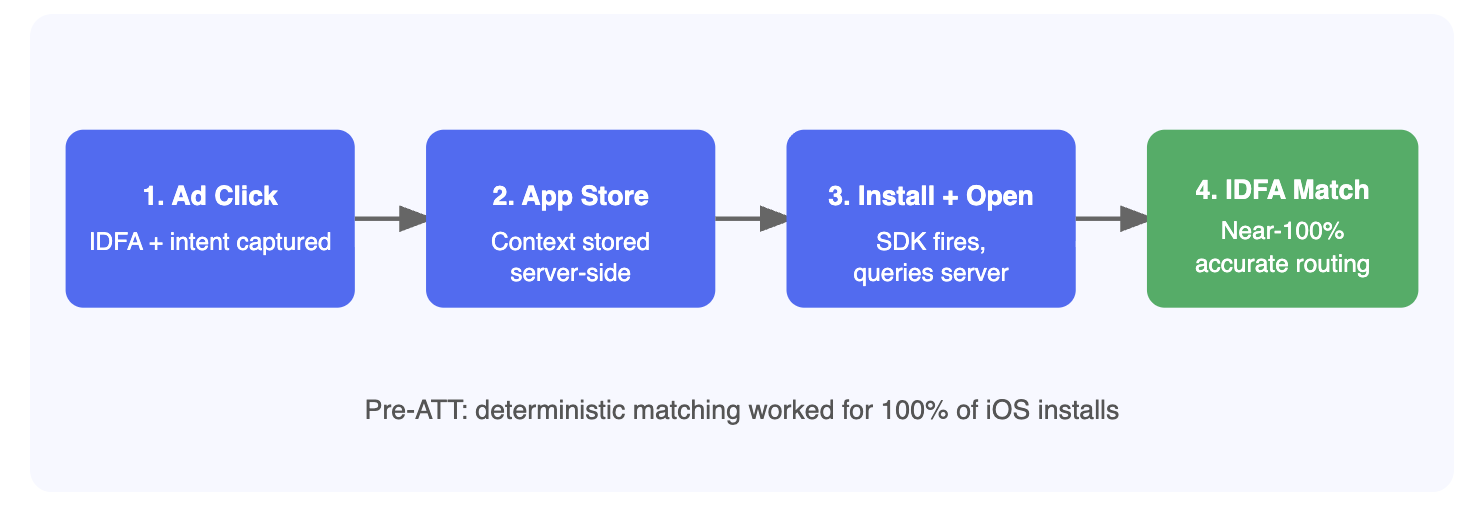
Before ATT, the flow worked in four deterministic steps:
-
User clicks an ad. The click URL captures the IDFA, Apple's device-level identifier, alongside campaign parameters (ad ID, creative, destination URL).
-
User is redirected to the App Store. The IDFA and deep link context are stored server-side by the deep linking provider.
-
User installs the app and opens it. The SDK fires a first-open event and queries the server for stored context.
-
Server matches the IDFA. The provider retrieves the stored context and routes the user to the intended destination: a specific product page, a trial offer, or a campaign-specific onboarding flow.
This was a deterministic match: same device identifier, same user, same session. Near-100% accuracy at any traffic volume.
50%+
Average conversion rate increase from deferred deep linking vs. home screen drops, according to Moburst. That lift degrades directly when match rates fall.
Why Your Deferred Deeplink Match Rate Dropped: 3 Root Causes
1. App Tracking Transparency: Why Most iOS Users Don't Share Their IDFA
In April 2021, Apple's App Tracking Transparency (ATT) framework required apps to explicitly request user consent before accessing the IDFA. When shown the native system prompt without context, the majority of iOS users decline.
The impact on your matching stack is immediate:
-
Users who grant consent: Eligible for deterministic, near-100% accurate matching
-
Users who decline: Fall back to probabilistic methods, with accuracy of 70-90% in controlled conditions and meaningfully lower on shared networks or with iCloud Private Relay active (Apple's Safari IP-masking feature, which hides device IP addresses from matching systems)
Apps in privacy-sensitive categories (finance, health, productivity) tend to see lower consent rates than gaming or entertainment apps. Users associate data tracking with higher perceived risk when an app handles sensitive information. Your fallback exposure depends directly on where your app falls in that spectrum.
2. iOS 17 Privacy Manifests: Apple Closes the Fingerprinting Loophole
After ATT limited IDFA availability, many deep linking vendors shifted to device fingerprinting: combining signals like IP address, screen resolution, OS version, and timezone to probabilistically identify a user across the click-to-install journey.
iOS 17 closed this loophole in two documented steps:
-
WWDC 2023 announcement: Apple declared that SDKs using APIs capable of fingerprinting must declare their usage in a privacy manifest. Fingerprinting for tracking is explicitly prohibited regardless of ATT consent status.
-
May 1, 2024 enforcement: Apps submitted without compliant privacy manifests began receiving rejections, confirmed by Apple's developer news and Bitrise's enforcement analysis.
The practical consequences for deferred deeplink iOS 17 implementations:
-
Vendors relying on undisclosed fingerprinting signals had to narrow their matching scope
-
Compliant probabilistic matching now operates within a short time window using only IP address and limited device type
-
Accuracy drops sharply on shared IPs (corporate networks, public WiFi) and disappears entirely for iCloud Private Relay users
3. SKAdNetwork Postbacks Carry No Deep Link Parameters
SKAdNetwork (SKAN) is frequently misunderstood as a solution to the deep linking problem. It is not. SKAN is Apple's privacy-preserving attribution framework. It tells you which campaign drove an install. Apple's developer documentation is explicit: SKAN postbacks are aggregate and parameterless by design. There is no mechanism for passing a destination URL, a product ID, or any session context through SKAN.
| SKAdNetwork | Deferred Deep Linking | |
|---|---|---|
| Purpose | Campaign attribution | Post-install user routing |
| Data passed | Campaign ID, conversion value | Destination URL, session context |
| Privacy model | Aggregate (no user-level data) | Per-session matching |
| Fixes match rate? | No | Yes, when configured correctly |
SKAN 4.0 (iOS 16.1+) added more postback tiers and time windows. The routing architecture is unchanged. Fixing your SKAN configuration has zero effect on your deferred deeplink accuracy.
Deferred Deeplink Match Rate by Method: 2025 Accuracy Breakdown
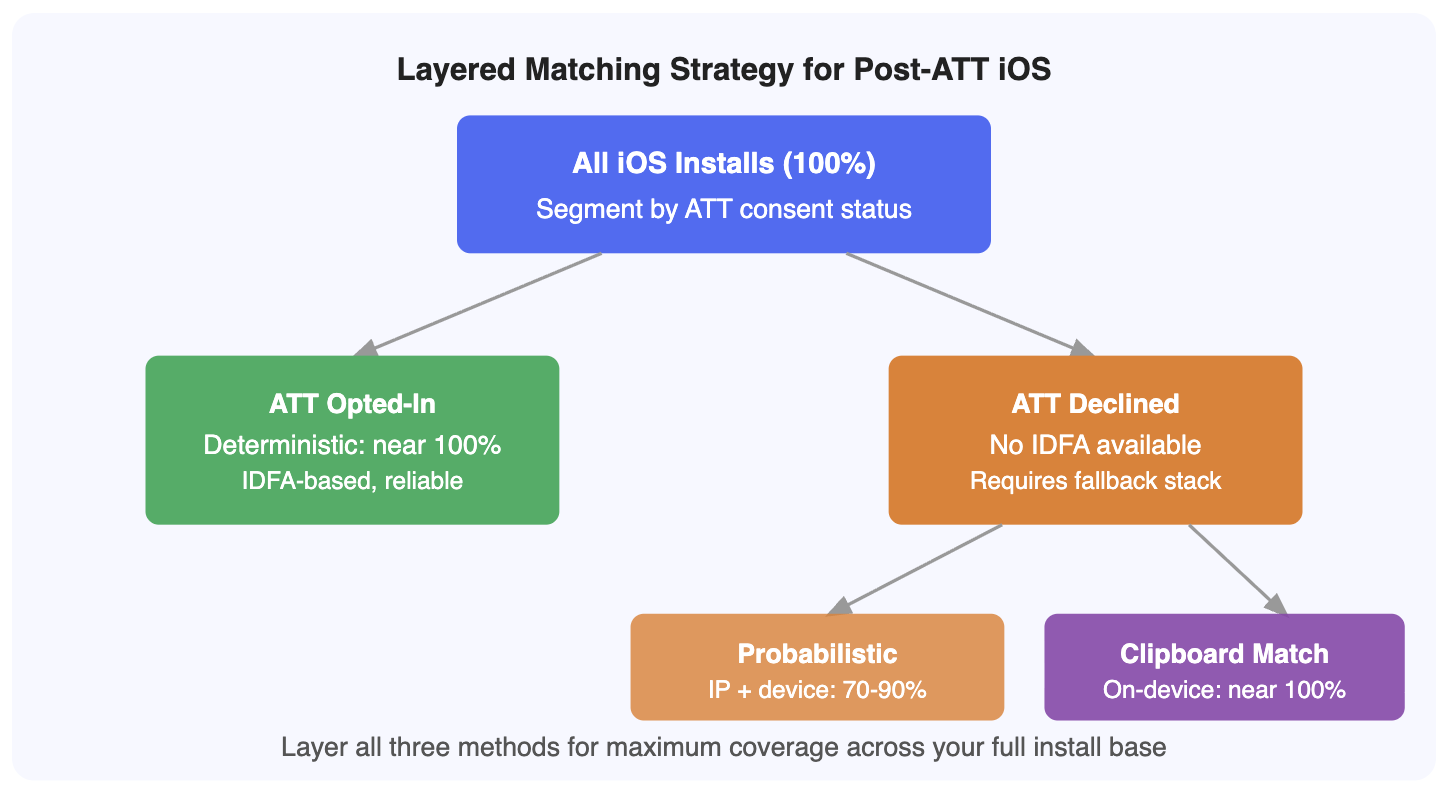
Here is what the deferred deeplink iOS 17 and later matching landscape looks like across all methods still available on iOS:
| Matching Method | Accuracy | Privacy Compliant | Key Limitation |
|---|---|---|---|
| Deterministic (IDFA) | Near 100% | Yes, with ATT consent | Only for users who opt in |
| Probabilistic (IP + device) | 70-90% controlled, lower in practice | Yes, within Apple guidelines | Falls on shared networks, VPNs, iCloud Private Relay |
| Clipboard/pasteboard | Near 100% | Yes, entirely on-device | Requires clipboard permission prompt |
| First-party link context | Near 100% | Yes | Limited to owned channels (email, QR, push) |
The core problem: No single method covers all users. An app relying only on deterministic matching misses every user who declined ATT. An app relying only on probabilistic matching accepts a 10-30% error rate with no visibility into which users were misrouted.
Want to see how Deferred deep linking works with your data?
Get hands-on with Airbridge and see real results.
Try It Free →4 Ways to Recover Deferred Deeplink Accuracy Without IDFA
1. Improve Your ATT Opt-In Rate with Pre-Permission Screens
Every additional user who grants ATT consent is one more install with near-100% routing accuracy. Growing your consenting pool is the highest-leverage fix in the stack.
When shown the native ATT prompt without context, most users decline by default. The solution is a custom pre-permission screen shown before the system dialog, giving you full control over the message, design, and timing.
According to Purchasely's research on ATT optimization, the apps improving consent rates in 2025 treat it as a product experience, not a privacy checkbox. What works:
-
Show the prompt after users complete a meaningful action, not at cold launch
-
Explain a specific, tangible benefit ("We use this to show you the promotion you came for")
-
Use a full-screen design rather than a modal overlay
-
A/B test prompt copy, timing, and design with the same rigor you apply to your paywall
The math: On a campaign delivering 10,000 iOS installs per month, every 10 percentage points of improvement in consent rate moves 1,000 more users from probabilistic fallback to deterministic matching. At a subscription app trial-to-paid median of 34.8%, that shift carries meaningful revenue impact.
2. Shorten Your Probabilistic Lookback Window
For users who decline ATT, probabilistic matching is the primary fallback. Its accuracy depends heavily on the lookback window you configure.
Why window length matters:
-
A wide window (24 hours) means many unrelated users share the same IP during the match period, creating false positives
-
A tight window (10-15 minutes) limits the pool to users who clicked and installed in rapid succession, dramatically reducing false matches
-
Most install-to-open sessions happen within 15-30 minutes of install (varies by app category)
What to do:
-
Check your deep linking provider's settings for lookback window configuration
-
Pull your install-to-open latency data from your provider's reporting dashboard
-
Set your probabilistic window to the shortest window that captures 90%+ of your historical install-to-open distribution
-
Monitor match rate and re-adjust quarterly as traffic patterns change
3. Add Clipboard-Based Matching for Non-IDFA Users
Clipboard-based (pasteboard) matching is the most accurate privacy-compliant fallback for users who decline ATT.
How it works:
-
Before sending the user to the App Store, the deep link context is copied to the device clipboard via the browser, server-side
-
After install, when the app opens for the first time, the SDK reads the clipboard and retrieves the stored context
-
The match is made entirely on-device, with no cross-app identifier exchange
Key trade-off: iOS shows a system prompt asking if the app can read the clipboard. Some users will decline.
Best use cases:
-
High-value campaign audiences (loyalty programs, referral rewards)
-
Limited-time offers where context loss is especially costly
-
Campaigns where you can explain the personalization benefit before install
4. Encode Session Context Directly in Owned-Channel Links
For campaigns you fully control, bypass device-level matching entirely by embedding the routing context directly in the link.
How it works: Append session parameters (product ID, campaign ID, destination path) to the deep link URL. When the user installs from that link, the referrer data arrives through the link itself, not through any device matching process.
Works for:
-
Email campaigns linking to a specific product or offer
-
QR codes in physical locations (packaging, print, out-of-home)
-
Push notifications to re-engage existing web visitors
-
Web-to-app flows from your own landing pages
Limitation: This does not apply to paid social or search ads. For those channels, use methods 1-3.
SKAdNetwork vs. Deferred Deep Linking: Two Different Problems
The most common misconfiguration is treating SKAN reporting and deferred deep linking as the same issue, and solving one while ignoring the other.
| SKAdNetwork (SKAN) | Deferred Deep Linking | |
|---|---|---|
| Answers | "Which campaign drove this install?" | "Where should this user land on first open?" |
| Data mechanism | Aggregate postbacks to ad networks | Per-session matching (IDFA, probabilistic, clipboard) |
| Privacy constraint | Parameterless by Apple design | Governed by ATT and fingerprinting rules |
| Configured via | Ad network + attribution settings | Deep linking SDK + provider settings |
| Fixing SKAN helps match rate? | No | N/A |
For a full comparison of deferred deeplinks vs. standard deep links and how the post-ATT environment affects each type, the distinction between routing and attribution is worth understanding fully.
The practical risk: A campaign could be perfectly attributed in SKAN while its deferred deeplinks fail for a meaningful share of users, easily 30% or more during high-traffic periods when probabilistic windows are configured too wide. Both problems require separate fixes.
How a Low Deeplink Match Rate Costs Subscription Revenue
Deferred deeplink accuracy is not a developer metric. It is a paid UA performance metric with a direct line to subscription revenue.
The failure chain, step by step:
-
User clicks an ad featuring a specific trial offer
-
Deferred deep link match fails (probabilistic misroute or no match)
-
User lands on the home screen instead of the offer page
-
User does not find the trial offer on their own
-
Trial start rate drops for that campaign cohort
-
Cost per trial rises; ROAS declines
34.8%
Median trial-to-paid conversion rate across 75,000+ subscription apps, per RevenueCat's 2025 State of Subscription Apps. Every percentage point of match rate recovery works against this baseline directly.
Research from Braze confirms that deep linking can double conversion rates on specific campaigns. For subscription apps at the 34.8% trial-to-paid median, closing even a portion of the match rate gap compresses your cost per subscriber meaningfully.
The layered stack, in order of priority:
-
Optimize your ATT pre-prompt to grow your deterministic pool (highest leverage, directly expands IDFA-eligible installs)
-
Tighten the probabilistic lookback window (quick configuration fix, improves accuracy for every non-IDFA install)
-
Add clipboard matching as a fallback (best accuracy for non-IDFA users willing to allow clipboard access)
-
Embed context in all owned-channel links (covers email, QR, push with deterministic accuracy at no matching cost)
No single method restores the pre-2021 baseline. The combination narrows the gap enough to measure directly in your trial funnel.


Ready to transform your mobile growth?
Learn how Airbridge helps leading brands measure and optimize every touchpoint.