Deferred Deeplink for Onboarding: How to Close the Install-to-First-Action Gap

You spent real money getting someone to tap your ad. The ad promised a specific thing: a workout plan, a discounted annual plan, a personalized result. They tap, they hit the App Store, they install, they open the app. And they land on a generic home screen that has nothing to do with what they were promised.
That blank, context-free first screen is where most paid installs quietly die. The user can't find the thing they came for, momentum evaporates, and within seconds they close the app. You paid for the install. You did not pay for a confused user who never reaches the screen you advertised. A deferred deeplink is the mechanism that closes this gap, and getting it right is one of the highest-leverage onboarding fixes available to an early-stage subscription app.
Key Takeaways
-
The install step erases context by default. A normal link can't survive the trip through the App Store or Google Play, so the destination and campaign intent you set up are lost the moment the user installs.
-
A deferred deeplink restores that context after install. It holds the intended in-app destination and campaign metadata, then delivers the user there on first open instead of dropping them on a home screen.
-
First impressions are decided fast. More than 82% of trial starts happen on Day 0 (RevenueCat State of Subscription Apps 2025), so the first session is where your funnel is won or lost.
-
Personalized first sessions retain better. Apps that land users on the promised content instead of a generic home screen report measurable gains in post-install conversion and retention (AppsFlyer and Branch case studies).
-
You can't optimize what you can't see. Once the link is in place, the next step is knowing which channels and creatives actually drive users who reach the promised screen and subscribe.
Why the Install-to-First-Action Gap Happens
Most founders assume that if a user installs, the hard part is over. The opposite is often true. The single riskiest moment in the funnel sits between the ad tap and the first meaningful in-app action, and two things conspire to break it.
1. The app store breaks the link
When a user already has your app, a standard deep link can open it straight to the right screen. But when they don't have the app yet, the flow has to detour through the App Store or Google Play to install first. That detour is where context dies. The store has no idea what screen the user was promised, what offer they clicked, or which campaign sent them. By the time the app opens for the first time, the original link and everything attached to it are gone.
So the user who tapped "Start your 30-day strength plan" doesn't arrive at a strength plan. They arrive at your sign-up wall or your default dashboard, and they have to go find what they came for. Every extra step they have to take to get there is another chance to drop off between the store and first action.
2. Generic home screens kill momentum
The reason this matters so much is timing.
The first session is not just one session among many. It is the session. More than 82% of trial starts happen on Day 0, and roughly 44.5% of purchases land on Day 0 as well. If the first thing a user sees doesn't match the promise that got them to install, you have spent your most valuable attention window on a mismatch.
This also shows up later as churn. The most common Google Play cancellation reason is "not enough usage," accounting for 37.2% of stated reasons (RevenueCat State of Subscription Apps 2026). Users who never connect their original intent to a concrete in-app action rarely build the habit that justifies a renewal, which drags down the lifetime value of every install you paid for. A generic home screen is the first domino in that chain.
What a Deferred Deeplink Actually Does
A deferred link solves one specific problem: it carries the destination and context across the install step so the first open lands the user exactly where they expected to be.
1. Standard deep link vs deferred link
A standard deep link assumes the app is already installed. Tap it, and the app opens to the target screen. Useful for re-engaging existing users, useless for new installs because there is no app to open yet.
A deferred link is built for the new-install case. It "defers" the routing until after the app is installed and opened for the first time, then sends the user to the intended screen. The practical difference for a marketer running acquisition ads is simple: the standard link works for people who already have you, and the deferred version works for the people you are paying to acquire.
2. The flow: click, store, install, restore
Under the hood, the deferred flow works in four steps:
-
Encode the intent. When you create the link, you attach the target in-app destination plus metadata such as the campaign, the offer, or a referral ID.
-
Capture on click. When a user without the app taps the link, the deep linking platform records those parameters before handing the user off to the store.
-
Install and open. The user downloads and opens the app for the first time, as normal.
-
Restore and route. On that first open, the platform matches the user back to the captured parameters and routes them to the promised screen with the original context intact.
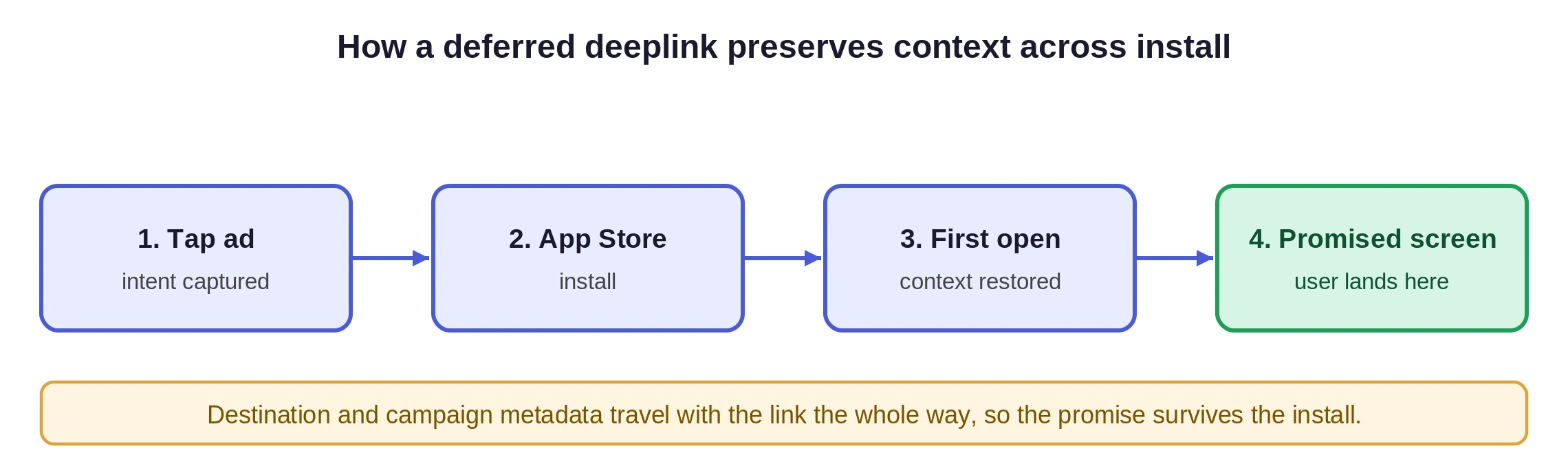
The payoff is that the shopper who tapped a "40% off annual plan" ad opens straight onto that discounted plan, not a generic welcome screen. The promise and the experience finally match.
Want to see how Deferred Deeplink works with your data?
Get hands-on with Airbridge and see real results.
Try It Free →How to Use Deferred Deeplinks to Optimize Your Onboarding Funnel
Installing the technology is not the same as using it well. Here is a practical sequence for turning deferred deeplink onboarding into measurable funnel gains.
1. Map every ad promise to a specific destination
Start with your ads, not your app. List every campaign and creative you are running, and write down the exact promise each one makes. A weight-loss creative promises a meal plan. A discount creative promises a price. A feature creative promises a tool. Each of those promises should map to a specific in-app destination, not your default home screen.
The rule is direct: if an ad makes a promise, the link should land the user on the screen that delivers it. If you can't name the destination screen for a given ad, that ad has nowhere to send people, and the gap is built in from the start.
2. Carry campaign context into the first session
Beyond the destination screen, decide what context to pass through the link. The channel the user came from, the offer they clicked, and any referral information can all travel with a deferred link. That context lets you shape the first session instead of treating every new user as a blank slate.
For example, a user from an "annual plan, 40% off" creative can open directly onto a paywall that already shows the discounted annual plan, rather than the standard pricing screen where they have to hunt for the offer they were promised. The fewer decisions you force in the first 60 seconds, the more users reach a meaningful action.
3. Personalize onboarding with the intent you carried over
Onboarding converts best when it feels like it was built for the specific person in front of it. The carried-over context gives you the raw material to do that without asking the user a single question.
Some practical moves:
-
Pre-fill the goal. If the ad was about muscle gain, set the onboarding goal to muscle gain and reuse that exact phrase on later screens and the paywall.
-
Match the social proof. Show testimonials from users with the same goal the ad targeted, so the proof feels relevant rather than generic.
-
Skip the redundant questions. If the channel already told you what the user wants, don't make them re-enter it. Every redundant step is a drop-off point.
This connects to a broader onboarding principle: small interactive steps and continuous personalization before the paywall increase emotional investment and reduce drop-off. Restored context is what lets that personalization start at second zero instead of after a five-screen questionnaire.
4. Shorten the path to the 'aha moment'
The destination screen should be the shortest possible distance to the action that makes the app valuable. If the promised screen still sits behind a forced account creation wall, a permissions prompt, and three tutorial slides, you have reintroduced the friction you were trying to remove.
Audit the path from first open to first real action. Move account creation to the moment intent is highest rather than the very first screen, offer SSO instead of email-only signup, and make any permission prompt explain a concrete benefit before the system dialog appears. The link gets the user to the right room. Your job is to make sure the room isn't locked.
Measure What the Link Actually Changed
Here is the part most teams skip. You can land users on the perfect screen, but if you can't see which campaigns and creatives produce users who actually reach that screen and subscribe, you are still optimizing in the dark.
This is where the funnel work and the measurement work meet. To know whether your routing strategy is paying off, you need to connect the channel and creative a user came from to what they did after install: did they reach the promised screen, start a trial, and convert to paid? Averages across all installs won't tell you. You need the funnel broken down by where users came from.
Concretely, that means tracking the install-to-first-action and install-to-subscription funnel by channel and creative, so you can pour budget into the ads that send users who convert and cut the ones that send users who bounce. That is also how you measure true lifetime value per channel rather than judging campaigns on installs alone. If you're running paid acquisition and want to see which channels and creatives actually drive subscriptions, not just installs, start free with Airbridge Core Plan, which includes 15,000 attributed installs. It surfaces the subscription funnel by channel so you can tell which deferred deeplink campaigns make money and which just spend it.
Common Mistakes That Undo the Gains
Even with the right routing in place, a few recurring mistakes quietly cancel out the benefit:
-
Sending everyone to the same screen anyway. If every campaign points at your home screen "for simplicity," you have the technology but none of the value. Map distinct destinations per promise.
-
Forgetting the no-app-yet case in testing. Teams test deep links on devices that already have the app installed, see it work, and ship. The deferred path only matters for users without the app. Test on a clean device every time.
-
Reintroducing friction after the landing. A perfect destination screen behind a forced signup wall defeats the purpose. Keep the path to the first action short.
-
Not measuring by channel. Without channel-level visibility into who reaches the promised screen and subscribes, you can't tell which campaigns to scale.
Close the Gap Between What You Promised and What They See
Every paid install is a promise. A deferred link is how you keep it: the destination and context survive the install, and the user opens onto the exact screen that made them tap in the first place. Pair that with onboarding that uses the carried-over intent, and you stop paying for installs that go nowhere.
The apps that win the first session are the ones where the ad, the install, and the first screen all tell the same story. Start by mapping one ad to one destination, test it on a clean device, and watch what happens to your install-to-first-action rate.

Ready to transform your mobile growth?
Learn how Airbridge helps leading brands measure and optimize every touchpoint.