Influencer Marketing ROI for Fitness Apps: 400K Views, Zero App Subscribers?
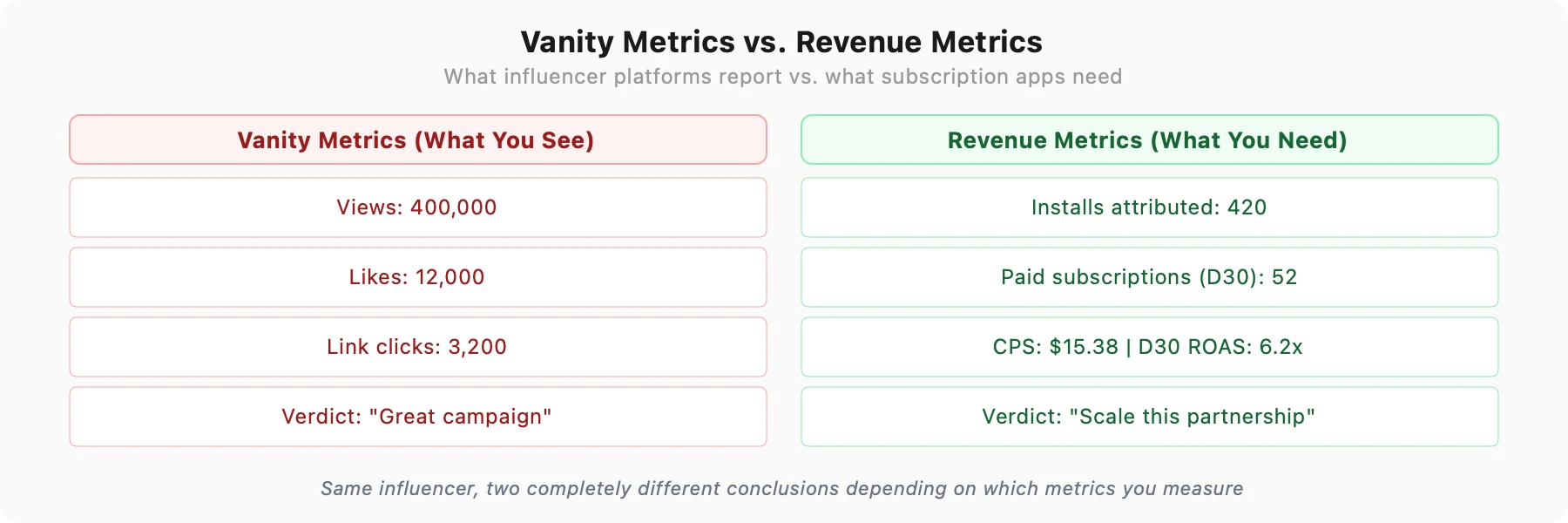
An influencer posts a 60-second TikTok featuring your fitness app. The video pulls 400,000 views, 12,000 likes, and 3,200 link clicks. Your team celebrates. Then someone asks the question nobody can answer: how many of those clicks turned into paying subscribers?
For subscription apps, the gap between influencer engagement and actual subscription revenue is where most marketing budgets go to waste. Measuring influencer marketing ROI remains the most commonly cited challenge in industry surveys. The reason is straightforward: influencer platforms report likes and clicks. Billing platforms report revenue. No system connects the two.
Key Takeaways
-
Likes, views, and clicks do not predict subscription revenue. These vanity metrics measure audience interest, not purchase intent or willingness to pay monthly.
-
The two numbers that matter are Cost per Subscription (CPS) and D30 ROAS per influencer. These separate revenue-driving creators from engagement-only performers.
-
UTM links and coupon codes break for app subscriptions. UTMs are stripped at the app store boundary, and coupon codes capture only a fraction of influencer-driven conversions.
-
Influencer ROI is bimodal, not average. Benchmarks like "$5.20 per $1 spent" hide that some influencers drive strong trial-to-paid conversion while others drive near-zero.
-
Airbridge Core Plan connects influencer tracking links to subscription events, giving teams per-influencer CPS and ROAS visibility through RevenueCat or Adapty S2S integration.
The Vanity Metric Trap: Why Likes Tell You Nothing About Influencer Marketing ROI
Growth teams running influencer campaigns for fitness and health apps face a fundamental measurement problem. The metrics that influencer platforms surface describe audience reaction. They do not describe revenue outcomes.
1. What Vanity Metrics Actually Measure, and What They Miss
Influencer platforms are designed to measure content performance, not business performance. Views tell you how many people saw the content. Likes tell you how many reacted positively. Clicks tell you how many tapped a link.
None of these answer the question subscription apps need answered: did this influencer drive users who converted to a paid subscription? The disconnect is structural. Influencer platforms have no visibility into what happens after the click. They cannot see app installs, trial starts, or subscription activations.
2. The Engagement-to-Revenue Gap in Subscription Apps
For e-commerce, the path from click to purchase is short: link, product page, buy. Attribution is straightforward. Fitness apps have a fundamentally different conversion path:
-
User sees influencer content
-
User clicks a link or searches the App Store
-
User installs the app
-
User starts a free trial
-
User converts to a paid subscription (often 7-14 days later)
Each step introduces friction and delay. By the time a user subscribes, the connection to the original influencer content has been severed. This is why e-commerce influencer marketing ROI benchmarks like $5.20-$5.78 per $1 spent do not translate to subscription apps.
3. Why Most Marketers Still Cannot Measure Influencer ROI
Across multiple industry surveys, ROI measurement consistently ranks as the single biggest challenge in influencer marketing. The tools, the budgets, and the creator partnerships are all in place. What is missing is the infrastructure to connect influencer spend to subscription revenue.
The root cause is infrastructure, not effort. Influencer platforms report engagement. App stores report installs. Billing platforms like RevenueCat and Adapty report revenue. No single system connects all three by default.
Teams that attempt to bridge this gap manually, typically with spreadsheets and coupon codes, capture only a partial picture.
What Influencer ROI Actually Looks Like for Fitness Apps
If your team evaluates influencers by follower count, engagement rate, or cost per click, you are optimizing for the wrong signal. For fitness apps, influencer marketing ROI must be measured at the revenue layer.
1. CPS and D30 ROAS: The Two Numbers That Decide Influencer Investment
Cost per Subscription (CPS) is total influencer spend divided by paid subscriptions attributed to that influencer. D30 ROAS is subscription revenue generated within 30 days of install, divided by influencer spend. Without these two numbers, teams default to engagement proxies that tell nothing about who drives paying subscribers.
Consider two influencers promoting the same subscription fitness app. This example illustrates why measuring influencer cost per subscription for a mobile app matters more than any engagement metric:
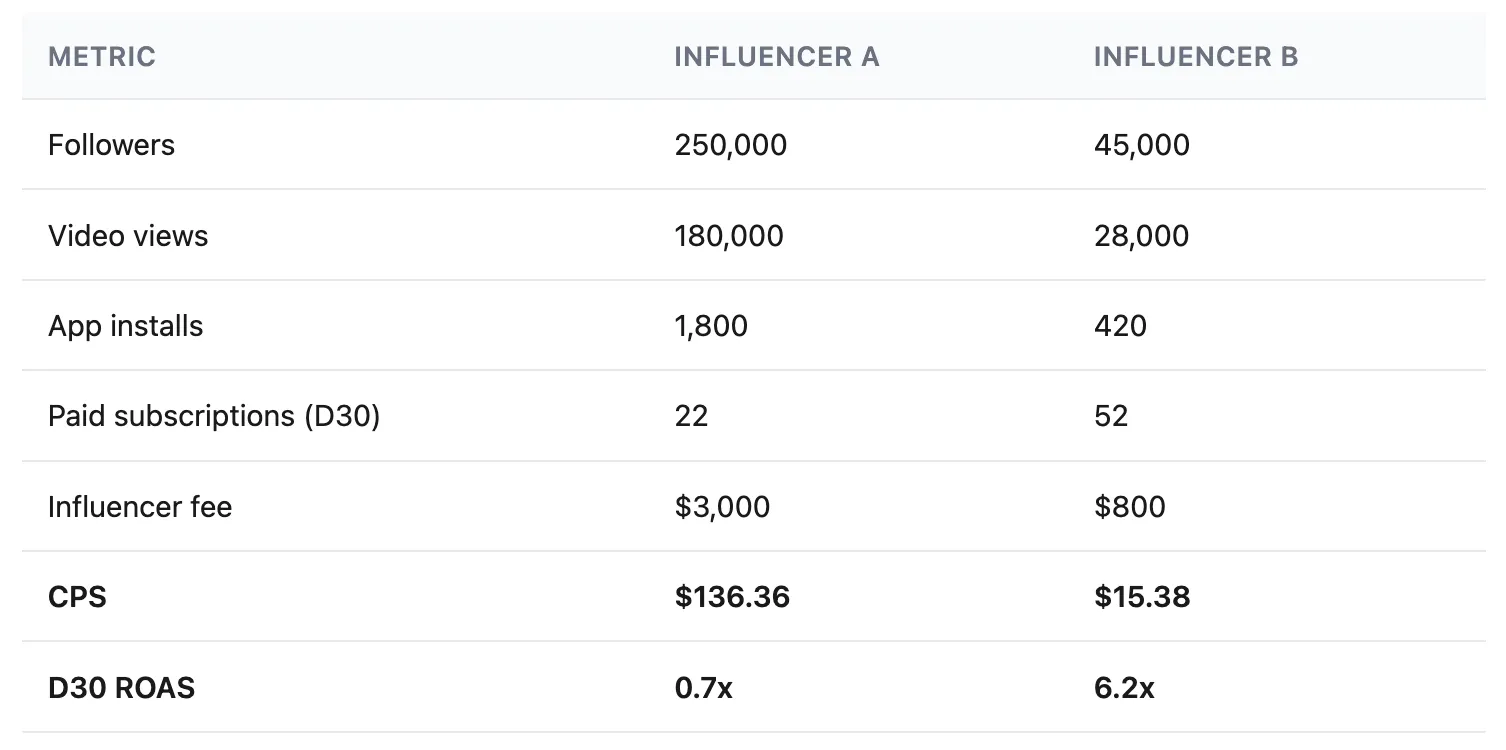
Influencer A wins on every engagement metric. But Influencer B produces more than twice as many paying subscribers at less than a quarter of the cost. If your measurement stops at the install or trial level, you would scale spend on Influencer A and cut Influencer B.
2. Why Influencer ROI Is Bimodal, Not Average
E-commerce brands with strong attribution see 6-10x returns on influencer spend. But this average obscures a bimodal distribution. For subscription apps, the pattern is even more pronounced.
A fitness influencer can drive thousands of installs from users who start a 7-day workout trial and cancel before the first billing cycle. Without per-influencer subscription data, high-churn influencers look identical to high-revenue influencers in every dashboard except the one that tracks revenue.
Want to see how Influencer marketing ROI works with your data?
Get hands-on with Airbridge and see real results.
Try It Free →Why Standard Tracking Methods Break for Fitness App Subscriptions
Standard tracking methods used in e-commerce influencer campaigns fail at the app store boundary.
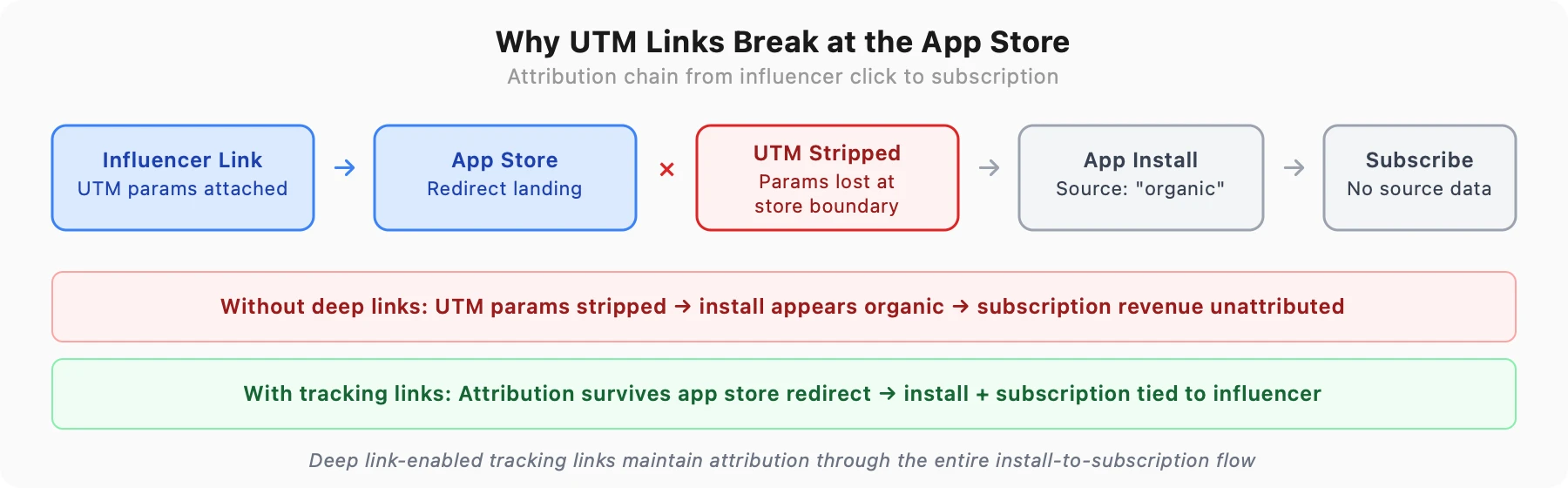
1. UTM Links Lose the User at the App Store
UTM parameters work by appending tracking data to a URL. When a user clicks a UTM-tagged link, the destination page reads those parameters and records the traffic source. For apps, this chain breaks:
-
User clicks the influencer's UTM-tagged link
-
Link redirects to the App Store or Google Play
-
The app store strips the UTM parameters
-
User installs the app
-
The app has no record of the influencer source
The install appears as organic. The influencer receives no attribution credit. If the user later subscribes, that subscription revenue is invisible to the measurement system.
2. Coupon Codes Capture Only a Fraction of Conversions
Coupon codes are the most common workaround for influencer attribution. The influencer shares a code ("Use code SARAH20 for 20% off"), and the team counts redemptions per code.
The problem: not every user who converts from influencer content uses the code. Coupon codes capture only a fraction of influencer-driven conversions because many users see the content, search the App Store directly, install, and eventually subscribe without ever entering a code. These users are attributed as organic.
This undercount creates a specific problem for budget allocation. The influencer appears less effective than they actually are, and organic acquisition appears more effective. Teams reduce influencer spend based on incomplete data while "organic" numbers that are actually influencer-driven inflate the baseline.
3. The Install-to-Subscription Gap
Even when a team attributes an install to an influencer, the attribution chain often stops there. The subscription event happens days later in a billing platform like RevenueCat or Adapty that has no record of the influencer source. The two systems operate independently, and the connection between influencer source and subscription revenue is lost.
Solving this requires a mobile measurement partner that connects influencer tracking links to post-install subscription events through server-to-server (S2S) integration with the billing platform.
How to Build an Influencer ROI Measurement Stack for Your Fitness App
Measuring influencer ROI for fitness and health apps requires three components working together.
1. Tracking Links with Deep Link Capability
Each influencer receives a unique tracking link that survives the app store redirect, maintaining attribution through the install flow. Unlike standard UTM links, deep link-enabled tracking links preserve the influencer source even when users land in the App Store or Google Play. This replaces the broken UTM approach with link technology designed for app install flows.
2. S2S Integration with Billing Platforms
Server-to-server integration with RevenueCat or Adapty captures subscription lifecycle events (Start Trial, Subscribe, Unsubscribe) regardless of app state. S2S enables real-time, independent signal transmission that does not rely on the user manually opening the app. This closes the install-to-subscription gap by creating a continuous data connection from influencer click to subscription revenue.
3. Per-Influencer Revenue Reports
With both components in place, the attribution system generates per-influencer funnels (Install to Start Trial to Subscribe), CPS by influencer, and D30 ROAS by influencer. These transform evaluation from "who gets the most likes" to "who drives the most subscription revenue per dollar spent."
Airbridge Core Plan provides all three components. Custom domain tracking links per influencer maintain attribution through the app store redirect. S2S integration with RevenueCat or Adapty captures 25 standard subscription events, including Start Trial, Subscribe, and Unsubscribe.
Standard events use predefined event names. Customers still need to log these events in their app code, but event naming and parameter structure is predefined by Airbridge, reducing schema design work. Most MMPs support RevenueCat and Adapty. Core Plan includes these from day one at no extra tier.
The Funnel report visualizes the full Install to Start Trial to Subscribe path per influencer source. The Revenue report shows subscription revenue attributed to each influencer's tracking link.
Teams see per-influencer CPS and D30 ROAS directly, enabling data-driven decisions about which partnerships to scale or end. If you are already tracking free trial to paid conversion by paid ad channel, adding influencer sources to the same attribution system is the natural next step.
Core Plan is the attribution layer, not an influencer management tool. It does not support custom events, fraud detection, or raw data export. These limitations are intentional.
Pricing: 15,000 free attributed installs, $0.05 per install after, no annual contract.
The Influencer Budget You Cannot Attribute Is the Influencer Budget You Cannot Scale
Every growth team wants to invest more in influencers that drive revenue and less in influencers that drive only engagement. The barrier is not willingness. It is visibility.
When your measurement stops at likes, views, and installs, you make investment decisions with incomplete data. The influencer who generates 400,000 views and 22 paid subscriptions looks better than the one who generates 28,000 views and 52 paid subscriptions, until you see the subscription data.
For teams evaluating the broader impact of influencer marketing on CAC, per-influencer subscription attribution is the foundation. And if your attribution numbers don't match between influencer platforms and internal data, proper attribution infrastructure is the fix.

Ready to transform your mobile growth?
Learn how Airbridge helps leading brands measure and optimize every touchpoint.