What is Deep linking and How Does It Work? URI Scheme, Universal Link, App Link
What are deep links and why are they so important?
💡 What are Deep Links?
Deep links direct users to specific locations within apps. When a mobile user clicks a link to a website or another app, Deep links redirect them straight to particular pages within the target app. In essence, Deep Links enable users to access desired in-app pages directly, bypassing the usual navigation process.
Deep links power a wide range of app marketing activities, from CRM campaigns to ad initiatives. Marketers use them to enhance push notifications, in-app messages, texts, social sharing, referrals, affiliate programs and more. Through deep links, marketers can improve user experience and boost conversion rates.
In this post, we’ll explore the different types of deep links and how to power your deep linking strategies with Airbridge.
The Different types of Deep Links
The three most commonly used mobile deep link standards are URI scheme, Universal Link on iOS, and App Link on Android.
URI Scheme: The most basic deep link
For example, to open the Airbridge app, you can simply call the pre-assigned scheme value: ‘airbridge://’.
When using a URI scheme to open an app, you can also specify which page or section of the app should open. This is done by adding a path after the scheme, similar to how website URLs work. The basic structure is: 'scheme://path'.
For example, if you want to open the Airbridge app and go directly to a specific product in their stock list, the URI scheme might look like this:
➡️ airbridge://stocklist/8516
The URI scheme is intuitive and easy to implement, but the drawback is that multiple apps can use the same scheme. This can lead to app open errors(the wrong app might open, or no app might open at all)or security issues. Also, URI scheme links often fail to direct users to the app store when they don't have the app installed.
In brief, the URI scheme:
- 👍 Pros: Easy to implement and quick to set up.
- 👎 Cons: Multiple apps can use the same scheme causing open errors and security issues. Might fail to direct users to app store for users without the app installed.
To make up for such downsides, iOS and Android each came up with their own deep linking implementation methods. These are iOS's Universal Links and Android's App Links.
Universal Link & App Link: Deep linking on iOS and Android
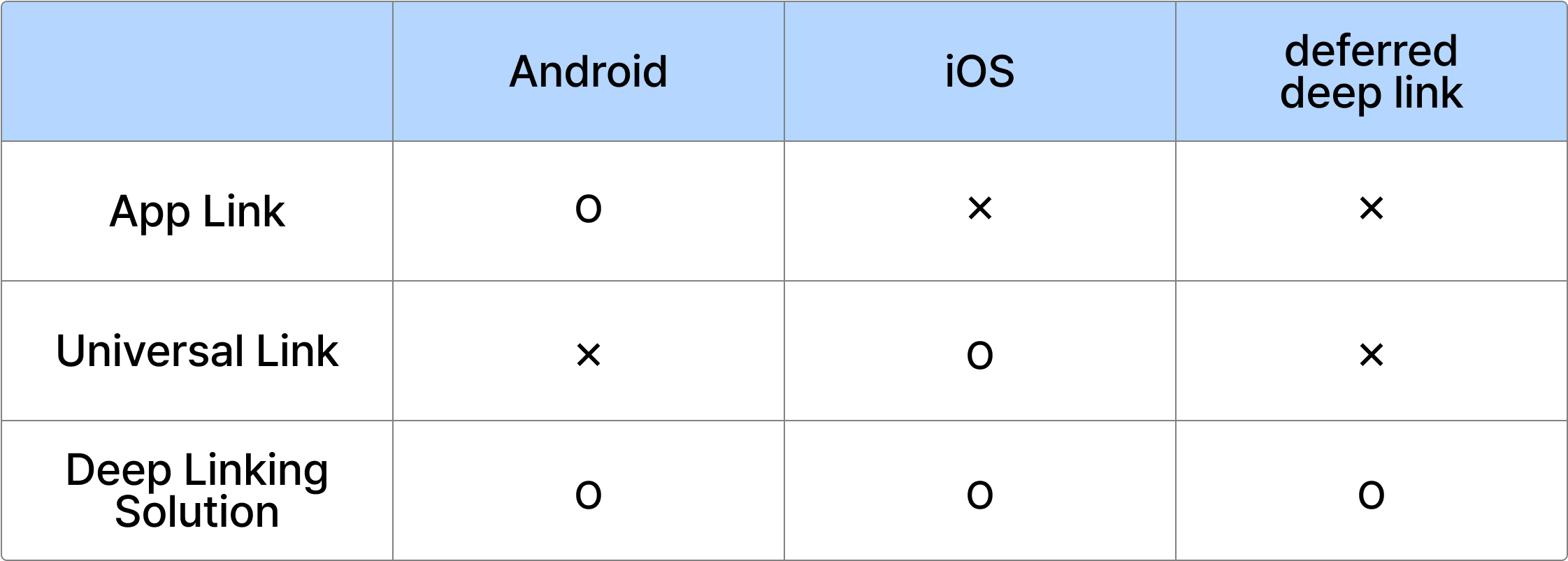
To overcome the drawbacks of URI schemes, namely scheme value duplication and security issues, iOS and Android introduced their own deep linking methods. iOS created Universal Links and Android developed App Links. These links support seamless opening on their respective operating systems and began to replace URI schemes.
However, Universal Links and App Links work properly only on their respective operating systems, not interchangeably. For example, an iOS user who receives a push notification with an Android App Link may encounter issues when trying to open the app.
Simply put, Universal Links and App Links:
- Pros 👍: Eliminate duplicate scheme issues. Open smoothly on their native OS.
- Cons👎: Don't open properly on other OS.
Universal Links and App Links can direct users without the app to the app store. However, they lack user-friendly features like deferred deep links, which allow users to access specific content directly after installation.
To solve these limitations and different implementation methods between Universal Links and App Links, many app developers now choose dedicated deep linking solutions. These deep linking solutions provide cross-platform compatibility and support deferred deep links, extending their functionality beyond operating system limitations. Google's Firebase Dynamic Links and Airbridge DeepLink Plan are examples of this.
Airbridge Deep Link Plan: Many Deep Links, One Platform
Deep links act as gateways to apps, and managing them effectively can save you and your users from a lot of headaches. The Airbridge DeepLink Plan fully supports URI schemes, Universal Links, and App Links, providing users with a seamless deep linking experience while saving time and effort for developers and marketers.
Why AirBridge DeepLinks?
-
Effortless migration
Using Firebase Dynamic Links or other deep linking solutions? Don’t worry! Migrate active deep links to Airbridge without code or dev support.
-
Easy link generation & management
Airbridge DeepLinks boast universal compatibility on both iOS and Android. -
Deferred deep linking
Direct users straight to their desired in-app destination—even if they haven't installed your app yet.
-
Custom QR & link branding
No need to use other solutions for QR codes, thumbnails or custom domains. The Airbridge DeepLink Plan includes all of the above.
-
Optimized for referral and affiliate marketing
Airbridge DeepLinks are tailored for marketing based on link sharing, like referrals and affiliate marketing.
-
Accurate, real-time data analysis
From deep link clicks to conversions, analyze your data in real time with powerful filter options based on your specific needs.
-
Competitive pricing
With the impending shutdown of Firebase Dynamic Links, demand for alternative deep linking solutions is on the rise. The Airbridge DeepLink Plan is an excellent solution with pricing based on Monthly Active Users (MAU), so you can pay as you grow.
Join Airbridge Today!
2025's competitive mobile market demands better connections for users and streamlined workflows for marketers. Enjoy seamless deep linking and analytics at the best value with Airbridge.


Ready to transform your mobile growth?
Learn how Airbridge helps leading brands measure and optimize every touchpoint.