Web-to-App Funnels Explained: What They Are, How They Work, and When to Use Them


Web-to-app is a user acquisition strategy where ad clicks land on a web page before the App Store. That web page qualifies, personalizes, or charges the user first, then redirects them to install the app. It is designed to improve conversion rates, recover ad signal lost after iOS 14, and reduce App Store commission costs.
If you run paid ads for a subscription app and keep hearing that you should "try web-to-app," this guide explains what it actually is, how it works mechanically, what the data says about its trade-offs, and how to decide whether building one is worth it for your situation.
Key Takeaways
-
Web-to-app routes ad clicks through a web page before the App Store. Users land on a quiz, landing page, or paywall, then download the app after engaging on the web.
-
iOS 14's tracking changes made it popular. Web-to-app uses cookies and UTM parameters to restore ad attribution data that Apple's SKAdNetwork cannot provide.
-
Web payments structurally favor margin. Every renewal that clears through Stripe instead of Apple IAP keeps up to ~27% more on that transaction. At volume and high price points, that compounds into a meaningful budget line.
-
Web and in-app subscribers follow opposite retention curves. Web starts stronger (84.5% Month 1 vs 48.2%) but churns faster. The curves cross around Month 6, and raw LTV ($10.8 vs $40.1) reflects that long-term divergence.
-
Fit matters more than category. The strongest web-to-app results come when the web page does selling work the App Store listing cannot: turning a quiz into a commitment before the install happens.
-
It adds real engineering complexity. Web-to-app requires a separate tech stack, a measurement setup, and policy compliance work. It is not plug-and-play.
What Web-to-App Actually Means
Traditional paid UA looks like this: a user sees your ad on Meta or TikTok, taps it, lands on your App Store product page, installs the app, then goes through in-app onboarding. The entire conversion path runs inside Apple or Google's ecosystem.
Web-to-app inserts a web step before the App Store. The user taps the ad and lands on a mobile web page you control, typically a short quiz, a personalized results page, or a direct paywall, then gets redirected to install. In some implementations, the user subscribes on the web before the install happens at all.
The term covers a wide spectrum. At the simpler end, it is a landing page between the ad click and the App Store link. At the more sophisticated end, it is a full alternative checkout where the user pays on the web and downloads the app as the delivery mechanism for a product they already purchased.
Three things web-to-app is not:
-
It is not a new app store. You still need a live app on iOS or Android.
-
It is not app-to-web, which is a separate strategy where users already inside the app get redirected to a web paywall to purchase.
-
It is not a blanket policy workaround. Web-to-app that complies with platform rules is legal. Using web payments to circumvent IAP in regions or categories where external purchases are not permitted is not.
Why Web-to-App Became a Standard Tactic
Three structural forces pushed web-to-app from a niche experiment to a mainstream strategy.
1. iOS 14 and the collapse of mobile attribution
When Apple introduced App Tracking Transparency in 2021, device-level tracking for app ads ended for users who declined consent. SKAdNetwork, Apple's privacy-safe attribution replacement, gives ad platforms aggregated, delayed, and heavily limited signals, providing far less data than marketers had before.
Web-to-app is a partial workaround. When users click an ad and land on a web page you control, standard web cookies and UTM parameters apply. This restores more granular attribution data before the user enters the App Store environment where tracking degrades. The ad creative, audience segment, and campaign that drove the click all become trackable again at the web layer (StartApp School, Lesson 26: Understanding Attribution).
2. App Store fees on every renewal
Apple charges 15–30% on subscription revenue processed through IAP. Google charges 15% after the first year. For a subscription app generating $20/month per subscriber, that is $3–6 per user per month going to the platform on every renewal, indefinitely.
Web payments change that math. Processing subscriptions via Stripe or a comparable provider costs roughly 3–4% per transaction. The difference is meaningful: up to ~27% more revenue retained per subscription when comparing web payment fees to Apple IAP (48 Laws of Subscription App Success, Law 30).
Following a 2025 contempt finding, Apple updated its App Review Guidelines to allow external payment links in US iOS apps (TechCrunch, 2026), giving web-to-app flows clearer legal standing than two years ago. Commission rules remain under active litigation, but the trend suggests web payment flows will retain their current legal standing.
3. Control over onboarding and pre-qualification
App Store product pages are rigid. You can run A/B tests on screenshots and descriptions, but you cannot show a personalized quiz, build a 20-question onboarding flow, or dynamically change messaging based on which ad the user clicked.
A web page has none of those constraints. Marketers build quiz funnels that ask about user goals and surface tailored results before the install. This pre-qualifies users and builds intent before they open the app. For apps with higher-complexity value propositions like habit formation, mental health, and personal finance coaching, the web page does selling work that a static App Store listing cannot.
Want to see how Web-to-app funnels works with your data?
Get hands-on with Airbridge and see real results.
Try It Free →How a Web-to-App Funnel Works
The mechanics of a web-to-app funnel are straightforward. Here is what a standard flow looks like:
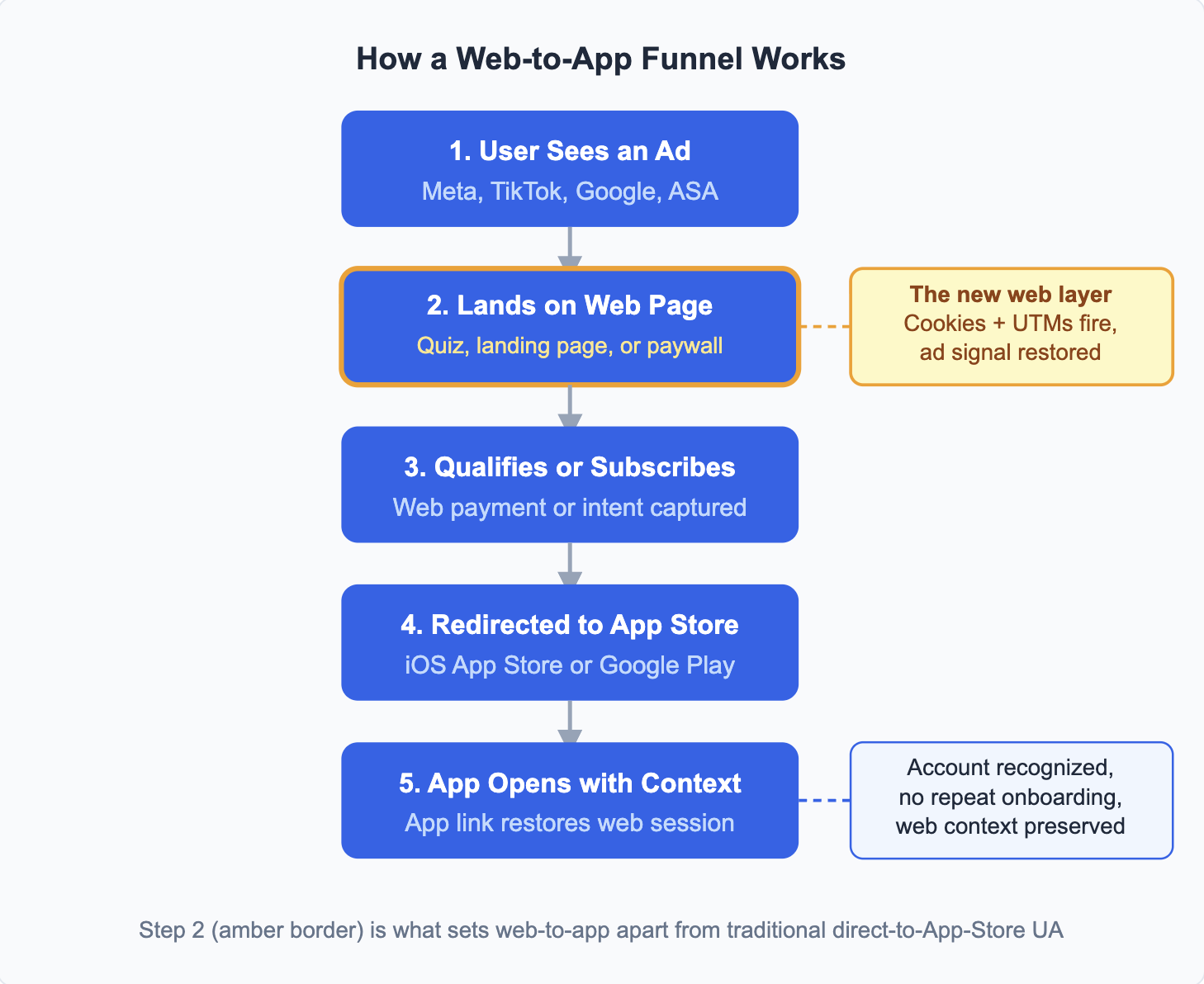
1. The ad click lands on your web page, not the App Store
The ad on Meta, TikTok, Google, or Apple Search Ads links to a URL you own, typically a mobile-optimized landing page or quiz. The moment the user lands, standard web analytics fire: cookies, UTM parameters, and browser-side tracking. This is where attribution signal is recovered.
2. The web experience qualifies or converts the user
This step varies by implementation. The simplest version is a short landing page with a single CTA pointing to the App Store. More sophisticated funnels include a multi-step quiz that personalizes the experience based on user goals, or a full web paywall where the user subscribes and enters payment details before installing.
3. The handoff from browser to app
After the web interaction, the user taps a link to the App Store or Google Play. If they already subscribed, the app recognizes them on first launch via an app link or email-based account lookup. If they only expressed intent, the in-app onboarding picks up where the web experience left off, often surfacing the same personalization from the quiz.
Throughout all three steps, web-side events, including page views, quiz completions, and purchase events, are tracked by your web analytics and passed back to your ad platforms as conversion signals. This closes the attribution loop that SKAdNetwork leaves open.
Web-to-App vs. Direct-to-App: What the Data Shows
The comparison between web-to-app and direct-to-app subscribers looks like this, based on Adapty's analysis of 16,000+ apps:
| Metric | Direct-to-App (In-App IAP) | Web-to-App (Web Paywall) |
|---|---|---|
| Conversion rate | 1.65% (download-to-paid) | 1.13% (download-to-paid) |
| Month 1 retention | 48.2% | 84.5% |
| Month 6 retention | 30% | 20% |
| LTV (raw) | $40.1 | $10.8 |
| Processing fee | 15–30% (App Store / Play) | 3–4% (Stripe or equiv.) |
| Attribution quality post-ATT | Degraded (SKAdNetwork) | Higher (cookies + UTM) |
Web raw LTV ($10.8) is lower than in-app ($40.1) due to faster long-term churn, despite stronger early retention. The ~27% fee savings on web payments are real margin, but they do not fully close the retention-driven gap. Source: Adapty State of In-App Subscriptions 2026.
Three things stand out from this data.
Conversion rates are lower on web. Users who go through the App Store convert at 1.65% on average; web paywall users at 1.13%. The extra step costs conversions for some apps. Web-to-app adds friction, and friction has a price.
Month 1 retention is genuinely better on web. Web subscribers hold at 84.5% in the first month versus 48.2% for in-app. Deliberate purchase intent is the most plausible explanation: web subscribers completed a quiz, reviewed a paywall, and chose to pay without the frictionless "start free trial" tap that in-app offers. That deliberateness produces stickier early subscribers.
The long-term LTV picture requires careful reading. Web subscribers churn faster over time, so their raw LTV is only $10.8 versus $40.1 in-app. That is partly an accounting gap: the ~27% you save by avoiding App Store fees is real margin not reflected in raw LTV. Even so, the retention divergence that begins around Month 6 is the dominant driver, and fee savings alone do not close it.
Web-to-app makes the most sense when you have a hypothesis that your web flow will produce higher-quality users, not simply when you want to reduce platform fees.
When Web-to-App Works, and When It Doesn't
The following diagram maps the key decision criteria at a glance:
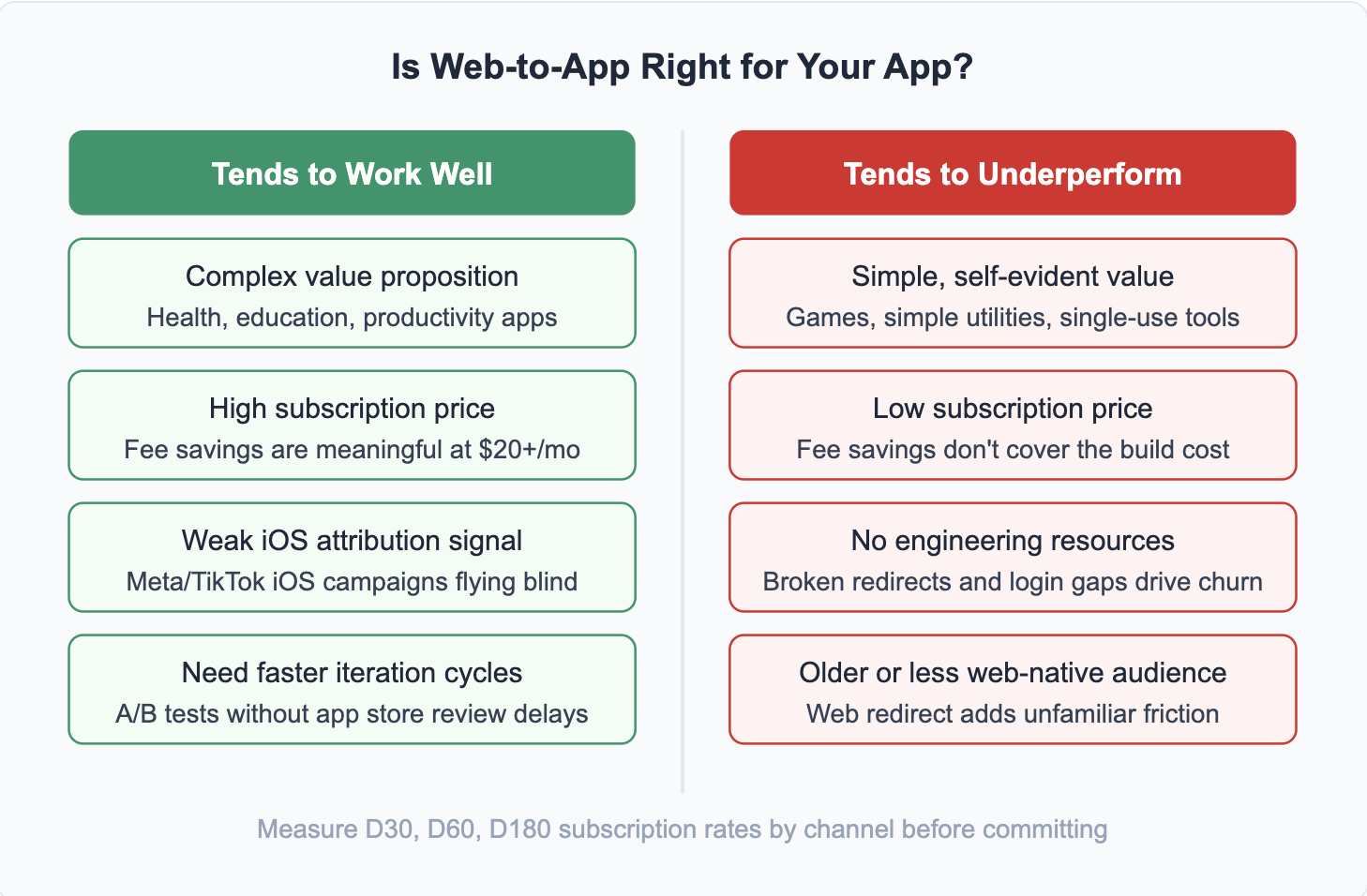
When web-to-app tends to work well:
Web-to-app earns its complexity cost when your app's value proposition requires explanation. Weight loss apps, language learning apps, and financial planning tools benefit from a quiz-driven flow that sets expectations before the install. The web page does selling work that a static App Store listing cannot.
It also makes more sense when your subscription price is high enough that fee savings matter in real dollars. At a $20/month price point, retaining ~27% more per transaction is roughly $5.40 per user per month, or $64.80 per year, in additional margin. At a $50/month subscription, the same percentage becomes a meaningful budget line.
For iOS campaigns running with degraded signal post-ATT, the attribution recovery from web click data alone can justify the investment. If your Meta or TikTok campaigns cannot tell you which creative drives subscribers, the web click layer restores enough signal to optimize.
When it tends to underperform:
If your app's value is immediately apparent from the App Store page, like a simple timer, a weather widget, or a casual game, adding a web quiz step introduces friction without adding clarity. Conversion rates will likely drop without a compensating lift in subscriber quality.
Engineering resources matter equally. A broken redirect, a mismatched account login on first open, or a web payment that does not sync with in-app entitlements will produce support tickets and early churn. Web-to-app done poorly costs more than it saves.
Start Where the Data Takes You
The most useful reframe for teams evaluating web-to-app is to stop asking "should we do this?" and start asking "which user segment is worth a web-qualified path?" The web funnel is not a replacement for your App Store channel; it is a parallel track for users whose purchase decision benefits from more information before they commit.
The data is honest about the trade-offs. The LTV gap between web and in-app subscribers is real and documented. The conversion rate hit is real. The build cost is real. What the aggregate numbers cannot tell you is whether your specific funnel, quiz design, and paywall positioning can outperform the average. That is only knowable through your own data.
The right approach is to treat web-to-app as a test, not a pivot. Route roughly 10–20% of one campaign through a simple landing page and measure subscription rates and 90-day retention against your baseline in-app cohort.
One underappreciated advantage of web funnels: price experimentation is substantially easier without App Store review cycles. Adapty's 2026 data shows price experiments improve LTV by 46% on average, and web is the fastest environment to run them. If the test shows retention holding and margin improving, scale from there.
Ready to transform your mobile growth?
Learn how Airbridge helps leading brands measure and optimize every touchpoint.