Deeplinks for E-Commerce Apps: Cart Recovery and Personalization

Cart abandonment emails are a solved problem on the web. A shopper leaves, you send a reminder, they click, and they land back on the exact cart they left. In your app, that chain breaks. The reminder fires, the user taps, and they get dumped on your home screen with no cart in sight. Most never dig back to find it.
The cost is real. Mobile shoppers abandon carts at roughly 80%, well above desktop, and across all of e-commerce abandonment hovers around 70%. The fix is not another discount. It is a routing problem, and deeplinks are how you solve it.
Key Takeaways
-
A reminder is only as good as where it lands. A push or email that drops users on the home screen instead of their cart throws away the click you paid for.
-
Deeplinks route taps to the exact in-app screen. A deeplink opens the specific cart, product, or offer, not the app's front door.
-
Deferred routing covers the users who matter most. A deferred link preserves the destination even when the app is not installed yet, sending the shopper through the store and into the right screen after install.
-
Timing beats everything. A first cart reminder sent within one to two hours can drive far more recovered revenue than one sent the next day.
-
Cart recovery is the entry point, not the ceiling. The same routing layer powers personalized product, post-purchase, and loyalty journeys.
Why Cart Recovery Breaks Inside Your App
On the web, every page has a URL. Your abandoned-cart email links to yourstore.com/cart, the browser opens it, and the cart is right there. There is no install step, no app-versus-browser decision, no routing logic to get wrong.
Apps do not work that way by default. Tapping a notification or an email link opens the app at whatever screen it feels like, usually the home feed. The shopper who was 30 seconds from checkout now has to search for the product, re-add it, and re-enter their details. Each extra tap is a chance to quit, and on a small screen with easy distractions, most do.
This is why app cart-recovery campaigns underperform their web cousins even when the copy and timing are identical. The message is fine. The landing experience is broken. Baymard Institute estimates that a large share of the roughly $260 billion in abandoned-cart value across the US and EU is recoverable through better checkout and re-engagement design. For an app, "better design" starts with sending the tap to the right place.
Deeplinks 101: Standard vs Deferred
A deeplink is a URL that opens a specific screen inside an installed app instead of the home screen. Tap one that points to a product and the app opens on that product page. It is the in-app equivalent of a web link that resolves to /cart rather than the domain root.
The difference that decides whether your campaign works comes down to two types:
-
Standard deeplink. Opens the right in-app screen, but only when the app is already installed. If it is not, the link fails: it shows an error or falls back to a mobile web page, and the routing context is lost.
-
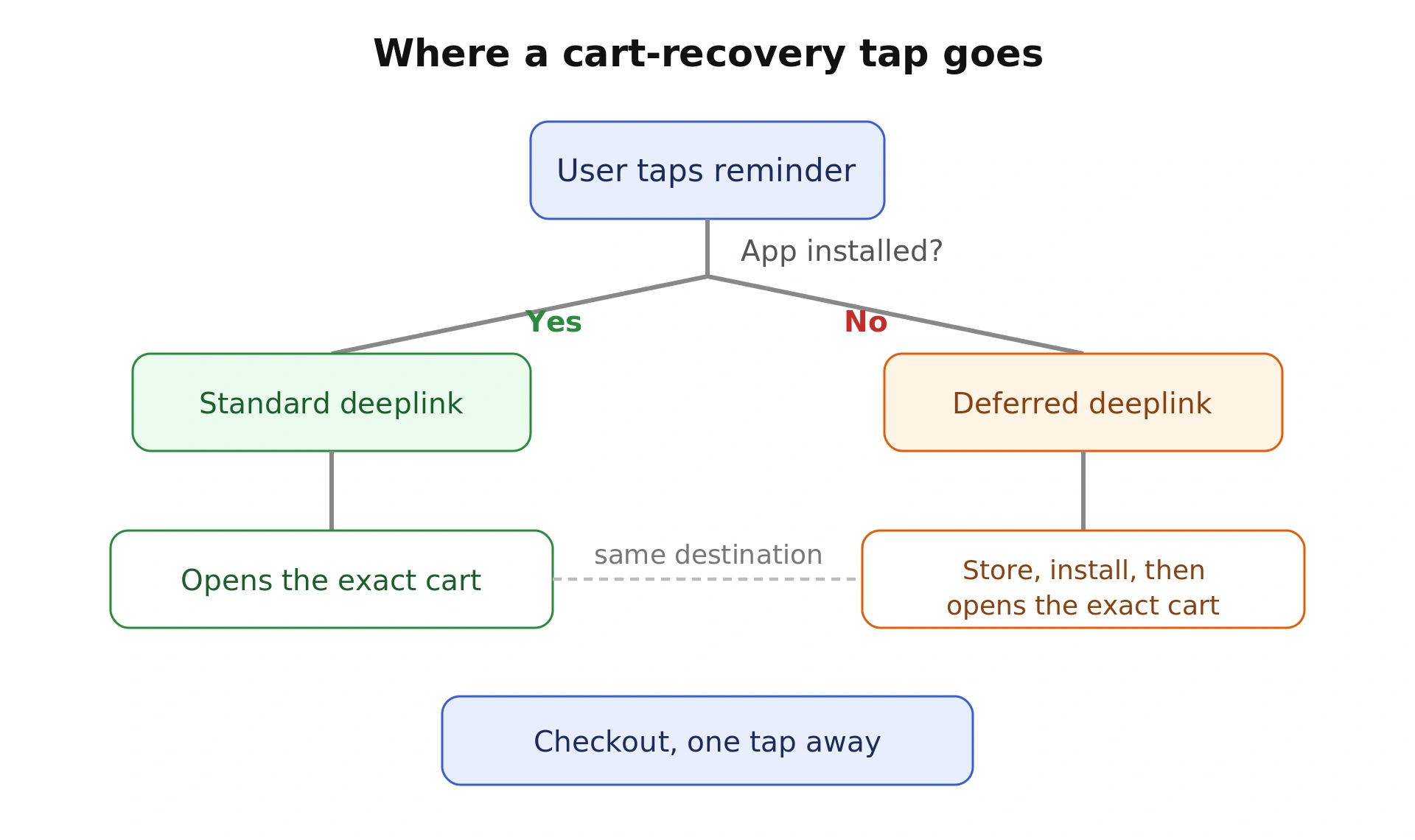
Deferred deeplink. Holds onto the destination across the install boundary. If the app is missing, it routes the user to the App Store or Google Play first, then opens the intended screen automatically once the app launches for the first time.
For cart recovery this matters more than it sounds, because a meaningful slice of your "lapsed" shoppers have deleted the app or never installed it. A standard link abandons them. A deferred one carries them all the way to their cart.
If you want the deeper technical comparison of how each type behaves across iOS and Android, this breakdown of deferred vs standard deeplinks is a good companion read.
Want to see how Deeplink works with your data?
Get hands-on with Airbridge and see real results.
Try It Free →How to Build a Deeplink Cart-Recovery Flow
You do not need a large team to ship this. If you have ever wondered how to send users back to abandoned cart via app deeplink, the answer is three moving parts: a cart event, a channel, and a link that points at the cart. Here is the sequence.
1. Capture the abandoned-cart event
Define what "abandoned" means for your app: an item added to cart with no purchase within a set window, often 30 to 60 minutes. Fire an event the moment it happens. This event is the trigger for everything downstream, so make sure it carries the cart contents and a stable identifier you can map back to the user.
2. Choose the recovery channel
Each channel has a different reach and conversion profile. Push is fast and cheap but only reaches users who opted in. Email reaches everyone but converts lower. SMS converts hard but costs more per send.
| Channel | Typical open rate | Typical cart conversion | Best for |
|---|---|---|---|
| Push | 30 to 40% | 8 to 12% | Opted-in active users, fast first touch |
| 15 to 25% | 5 to 8% | Broad reach, richer content | |
| SMS | High | 21 to 40% | High-intent, time-sensitive nudges |
Most teams stack them: a push within the hour, an email a few hours later, an SMS for the highest-value carts. Adding SMS on top of email has been shown to lift overall cart recovery toward 38%.
3. Route the tap with a deeplink
This is the step that separates a recovered sale from a lost one. Every recovery message must carry a deeplink that opens the specific cart, not the home screen. Build the link with the cart identifier from step 1 so the app knows exactly what to render. Vendor case studies report that email-to-app journeys built on proper routing can lift conversions by up to 4x versus links that dump users on a generic screen.
4. Cover the app-not-installed case
For any user who might not have the app, use a deferred deeplink instead of a standard one. The shopper who deleted your app three weeks ago still gets routed: store, install, cart. Without this, a large and valuable segment of your reminders simply dead-end.
5. Time the sequence
Speed is the highest-leverage variable. A first reminder sent within one to two hours of abandonment can dramatically outperform one sent a day later. Send the immediate push first, then space follow-ups over the next 24 to 48 hours. Sending a conversion-focused message minutes after a user exits without buying is a well-established lifecycle tactic (Law 36, Push Notification Immediately After Exit, in the 48 Laws of Subscription App Success), because intent is never higher than right after they leave.
A simple, reliable cadence looks like this: a push within the first hour, an email at four to six hours for anyone who did not return, and a final SMS the next day reserved for higher-value carts (the next-day follow-up echoes Law 37, Send a Second Offer the Next Day). Each touch carries the same deeplink to the same cart, so no matter which message a shopper acts on, the destination is identical and the path to checkout stays short.
Beyond the Cart: Personalization with Deeplinks
Once the routing layer exists, cart recovery is just the first use case. The same link that opens a cart can open any screen tied to a specific user and a specific intent. This is where deeplinks shift from a recovery tool to a retention engine.
A few high-value plays:
-
Personalized product re-engagement. Browsed but did not add to cart? Send a link straight to that product or a curated set of similar items.
-
Post-purchase journeys. Route a buyer to order tracking, a how-to-use screen, or a complementary product. First-time buyers who get personalized post-purchase follow-ups have shown materially higher repeat-purchase rates.
-
Loyalty and offers. Drop users directly into a rewards screen or a personalized discount instead of making them hunt for it.
The retention payoff is measurable. Deeplinking strategies have been associated with roughly 12 to 15% lifts in one-day, one-week, and one-month retention, and personalized deeplink onboarding has been linked to large day-30 retention gains. The mechanism is the same every time: less friction between the message and the moment of value.
Setting Up Deeplinks the Right Way
Deeplinks rely on platform-level standards, and the setup is where most implementations quietly break. On iOS you configure Universal Links, which require an apple-app-site-association file hosted over HTTPS on your domain. On Android you configure App Links, verified with a Digital Asset Links file. You need both, since they are not interchangeable.
A few practical rules that save days of debugging:
-
Always include a web fallback. If the link cannot open the app, it should still land the user on the equivalent web page with the same parameters. Never let a tap dead-end.
-
Design platform-agnostic URLs. Use query parameters both platforms can parse and safely ignore when unknown, so an iOS-shared link does not break for an Android user.
-
Budget time for propagation. iOS caches the association file aggressively. Apple's guidance puts propagation at up to 24 hours (Technical Note TN3155), and CDN refresh can add more, so plan for a day or two. Test on real devices with a fresh install, not the simulator.
If maintaining association files, fallbacks, and per-platform routing across both stores sounds like more than you want to own, this is exactly the layer a deeplinking provider handles for you, which brings us to the last piece.
Common Mistakes That Break Deeplink Cart Recovery
Even a correct setup leaks revenue when these slip through:
-
Linking to the home screen "for now." It is the single biggest conversion killer and it never gets fixed later. Route to the cart from day one.
-
Using standard links everywhere. Lapsed and uninstalled users are often your highest-intent recovery segment. Skipping deferred routing abandons them.
-
Ignoring the web fallback. A broken tap is worse than no message, because you paid for the click and taught the user your reminders do not work.
-
Sending late. A perfectly routed reminder that arrives a day after abandonment competes with a cold lead, not a warm one.
-
Not knowing which message worked. If you cannot tell whether the push, the email, or the SMS drove the recovered purchase, you cannot cut the spend that is wasted.
Turn Abandoned Carts Into Recovered Revenue
The web already taught your shoppers to expect a reminder that lands them right back where they left off. Your app can meet that expectation, but only if every tap routes to the exact cart and survives the case where the app is not installed.
That takes a deeplinking layer that handles standard and deferred routing across both stores, plus a way to see which messages actually drive purchases instead of just opens. If you are running cart-recovery and re-engagement campaigns and want both, Airbridge Core Plan connects your deeplinks to the purchases they generate. Start free with 15K attributed installs, or book a demo to see it on your own flows.

Ready to transform your mobile growth?
Learn how Airbridge helps leading brands measure and optimize every touchpoint.