MMP vs GA4 for Fitness Apps: Why GA4 Can't Track Trial-to-Paid by Channel

MMP vs GA4 for Fitness Apps: Why GA4 Can't Track Trial-to-Paid by Channel
Your fitness app's GA4 dashboard shows 3,000 monthly installs. Google Ads is the top source. But when you open RevenueCat, you see 180 paid subscribers — and GA4 cannot tell you how many came from Meta, how many from TikTok, how many from Apple Search Ads.
You know the total. You do not know the breakdown. The channel that looks best in GA4 may not be the channel that produces subscribers.
This is not a configuration problem. GA4 was not designed for mobile attribution — it lacks cross-channel deduplication and cannot maintain user-level tracking across ad networks over time. For fitness apps running trials that convert days later and renewals that happen months later, the gap is structural.
Key Takeaways
-
GA4 shows installs from Google Ads. It does not reliably attribute installs from Meta, TikTok, or Apple Search Ads. Non-Google channels appear as "Direct" or "Unknown."
-
GA4 cannot connect trial starts to paid conversions by channel. A 7-day trial converts after the session ends. GA4 loses the thread.
-
Health & Fitness trial-to-paid median is 37.7%. Without channel-level data, you cannot see whether a channel is at 20% or 50% (RevenueCat, State of Subscription Apps 2025).
-
57% of Health & Fitness subscriptions are annual. Not knowing which channel drives annual subscribers means misallocating budget away from your highest-LTV users (RevenueCat, State of Subscription Apps 2025).
-
An MMP with billing integration connects what GA4 cannot — ad channels to subscription outcomes via S2S.
What GA4 Shows — And What It Doesn't
For a fitness app running paid UA across multiple channels, GA4 provides one slice of the picture and hides the rest.
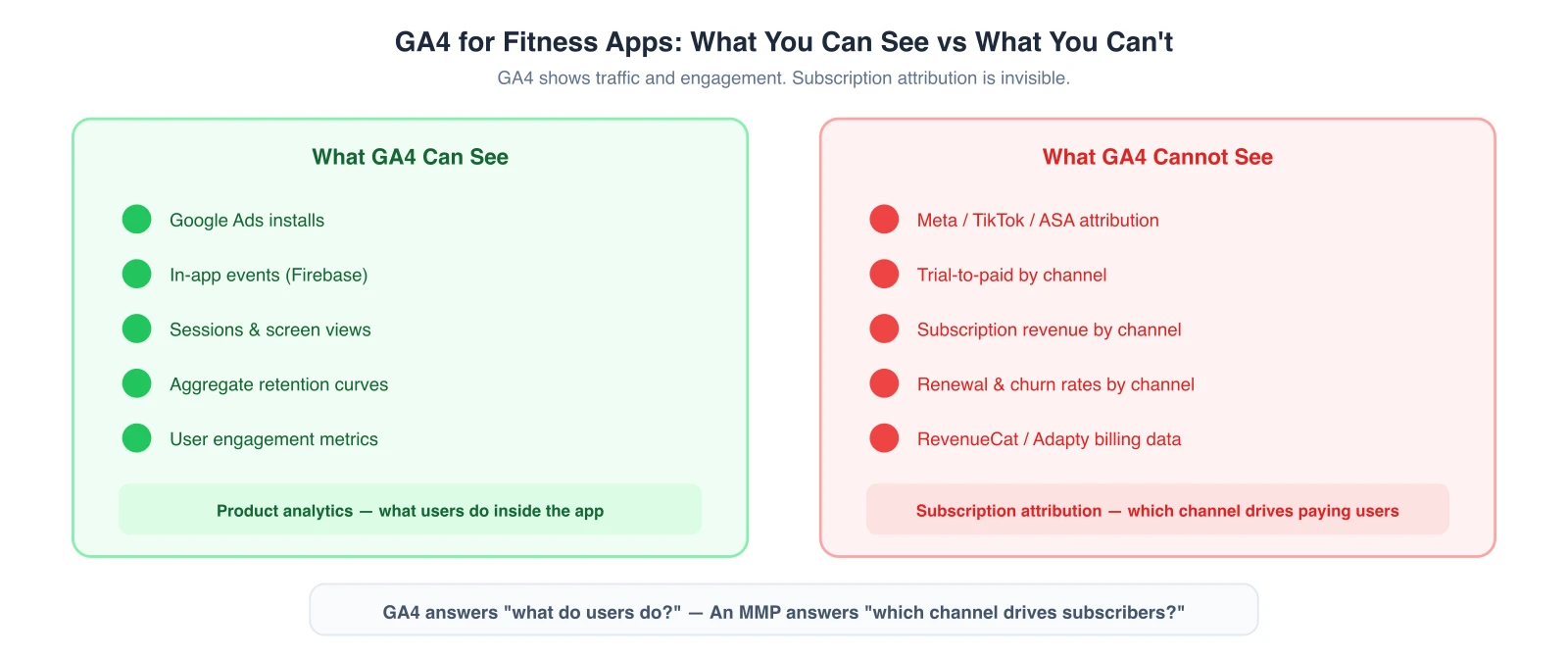
What GA4 can see:
-
Installs and sessions attributed to Google Ads
-
In-app events (if configured with Firebase)
-
Aggregate user behavior — screens viewed, features used, retention curves
What GA4 cannot see:
-
Which Meta, TikTok, or Apple Search Ads campaign drove a specific install
-
Trial starts by acquisition channel
-
Trial-to-paid conversion rates by channel
-
Subscription revenue by channel
-
Renewal and churn rates by channel
The result: Your GA4 dashboard shows traffic and engagement. Your RevenueCat dashboard shows subscribers and revenue. No view connects the two — the subscription metrics that matter for budget decisions are invisible in GA4.
Four Reasons GA4 Breaks for Fitness App Subscriptions
GA4's limitations for subscription attribution are not missing features. They are architectural constraints. Even in a post-ATT environment, subscription apps need persistent user-level attribution that GA4 was never built to provide.
-
Google-only channel attribution. GA4 natively attributes installs to Google Ads. For Meta, TikTok, and Apple Search Ads, GA4 relies on UTM parameters or manual campaign tagging — which do not work for mobile app installs. The result: non-Google installs appear as "Direct" or "(not set)." If 40–60% of your UA spend is on Meta and TikTok, GA4 is blind to half your budget.
-
Last-touch attribution only. GA4 offers Last Touch and Data-Driven Attribution — both of which cannot track view-through conversions. A user sees your fitness app ad on Instagram, searches for it later, and installs from the App Store. GA4 credits the App Store. The Meta ad that drove the decision is invisible.
-
No persistent user-level attribution. GA4 breaks once revenue becomes delayed. A fitness app with a 7-day trial converts the subscriber on day 7 or later. GA4 cannot reliably tie that conversion back to the original ad click. Trials convert days later. Renewals happen months later. GA4 loses the connection at every step.
-
No billing platform integration. RevenueCat and Adapty process subscription events — Start Trial, Subscribe, Renew, Cancel — on Apple and Google billing servers. GA4 has no S2S connection to these platforms. The subscription data that determines your actual ROAS exists in RevenueCat, not in GA4.
Want to see how MMP works with your data?
Get hands-on with Airbridge and see real results.
Try It Free →What Fitness App Teams Actually Need
Fitness and health apps have specific metrics that drive budget decisions. GA4 cannot surface any of them at the channel level.
-
Trial-to-paid by channel. The Health & Fitness median is 37.7%, with the top 25% at 51.4%+ (RevenueCat, State of Subscription Apps 2025). The gap between median and top quartile is enormous — but you can only optimize for it if you see which channel is at 25% and which is at 50%.
-
Renewal rate by channel. Health & Fitness apps have the highest active renewal rate among app categories at 86.4% (RevenueCat, State of Subscription Apps 2025). But this is an aggregate. A channel driving users who renew at 90%+ is worth more than one driving users who churn after month 1 — and this difference is invisible without channel-level renewal data.
-
Annual vs monthly mix by channel. 57% of Health & Fitness subscriptions are annual (RevenueCat, State of Subscription Apps 2025). Annual subscribers have the highest LTV. If Channel A drives mostly monthly subscribers and Channel B drives mostly annual subscribers, the budget allocation changes entirely.
-
Creative-level subscription data. Which ad creative drives trial starts? Which drives paid conversions? Install-optimized creatives and subscription-optimized creatives are often different — but only visible when subscription events connect back to acquisition data.
GA4 vs MMP: What Each Can Do for Fitness App Subscriptions
GA4 is a product analytics tool. An MMP is an attribution tool. For fitness apps, the distinction matters at every step of the subscription funnel.
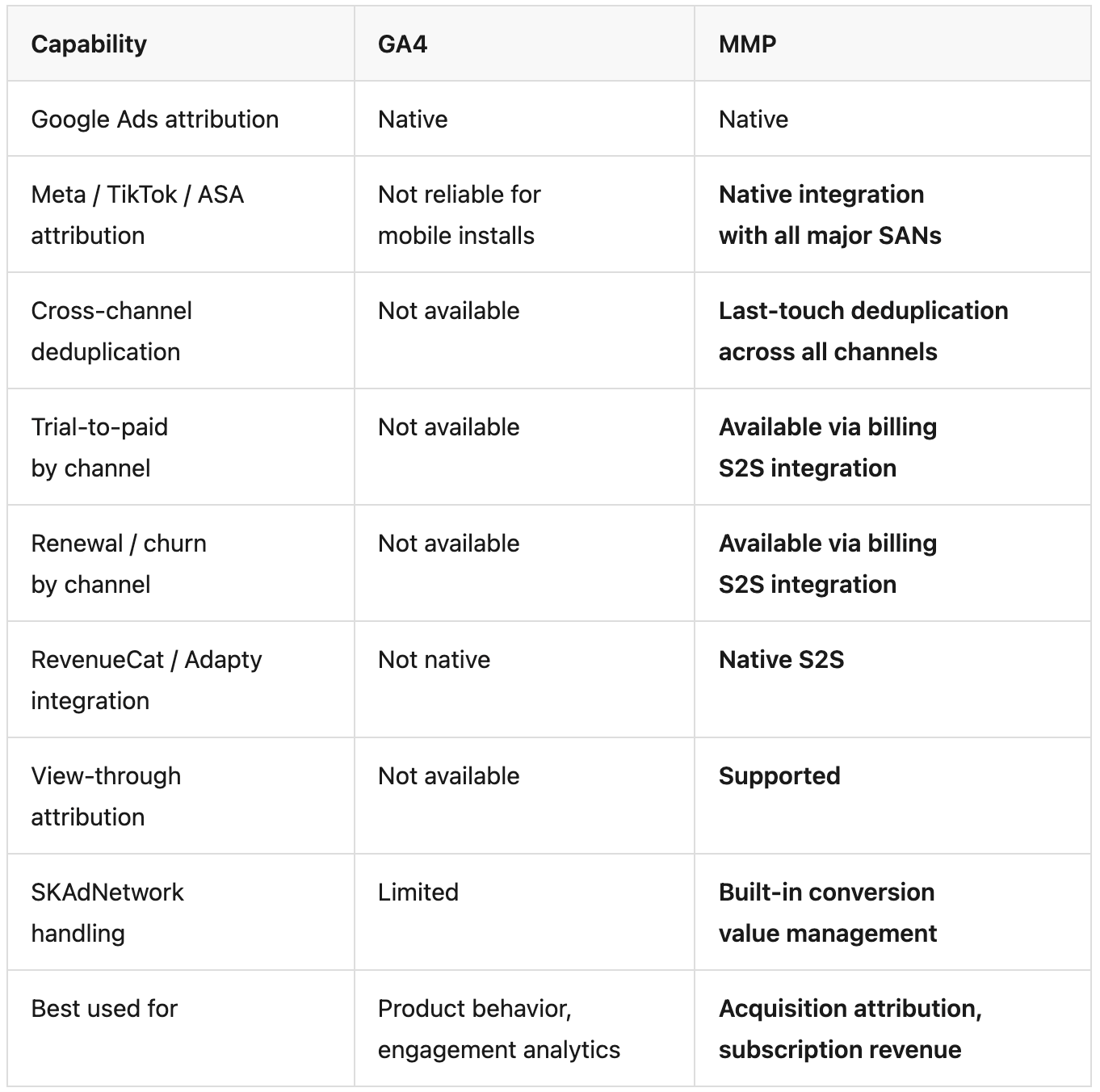
GA4 and an MMP are not competing tools — they answer different questions. GA4 tells you what users do inside your app. An MMP tells you which ad channel brought the users who pay.
How Core Plan Bridges the GA4 Gap
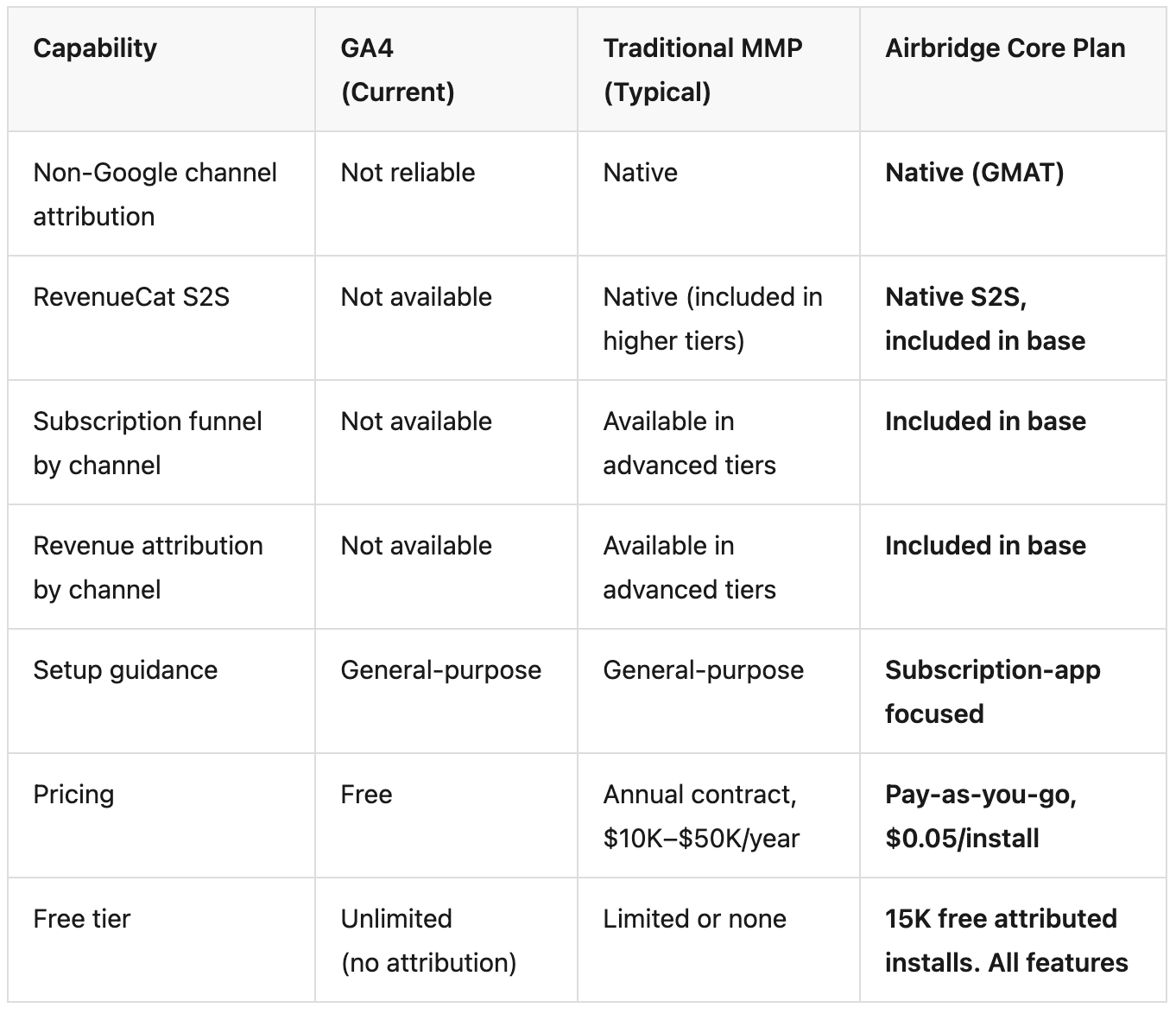
Core Plan includes native S2S integration with RevenueCat and Adapty in the base offering. Subscription events flow into attribution without requiring a higher-tier upgrade.
For fitness app teams currently using GA4 for everything, the addition is specific: keep GA4 for product analytics. Use Core Plan for acquisition attribution. The subscription metrics GA4 misses — trial-to-paid by channel, renewal rates by source, revenue by campaign — become visible once RevenueCat data connects to ad channel data through an MMP.
25 predefined subscription-optimized standard events — including Start Trial, Subscribe, and Unsubscribe — map directly to the events RevenueCat sends. Native integrations with Meta, Google, Apple Search Ads, and TikTok cover the channels GA4 misses.
GA4 Shows Traffic. An MMP Shows Revenue by Source.
Your fitness app's GA4 dashboard is not wrong — it is incomplete. It shows installs, sessions, and engagement. It does not show which channel's installs become subscribers, which subscribers renew, and which channels are worth more budget.
That gap is not fixable within GA4. It requires a system that receives data from both sides — ad channels and billing platforms — and connects them. For a fitness app running paid UA across Meta, Google, Apple Search Ads, and TikTok, that system is an MMP.


Ready to transform your mobile growth?
Learn how Airbridge helps leading brands measure and optimize every touchpoint.