Paid User Acquisition, Explained: What It Is, What It Costs, and When to Start

Paid user acquisition (paid UA) is the practice of paying ad platforms — Meta, Google, TikTok, Apple Search Ads — to show your app to targeted users and drive installs or trial starts. Unlike organic growth, paid UA gives you direct control over who sees your app, how much you spend, and what action you optimize for. For subscription apps, the goal isn't installs — it's paying subscribers.
Key Takeaways
-
Paid UA covers four primary channels. Meta, Google, TikTok, and Apple Search Ads (ASA) drive the vast majority of paid installs — not influencer deals or app store optimization.
-
Don't optimize for CPI alone. CPI tells you what your ads cost, not whether they're working. What matters is cost per paying user — divide CPI by trial start rate (median: 6.2%) to get cost per trial, then divide by trial-to-paid rate (median: 34.8%) to get cost per paying user.
-
You need three things before spending. A paywall converting at least 1.9% of installs to paid subscribers, a defined optimization event, and a budget of at least 10x your target CPA.
-
Start where intent is highest. For iOS, Apple Search Ads is the first channel. For Android, Google App Campaigns. Add TikTok only when your creative engine is ready.
-
The funnel has five checkpoints. CPM → CPI → cost per trial → cost per paying user → LTV. You need all five to know if paid UA is working.
-
LTV must exceed CAC. Among Health and Fitness subscription apps, the median year-one LTV per paying user is $27.21 — your cost to acquire that user must stay below it.
What Does Paid UA Actually Include?
Paid UA is often conflated with every form of marketing that costs money. It isn't.
Paid UA means running ads on self-serve platforms that charge you per impression, click, or install. The four primary channels are Meta (Facebook, Instagram), Google (App Campaigns), TikTok, and Apple Search Ads (ASA).
Paid UA does not include influencer deals, podcast sponsorships, brand awareness campaigns, or ASO (App Store Optimization). Those may complement paid UA, but they operate on different mechanics.
Channel reach varies significantly. TikTok reaches roughly 20% of the world's population — substantial scale, but only useful if your creative is built for the format. On iOS, the AppsFlyer Performance Index ranks Apple Search Ads first by install quality, followed by TikTok, Meta, and Google. On Android, Google App Campaigns leads, with Meta second. These are performance rankings — the order you should actually start them is covered in the channel selection section below.
The practical implication: start with one channel, not four.
What Does Paid UA Cost?
The number most people track — cost per install (CPI) — is the wrong metric for subscription apps.
Typical CPI ranges for subscription apps:
-
iOS: $2–$6+ (Health & Fitness average: $5.78; category range is wide — Photo & Video averages $14.66)
-
Android: $1–$4+ (Tier-1 markets can exceed $5)
But a $2 CPI on iOS sounds cheap until you do the math. Among subscription apps, the median trial start rate is 6.2% and the median trial-to-paid conversion is 34.8%. Run those numbers:> $2 CPI × 100 installs = $200 spend → ~6 trial starts → ~2 paying users → approximately $100 cost per paying user
If your CPI is $5 (common on iOS), that same funnel produces approximately a $250 cost per paying user.
| Metric | Median | Top Quartile |
|---|---|---|
| Trial start rate | 6.2% | 20.3% |
| Trial-to-paid conversion | 34.8% | 62%+ |
| Download-to-paid by Day 35 (D35) | 1.9% | 8.5% |
| Y1 LTV per payer (H&F) | $27.21 | — |
| D60 Revenue per Install (H&F) | $0.63 | — |
The top-quartile trial start rate of 20.3% is more than 3x the median. That gap is entirely paywall and onboarding — not ad creative.
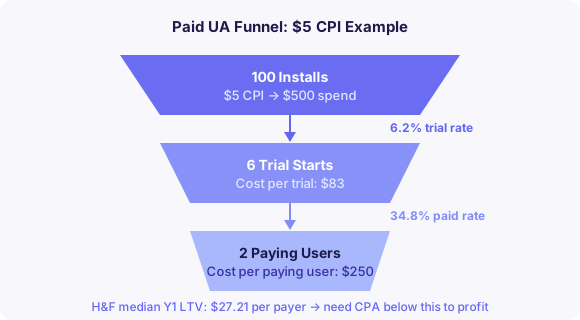
A $5 CPI with median conversion rates produces approximately $250 per paying user. At top-quartile trial start rate (20.3%), that drops to ~$71.
Start measuring what matters — for free
Airbridge Core Plan gives growing teams real attribution, deep linking, and audience tools at no cost.
Start Free for 30 Days →When Should You Start Paid UA?
The single most common mistake: starting paid UA before the conversion funnel works.
You need three things in place first:
1. A paywall that converts. The median download-to-paid rate across subscription apps is 1.9%. If your paywall is below this, paid UA will amplify a broken funnel — not fix it. Get to 1.9%+ before spending on ads.
2. A clear optimization event. Platforms like Meta and Google need a conversion signal to optimize against. "Install" is too weak. "Trial start" or "purchase" is what you want. Without a defined event, the algorithm cannot find the right users.
3. Enough budget to learn. At 10x CPA as a daily budget minimum, a $25 target CPA requires $250/day — or $7,500/month just to get clean data. Below this, the algorithm doesn't get enough signals to optimize.
The competitive pressure to start is real. Health and Fitness app UA spend on iOS grew 97% year-over-year (2024–2025). With over 2.2 million apps on the App Store (42matters, April 2026), organic discovery alone won't build a business. But spending on a broken funnel is worse than waiting.
The threshold: launch paid UA when your paywall hits 1.9% download-to-paid and your budget can sustain 10x CPA for at least 30 days.
How Do You Pick Your First Paid UA Channel?
The right answer depends on your platform, not your preference.
| Channel | Best For | Strength | When to Add |
|---|---|---|---|
| Apple Search Ads | iOS first installs | High-intent users, clean attribution, keyword-level targeting | Start here for iOS |
| Google App Campaigns | Android first installs | Android-first advantage, broad reach | Start here for Android |
| Meta (Facebook/Instagram) | Both platforms | Broadest targeting, lookalike audiences | After ASA/Google baseline |
| TikTok | Both platforms | Scale at low CPM | Only when creative engine is ready |
iOS apps: Start with Apple Search Ads. Users searching the App Store have high purchase intent — they're actively looking for an app like yours, not passively scrolling. One caveat: ASA optimizes toward clicks and installs, not purchase events, so pair it with downstream conversion tracking to measure trial starts. Once you have a cost-per-trial baseline from ASA, expand to TikTok (if your creative engine is ready) or Meta.
Android apps: Google App Campaigns is the natural starting point. Google's ecosystem gives it a structural advantage on Android — Play Store data informs targeting in ways other platforms can't replicate.
TikTok: Only start TikTok when you have a creative team (or freelancer) who can produce hook-first video at volume. TikTok's algorithm rewards creative iteration above all else. If you can't regularly test new creatives each week, you're not ready.
Meta: Useful for scale and lookalike audiences once you know what a paying user looks like. Start with broad targeting and let the algorithm find your audience — don't over-restrict.
How Do You Know If Your Paid UA Is Working?
Track five metrics in sequence. If any one breaks down, you've found the problem.
CPM (cost per 1,000 impressions): Measures ad auction competitiveness. If CPM spikes, your creative may have fatigued or competition in your category increased.
CPI (cost per install): The product of CPM and click-through/install rates. High CPI usually means weak creative or wrong audience, not the wrong channel.
Cost per trial start: CPI ÷ trial start rate. If this is high, your app store page or onboarding is filtering out the users your ads are reaching.
Cost per paying user: Cost per trial ÷ trial-to-paid rate. This is the number that determines whether paid UA is profitable. Among subscription apps, the median trial-to-paid rate is 34.8% — below that, investigate your paywall.
ROAS / LTV ratio: The final check. For Health and Fitness subscription apps, median year-one LTV per paying user is $27.21 — and the top-quartile threshold is $33.91. If your cost per paying user is $40, you're losing money on every subscriber. No amount of creative testing fixes negative unit economics.
The practical rule: don't optimize for CPI. Optimize for cost per paying user, then back-calculate the CPI that makes the math work.
Paid UA Is a Funnel Problem, Not an Ads Problem
Most subscription apps that struggle with paid UA aren't failing at ads — they're failing at conversion. The ad platforms will deliver users. What happens after the install determines whether paid UA is a growth engine or a money drain.
Fix your paywall first. Define your optimization event. Set a budget that gives the algorithm room to learn. Then choose one channel, measure all five funnel metrics, and scale what works.
Sources)
-
Analysis based on RevenueCat State of Subscription Apps 2025 (75K+ apps)
-
Adapty State of In-App Subscriptions 2026 (16K+ apps)
-
RevenueCat Startup School — Paid User Acquisition (35-lesson course); 42matters App Store data (April 2026).

Ready to see what Core Plan can do?
Free attribution, deep linking, and audience tools — built for teams that are ready to grow.