Why 56% of New Apps Stay Under $1K: 3 Marketing Mistakes

You built the app. You hit publish. Then nothing happens.
No surge in downloads. No word-of-mouth. Not even a trickle of new users. Most founders assume the silence means the product is broken. It usually doesn't. It means the go-to-market hasn't started yet.
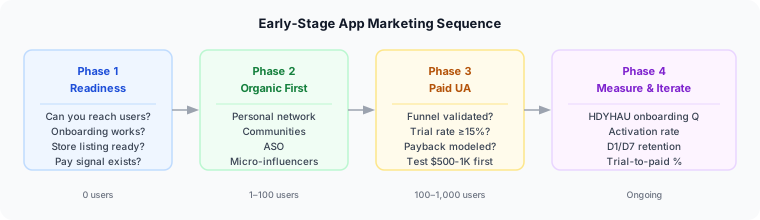
This guide gives you the exact sequence from pre-launch readiness through organic app marketing tactics to the point where paid UA becomes viable.
Key Takeaways
-
56% of new apps earn less than $1,000 in their first year. The gap is almost never about product quality alone.
-
Run a 4-point readiness checklist before spending a dollar on any channel.
-
Almost every successful consumer app built its first 1,000 users through one primary strategy — not five.
-
iOS Health & Fitness CPI averages $5.78, with a cost per paying user of $23-29. Paid UA only works when your funnel is already converting.
-
A single onboarding question — "How did you hear about us?" — is your best zero-cost measurement tool at this stage.
-
Lifecycle marketing (email, push) can add ~10% to ARR but cannot rescue a broken funnel.
Why Most New Apps Never Find an Audience (And It's Not the Product)
App marketing is the practice of acquiring, activating, and retaining users for your app through deliberate channel strategy — not luck or virality.
The top 10% of subscription apps capture 95% of all subscription revenue. The median subscription app earns just $92/month after its first full year. That gap is stark, and it rarely comes down to product quality alone.
The real pattern: most founders ship the app and then wait. They wait for the App Store algorithm to surface them. They wait for word-of-mouth to kick in. They wait for organic traffic that never comes.
The apps in the top tier treated go-to-market as a deliberate discipline, not something that happens automatically after shipping.
There are 2.3 million apps on the App Store and 1.5 million on Google Play. Consumer spending on iOS reached $103 billion in 2024. At 258,000 app downloads per minute globally, user attention is the scarcest resource in the market. Attention must be earned or purchased. Neither happens by accident.
The three components of product-market fit tell you where things break down: Product (the right solution), Market (a specific audience), and Messaging (packaging that helps people understand why it matters). Getting messaging wrong is as costly as getting the product wrong. Most early-stage apps fail at the third piece, not the first.
Run the Pre-Marketing Readiness Checklist
Marketing amplifies what's already working. If the core conversion experience is broken, spending on channels makes the problem worse faster.
Before you pick a single marketing channel, verify that these four conditions are true.
1. You can reach your target audience
You need at least one path to the people you're building for. A community you're active in. A network segment. A platform where they congregate. If you have no idea where your target users spend time online or offline, channel selection is premature.
2. Users can actually try the core experience
Onboarding friction is invisible to the builder. Someone who has never used your app should be able to reach the moment of value within the first session. If your onboarding requires too many steps or too much prior knowledge, users leave before they experience the product.
3. The app genuinely helps with the Job to Be Done
82% of free trial starts happen on Day 0 — the first session. The decision to try or not is made almost immediately. That means your store listing, screenshots, and onboarding flow are marketing assets as much as the product itself. Weak store creative kills conversion before any channel gets a chance to prove itself.
4. You have some signal on willingness to pay
Before scaling acquisition, you need at least soft evidence that someone would pay for this. Willingness to pay signals: users who return without prompts, users who tell others organically, users who ask about pricing. Vanity metrics — downloads, social following, App Store rankings — are misleading at this stage.
Run through the checklist honestly. If more than one item fails, fix those before investing in marketing.
Get Your First 100 Users Without Paying for Ads
The principle here: make a small group genuinely happy before expanding outward.
Trying to reach everyone at the start dilutes the signal you need to improve. Your first 100 users are a learning cohort, not a revenue target.
Research on how the biggest consumer apps reached their first 1,000 users consistently shows the same pattern: one primary strategy, executed deeply. Buffer wrote 150 guest posts in 9 months and built 100,000 users organically. Loom got 3,000 users from a single Product Hunt launch. Slack's press blitz generated 8,000 invitation requests on day one.
Pick one channel. Go deep before you go wide.
1. Start with your personal network
The fastest path to your first users is direct. Email people you know in your target segment. Be specific about what you're looking for: "I built an app for [specific problem], and I think it would help you. Can I send you a link and get 15 minutes of feedback next week?" This is not scale, but it gives you signal fast with zero budget.
2. Go where your audience already exists
Online communities (Reddit, niche Discords, Facebook Groups, Slack communities) are distribution channels if used right. The wrong approach: drop a launch post and leave. The right approach: be an active contributor for weeks before mentioning your app, then share it as something that might help — not as a promotional post.
The most effective first-channel strategy for community-based apps: find the 3-5 forums where your target audience asks questions you can answer with your product, contribute genuinely, and reference your app when it's directly relevant.
3. Optimize your App Store presence before promoting anything
40% of app users discover apps through App Store search or browsing. Your store listing is the highest-leverage free marketing asset you have.
The components that move conversion:
| Element | What to prioritize |
|---|---|
| Title + Subtitle | Primary keyword in title; secondary keyword in subtitle |
| Screenshots | First screenshot communicates the core value proposition in 3 seconds |
| Preview video | 15-30 seconds, shows actual product experience |
| Ratings and reviews | Prompt at the right moment — post-achievement, not mid-task |
| App quality signals | Crash rates and retention now influence ranking algorithms |
A/B test your store listing assets before spending on paid. This is free and directly improves every channel's conversion rate.
4. Partner with micro-influencers in your niche
Micro-influencers (1,000-50,000 followers) consistently outperform larger accounts for early-stage app launches. Their audiences are more engaged and more niche, which means your conversion rate is higher even at lower reach.
The outreach approach that works: give them early access, let them form their own opinion, give them creative freedom on how they describe it. Require a trackable referral code so you know what's working. Do not write their script for them.
The Earned/Owned/Paid framework is the mental model for this phase. Owned = your app, website, store listing. Earned = word-of-mouth, press, organic social. Paid = advertising. In the early stage, you are almost entirely in Owned and Earned territory. Virality is unpredictable — do not plan for it. Build for it, but don't count on it.
Want to see how App marketing works with your data?
Get hands-on with Airbridge and see real results.
Try It Free →When (and How) to Start Paying for Users
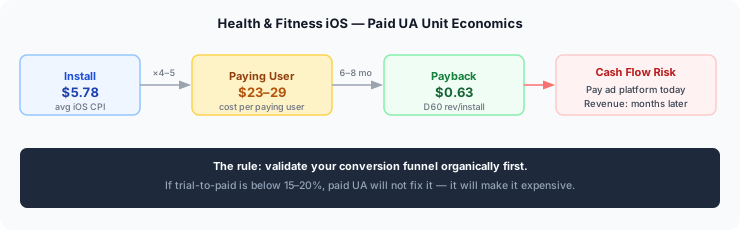
Paid UA is an amplifier — it accelerates what's already converting organically, not a fix for what isn't. Here's what that means in practice.
iOS CPI for Health & Fitness apps averages $5.78 globally. Cost per paying user (CPPU) runs approximately 4-5x CPI — so $23-29 per paying user. Median Day 60 revenue per install in Health & Fitness is $0.63. At those economics, you need a strong conversion funnel and a clear payback timeline before a paid campaign becomes profitable.
Paid users tend to pay off 6-8 months after the initial install. When your app earns $5/month in subscription revenue but you must pay the ad platform today, cash flow can kill the business before LTV is ever realized.
1. Know which channels match your platform
On iOS, Apple Search Ads consistently ranks first for install quality. On Android, Google Ads is the equivalent anchor channel. Meta and TikTok are strong supplementary channels for non-gaming subscription apps in North America. Start with the platform where your audience already has intent, not the one with the lowest CPI.
2. Define your readiness conditions
Three things must be true before you run paid:
-
You have at least 50-100 organic users whose behavior you understand
-
Your trial start rate shows users find value — even 5-8% is a start, but make sure it's not declining
-
You know your payback window and have cash to sustain it
If any of these fail, organic work is not finished.
3. Start with a test budget, not a campaign budget
Run a $500-1,000 test per channel before committing. Look at cost per trial, not cost per install. Cost per install tells you about the channel's efficiency. Cost per trial tells you whether the channel is sending people who actually want what you're building.
How to Know Whether Your Marketing Is Working
Early-stage measurement does not require complex infrastructure. Most founders over-invest in tooling and under-invest in reading the data they already have.
The metrics that matter at this stage:
| Metric | What it tells you | Target signal |
|---|---|---|
| Activation rate | % of installs that reach core feature | Should improve with each onboarding change |
| Day 1 retention | % who return next day | Does it trend upward as you improve onboarding? |
| Trial start rate | % of installs that start a free trial | 90th percentile: 20%+; top quartile: 12%+; all-category median: ~6% (SOSA 2025) |
| Trial-to-paid conversion | % of trials that convert to paying | All-category median: ~35%; H&F median: ~40% (SOSA 2025) |
| Channel source distribution | Where your actual users come from | Tells you where to double down |
1. Ask "How Did You Hear About Us?" in onboarding
This single question is the simplest zero-cost channel signal source you have — and it complements, not replaces, any analytics tools you add later. Add it as one screen during onboarding — before the paywall, after the core experience. Offer 5-8 options (App Store search, friend/family referral, Instagram, TikTok, Google search, podcast, other) and an open text field.
You will immediately see which channels are producing real users, not just installs. This data correlates with downstream LTV: users who came from referrals consistently outperform paid installs on retention and subscription conversion. You do not need any external tools to run this.
2. Track activation, not downloads
Downloads are vanity at this stage. Activation — defined as the moment the user completes the core intended action for the first time — is the real leading indicator. Every optimization to onboarding should be measured against its effect on activation rate.
3. Watch early retention as a product signal
Nearly 80% of users abandon new apps within 3 days. If your Day 3 retention is below 20%, no amount of marketing will build a sustainable app. This is a product problem, not a marketing problem. Fix it before investing further in acquisition.
3 Mistakes That Kill Early-Stage App Marketing
1. Spreading across too many channels at once
The data from the most successful early-stage consumer apps is consistent: one channel, done deeply, outperforms five channels done shallowly. Spreading across channels at this stage means you understand no channel well enough to improve it. You end up with noise, not signal.
The practical consequence: founders who spread across three channels at launch typically can't tell which channel is working, can't allocate budget correctly, and can't iterate fast enough on any single channel to improve it. The data stays noisy indefinitely.
2. Running paid ads before organic validation
Paid UA applied to a leaky funnel produces expensive data about a broken product. If your trial start rate is 5% and your trial-to-paid conversion is 10%, spending on Meta ads gives you a high CPPU and no clarity on what to fix.
Organic users are more forgiving of product imperfections and more likely to give feedback. Use them to fix the funnel. Then pay to fill it.
3. Investing in lifecycle marketing too early
Email sequences and push notifications have a hard ceiling: even done well, they move revenue by around 10%. That's meaningful at $1M ARR. It's irrelevant if your trial start rate or trial-to-paid rate is below median. If your core conversion isn't working, spend zero time on welcome sequences and engagement" class="glossary-link" title="Re-engagement">re-engagement campaigns. Come back to them when you have a subscription base worth retaining.
Audience Is Built, Not Found
Every app that has an audience today started with zero users. The ones that built something real were deliberate about the sequence: validate the experience, earn the first hundred, understand what's working, then scale.
There is no shortcut that skips the early organic phase. The data on paid UA payback windows makes this concrete: you need a working funnel before you can afford to fill it.
The sequence in this guide is the one that works consistently across verticals:
Readiness check → one organic channel → store optimization → paid when the funnel converts → measurement from day one.
Start where you are. Build the audience the way every successful app did — one deliberate user at a time, until the channel compounds on its own.
Sources)
-
Lenny's Newsletter, "How the Biggest Consumer Apps Got Their First 1,000 Users"
-
MobileAction, "Organic App Growth in 2025"
-
SplitMetrics, App Store Acquisition Channels glossary. Benchmark data from: RevenueCat State of Subscription Apps 2025 (75,000+ apps)
-
Adapty State of In-App Subscriptions 2026 (16,000+ apps)
-
RevenueCat StartApp School (Paid UA + App Monetization modules)
-
48 Laws of Subscription App Success playbook.
Ready to transform your mobile growth?
Learn how Airbridge helps leading brands measure and optimize every touchpoint.