The 5 Best Adjust Alternatives for 2026

Your Adjust contract is up for renewal. Before you auto-renew, it is worth asking whether this is still the right tool for where your app is going.
Adjust is a capable platform. But "capable" is not the same as "right for your stack at your current stage." Pricing requires a sales call to unlock. Features your subscription app actually needs may sit behind a higher tier. And if your team is managing a trial-to-renewal funnel, a general-purpose measurement platform can track installs accurately while telling you nothing about whether those installs generate revenue.
Key Takeaways
-
Pricing transparency varies sharply across platforms. Adjust, AppsFlyer Enterprise, Singular, and Branch all require custom quotes. Kochava and Airbridge publish at least starter pricing publicly.
-
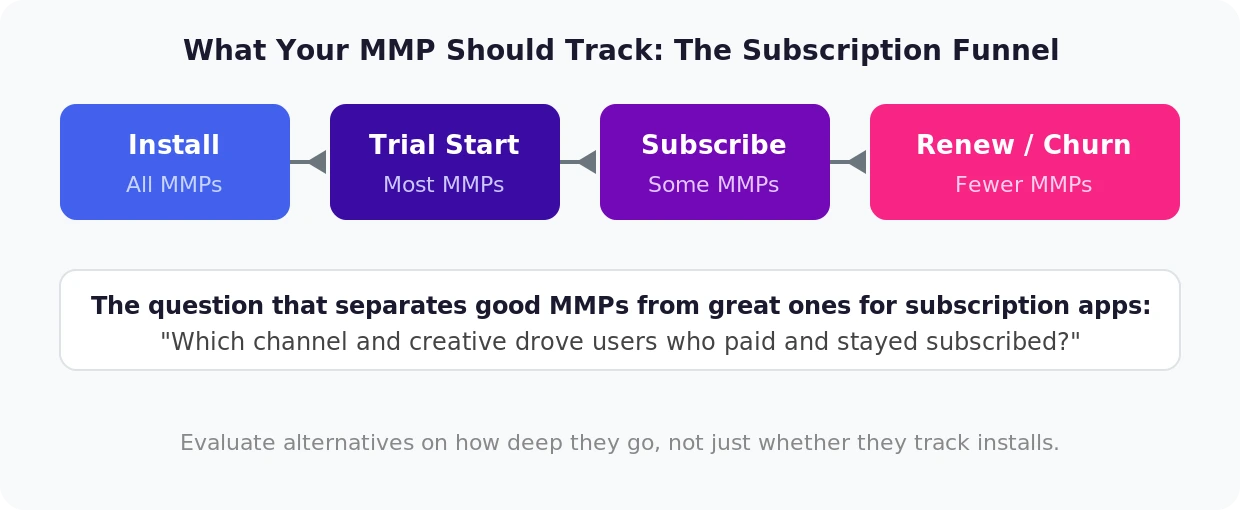
Subscription funnel depth is the real differentiator. The right tool connects trial starts, paid conversions, renewals, and churn to the specific channels and creatives that drove them.
-
All five alternatives cover the four major ad channels. Meta, Google, Apple Search Ads, and TikTok are natively supported across every platform listed here.
-
Contract structure affects total cost at least as much as per-unit pricing. Know whether you are signing annual or pay-as-you-go before entering any negotiation.
-
The best alternative is not universal. An enterprise app spending $100K/month on paid UA has different requirements than a 5-person team running its first attribution setup.
What to Evaluate Before Switching from Adjust
Not every Adjust alternative belongs on your shortlist. These four criteria separate the real contenders from the noise.
1. Pricing transparency and contract flexibility
Adjust uses a custom quote model built around monthly tracked users (MTUs). You need a sales conversation to get a number, and annual contracts are standard. Before putting any alternative on your shortlist, confirm whether pricing is publicly listed, whether pay-as-you-go is available, and what the minimum commitment looks like.
A platform that requires a 12-month contract at an undisclosed price solves your renewal problem without solving your transparency problem. If your paid UA spend varies month-to-month or your team is pre-Series A, prioritize platforms that explicitly offer monthly billing or no-minimum pay-as-you-go. Minimum spend thresholds can create effective annual commitments even on ostensibly "flexible" plans.
2. Subscription funnel measurement depth
Install attribution is table stakes. For subscription apps, the measurement that determines whether paid UA is profitable is further down the funnel: did the user from your Meta campaign start a trial? Did they convert to paid? Are they still subscribed 90 days later?
A mobile measurement platform that stops reporting at the install level cannot connect your ad spend to subscription revenue. When evaluating any alternative, ask specifically whether trial start, first subscription, and renewal events are trackable by channel and creative without custom development work. Ask which events are pre-configured vs. which require your engineering team to define schemas from scratch.
3. Channel coverage and integration breadth
The four major Self-Attributing Networks (Meta, Google, Apple Search Ads, and TikTok) account for the majority of paid UA spend for most subscription apps. Every major mobile measurement platform covers these natively. Differences emerge at the edges: support for smaller ad networks, data warehouse connections (BigQuery, Snowflake, Redshift), and billing platform integrations like RevenueCat and Adapty.
If your tech stack includes RevenueCat, confirm native integration exists before signing. If you run non-standard ad networks beyond the four SANs, verify coverage explicitly. A channel your measurement tool does not cover is a blind spot that grows more expensive as spend scales.
4. Migration support and data continuity
Switching measurement platforms requires re-integrating SDKs, reconfiguring postback connections and attribution window settings, and managing a data gap window before the new platform's stream stabilizes. Ask each vendor how long a standard migration takes for a single iOS/Android app, what support is included at no extra cost, and whether historical attribution data carries over.
Vendors with dedicated migration engineers or structured onboarding programs reduce execution risk significantly. Vendors that hand you documentation and leave you to it require your engineering team to absorb the migration overhead. Factor this into your true cost comparison.
The 5 Best Adjust Alternatives at a Glance
Here is how the five mobile measurement partners compare on the criteria that matter most at renewal time.
| Platform | Best For | Starting Price | Subscription Events | Contract |
|---|---|---|---|---|
| AppsFlyer | Enterprise apps, large UA budgets | $0.07/conversion (Growth plan) | Full funnel; creative analytics in ROI360 tier | Annual or PAYG |
| Singular | Unified spend and attribution data | Custom quote | Full funnel; fraud prevention included | Annual |
| Branch | Deep linking, web-to-app flows | Custom quote | Attribution available; linking is primary strength | Annual |
| Kochava | Raw data access, custom analytics | Free up to 10K conversions; from $500/month (Foundation tier) | Full funnel; strong data export | Monthly or annual |
| Airbridge | Subscription apps scaling paid UA | 15K free installs, then $0.05/install | Subscription events pre-configured | Pay-as-you-go |
Want to see how Adjust works with your data?
Get hands-on with Airbridge and see real results.
Try It Free →In-Depth Review: The 5 Best Adjust Alternatives for 2026
1. AppsFlyer: Best for enterprise apps with large UA budgets
AppsFlyer holds the largest market share among mobile measurement platforms globally, used by more than 15,000 brands across industries (AppsFlyer, 2026). Its attribution infrastructure covers every major ad channel and more than 10,000 partner integrations. Fraud detection via Protect360 is among the most thorough available.
The Growth plan charges $0.07 per attributed conversion after an initial 12,000-conversion Welcome Package. Enterprise plans negotiate lower rates on annual contracts. Creative-level subscription analytics require the ROI360 add-on tier, meaning full subscription funnel visibility comes at a cost premium above the base plan.
Best for: Apps with $50K+/month in UA spend that need broad ad network coverage, enterprise fraud prevention, and dedicated account support.
Where it falls short vs. Adjust: The add-on tier model means teams frequently pay for features they do not use in order to access the features they need. No fully self-serve onboarding path makes it a poor fit for early-stage teams.
2. Singular: Best for unified marketing data
Singular combines attribution with cross-channel cost aggregation in a single dashboard. If your growth team runs campaigns across Meta, Google, TikTok, programmatic networks, and influencer spend, Singular pulls ad spend and attribution data together without manual report reconciliation. Fraud prevention covers more detection methods than most alternatives in this list, and the reporting API is included at no additional charge.
Pricing is not publicly listed. Singular bills by attributed events or ad spend volume, with annual contracts as standard. There is no published free tier.
Best for: Growth teams running 10-plus channel campaigns who need unified spend-to-outcome reporting in one place.
Where it falls short vs. Adjust: If subscription funnel depth is your primary need rather than cross-channel spend aggregation, Singular's overhead may not be justified. Getting a price number requires a sales conversation, just like Adjust.
3. Branch: Best for deep linking and web-to-app flows
Branch specializes in deep linking and cross-channel user journeys. If a significant share of new users arrives through email campaigns, social referral links, or web-to-app flows, Branch routes those users into the correct in-app context with attribution intact. Many teams deploy Branch as a specialist linking layer alongside a separate primary measurement tool.
Branch offers attribution for subscription events, though its architecture is built for cross-channel journey continuity rather than subscription billing funnel analysis. Pricing is custom and requires a sales contact. Annual contracts are standard.
Best for: Apps where broken web-to-app attribution or deep link failures are the primary pain point, and where a specialist linking layer adds measurable conversion value on top of an existing attribution setup.
4. Kochava: Best for raw data access
Kochava's core differentiator is data control. Row-level attribution data exports directly to BigQuery, Snowflake, and Redshift, giving data engineering teams the flexibility to build custom attribution models alongside Kochava's native reporting. Attribution window configuration, multi-touch models, and fraud rules are more granular here than in most alternatives.
Kochava offers a free tier up to 10,000 attributed conversions per month, with paid plans starting at $500/month (Foundation tier; Enterprise at $2,000/month). Enterprise pricing scales by MTU or conversion volume. The platform carries a steeper learning curve than most alternatives, and onboarding is not self-guided.
Best for: Data-science-heavy teams who need granular export capabilities, configurable attribution windows, and direct data warehouse access without a mandatory annual contract.
5. Airbridge: Best for subscription apps scaling paid UA
Airbridge Core Plan is built around the subscription funnel. The 25 standard events include Start Trial, Subscribe, and Unsubscribe pre-configured. Renewals are tracked via semantic attributes on the Subscribe event, so renewal data flows without additional schema work. Attribution covers the four major Self-Attributing Networks: Meta, Google, Apple Search Ads, and TikTok.
Pricing is transparent and public: 15,000 free attributed installs, then $0.05 per install. No annual contract. No minimum monthly spend. Lifetime value reporting by channel and creative is available in the base plan, as are native integrations with RevenueCat and Adapty, included at no add-on tier. Among the adjust alternatives evaluated here, this is the only plan with fully public per-install pricing.
In a 2026 survey of 21 subscription app founders, contract flexibility was the #1 reason cited for evaluating adjust alternatives to their existing MMP. Airbridge Core Plan is the only platform in this comparison with no minimum commitment and no annual lock-in.
Honest limitations: Core Plan does not support custom events (Growth Plan required). Maximum two third-party integrations. Coverage is GMAT channels only: Meta, Google, Apple Search Ads, and TikTok. No raw data export. No agency or partner portal access. If your stack includes non-standard ad networks, requires custom event definitions, or your team needs row-level data exports, these are real constraints to evaluate before committing.
Best for: Subscription apps running paid UA on Meta, Google, ASA, and TikTok, spending $1K to $30K/month, where transparent pay-as-you-go pricing and subscription-first measurement matter more than maximum network coverage.
For a deeper head-to-head including Adjust itself, see AppsFlyer vs. Airbridge vs. Adjust vs. Branch: Best MMP for Subscription Apps in 2026.
The Right Alternative Starts with the Right Question
The best Adjust alternative is not the one with the longest feature list. It is the one whose pricing model, subscription funnel depth, and channel coverage match where your app is right now and where you need it to be in 12 months.
For subscription apps running paid UA on Meta, Google, Apple Search Ads, and TikTok that need to see which channels are actually driving paying subscribers, not just installs, Airbridge Core Plan is built for that specific measurement problem. Start free with 15K attributed installs and see trial-to-subscription data by channel before committing to a contract.

Ready to transform your mobile growth?
Learn how Airbridge helps leading brands measure and optimize every touchpoint.