How to Write an App Value Proposition People Understand in 5 Seconds

You built the app. You know what it does. But when someone lands on your App Store listing, most visitors leave without installing. Page-view-to-install conversion rates average just 33.7% on iOS and 26.4% on Google Play (Business of Apps, based on AppTweak 2020 data). The problem is rarely the product. It is the words you use to describe it.
An app value proposition is a single, clear statement that names who your app is for, what problem it solves, and why your approach is different. Written so a stranger can grasp it in seconds. Get it wrong and you lose the install before a user ever sees your onboarding, your paywall, or your product.
56% of new apps earn less than $1,000 in their first year. Only 9% break $100K. The common assumption is that these apps have a product problem or a pricing problem. But most apps approach conversion as a pricing problem when it is actually a belief problem. If users do not understand why your app matters to them, they will never get far enough to see your price.
Key Takeaways
-
Your value proposition decides whether someone installs. It names who your app is for and why it matters to them, before they ever see a feature.
-
Start with one audience and one problem. A value proposition for everyone speaks to no one. Pick the segment that feels the pain most acutely.
-
Use your users' words, not your product language. Pull exact phrases from App Store reviews, Reddit threads, and support tickets.
-
Apply the 4-component formula. Specific audience + job/problem + how you address it + your unique approach. Fill in the blanks and you have a working draft.
-
Test with the 5-second rule. If someone outside your team cannot repeat your value proposition after reading it for 5 seconds, rewrite it.
Why Most App Descriptions Fail (And What They Cost You)
Most app descriptions read like a product spec sheet. They list features, mention technical capabilities, and use language that makes sense internally but means nothing to someone scrolling the App Store at 11 PM.
The cost is not abstract. It is lost installs, wasted ad spend, and a paywall nobody reaches.
1. The 7-Second Decision Window
Users spend an average of seven seconds on an App Store listing page before deciding whether to explore further, according to research by Phiture and AppAgent based on a sample of over 25,000 visitors. That means two out of three people who find you walk away.
Your value proposition is what fills those seven seconds. If it is unclear, no amount of screenshots or review stars will compensate.
2. Feature Lists Are Not Value Propositions
Consider two descriptions for the same meal planning app:
| Approach | Description |
|---|---|
| Feature list | "AI-Powered Meal Planner. 10,000 recipes. Smart grocery list." |
| Value proposition | "For busy parents who want to feed their family well but don't have time to plan. We turn 'What's for dinner?' into a 30-second decision." |
The first tells you what the app has. The second tells you who it is for and what changes in your life. The difference is the gap between a spec sheet and a reason to care.
A feature list answers "What does this app do?" A value proposition answers "Why should I care?" Users in the App Store are asking the second question.
3. The Belief Gap: Why Unclear Messaging Kills Conversion
Product-market fit has three components: the right product, the right market, and the right messaging. Sometimes an app does a great job solving a problem but struggles to explain it. Positioning and messaging are just as important as the solution itself.
This belief gap is why you see apps with strong retention among existing users but poor install conversion rates. The product works. The explanation of the product does not.
When OMENA, a wellness app, replaced a standard paywall with one that explained the app's value before asking for payment, their trial start rate doubled. The product did not change. The communication did.
Identify One Audience and One Problem
Before you write a single word of your value proposition, you need two inputs: who this is for and what pain you solve. Skip this step and everything downstream falls apart.
1. Why "Everyone" Is the Wrong Audience
When you target everyone, everything breaks. Messaging becomes generic. Users cannot identify themselves in your description. Feedback from different user types contradicts. Pricing does not map to perceived value.
The test is simple: ask five current users how they would explain your app to someone else. If they struggle or each gives a wildly different answer, your positioning is not specific enough.
A fitness app that says "Get fit" speaks to no one in particular. A fitness app that says "For runners training for their first half-marathon" speaks to a person who immediately thinks, "That is me."
2. Define Users by Context and Pain, Not Demographics
Demographics tell you who people are. Context tells you when they need you.
The Jobs to Be Done framework captures this well: "When I [situation], I want to [motivation] so I can [outcome]." Users do not buy features. They hire apps to make progress in a specific situation.
A budgeting app might define its audience as "millennials aged 25-35." That is a demographic. A sharper definition: "People who just got their first salaried job and have no system for managing money." That is a context. The second version writes your value proposition for you.
Emotional jobs drive retention and willingness to pay far more than functional jobs. A meditation app solves the functional job of "guided breathing exercises." The emotional job is "I want to stop feeling like my brain never shuts off."
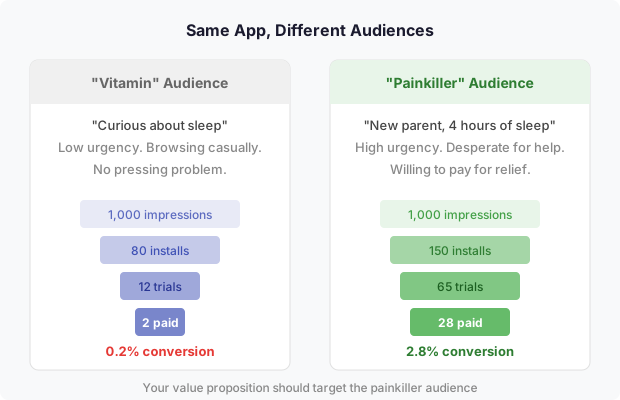
3. The Painkiller Test: Is Your Problem Urgent Enough?
Not all problems are equal. Painkiller apps that solve urgent, felt pain monetize faster. They drive quicker activation, higher conversion, and stronger retention.
Here is the critical insight: the same app can be a painkiller for one audience and a vitamin for another. A sleep tracking app is a vitamin for someone who is "curious about sleep." It is a painkiller for a new parent running on four hours a night who desperately needs to optimize the little sleep they get.
Your value proposition should target the audience for whom you are a painkiller. That is where urgency lives, and urgency drives installs. If you are still figuring out who your first audience should be, start with the group that feels the pain most acutely.
 conversion rate indicators">
Translate the Problem Into User Language
You have your audience and their pain. Now you need to describe it in words they actually use, not words your product team uses.
1. Where to Find Your Users' Exact Words
The best value proposition copy is stolen, not written. Go to these sources and pull exact phrases:
-
App Store and Google Play reviews (yours and competitors'). Look for how users describe the problem your app solves, not how they praise features.
-
Reddit threads and forums where your target audience discusses their frustrations.
-
Support tickets and chat logs. Users describe problems in their rawest form when asking for help.
-
Interview transcripts. If you have done user interviews, search for emotional language.
A wellness app found that users experiencing brain fog described it as: "It feels like I have cotton wool in my brain." They used that exact phrase in an ad. It worked because it felt real, not manufactured.
2. Product Language vs. User Language (With Examples)
| Product Language | User Language |
|---|---|
| "AI-powered personalized workout algorithm" | "Workouts that actually fit my schedule" |
| "Comprehensive financial tracking dashboard" | "Finally know where my money goes" |
| "Advanced sleep analysis with biometric integration" | "Figure out why I wake up tired" |
| "Intelligent recipe recommendation engine" | "Tell me what to cook with what I have" |
Product language describes what you built. User language describes what changes in someone's life. Your value proposition uses user language.
3. The Friend Test: Would a Real Person Say This?
Read your value proposition out loud. Would a user say this to a friend? If the answer is no, rewrite it.
"Our app leverages machine learning to optimize your fitness journey" fails the friend test. Nobody says that at dinner. "It builds workouts around your actual schedule, even if you only have 20 minutes" passes. That is something one friend tells another.
This is not about dumbing things down. It is about matching the language your users already think in.
Start measuring what matters — for free
Airbridge Core Plan gives growing teams real attribution, deep linking, and audience tools at no cost.
Start Free for 30 Days →Write Your Value Proposition Using a Proven Formula
You have your audience, their pain in their own words, and a clear sense of what your app does about it. Now assemble these into a single statement. Here is how to write an app value proposition that a stranger can repeat back to you.
1. The 4-Component Formula
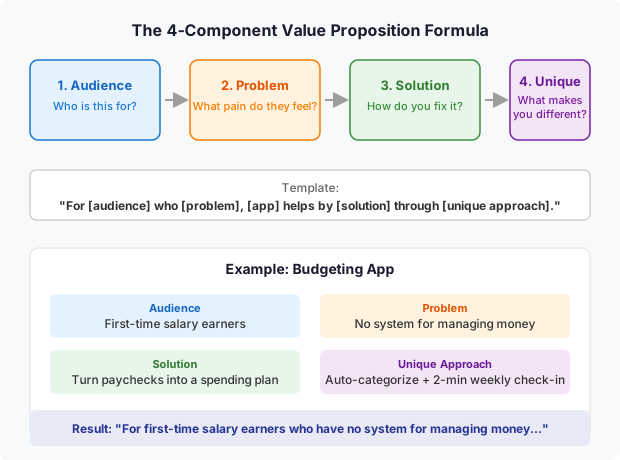
A positioning statement has four components:
-
Specific audience: who is this for?
-
Job or problem: what are they trying to do or solve?
-
How your app addresses it: what does your app do about this problem?
-
Your unique approach: what makes your way of solving it different?
The template:
For [specific audience] who [job/problem], [your app] helps by [how you address the pain] through [unique approach].
Here is how a financial app might fill this in:
For first-time salary earners who have no system for managing their money, [App Name] helps by turning every paycheck into a clear spending plan through automatic categorization and weekly check-ins that take under 2 minutes.
Every word earns its place. The audience is specific (first-time salary earners, not "millennials"). The problem is concrete (no system for managing money). The approach is distinct (automatic + 2-minute check-ins).
2. Two Alternative Frameworks (Moore and Blank)
If the 4-component formula does not click, two other proven templates work well (rapptrlabs.com). The key difference: Moore's formula adds a competitive frame ("Unlike X"), while Blank's strips everything down to a single sentence.
Geoffrey Moore's formula (from Crossing the Chasm):
For [target user] who [need/opportunity], our app is a [category] that [primary benefit]. Unlike [alternative], we [key differentiator].
Steve Blank's XYZ formula:
We help [target user] do [job] by doing [primary benefit].
Real examples of these in practice:
-
Bumble: "For people who want meaningful connections, Bumble is a dating app where women make the first move." (Moore's framework applied; rapptrlabs.com)
-
Pocket: "We help busy readers save articles for later by letting them bookmark anything in one tap."
Pick the formula that feels most natural. The important thing is that all three force you to name your audience and their problem before describing your solution.
3. Before-and-After Examples for Subscription Apps
| App Type | Before (Generic) | After (Value Proposition) |
|---|---|---|
| Fitness | "The complete fitness app" | "For people who quit gyms but still want to get strong. Home workouts that adapt to your level, no equipment needed" |
| Meditation | "Mindfulness made easy" | "For overthinkers who can't fall asleep. Guided sessions that quiet your mind in under 10 minutes" |
| Finance | "Smart budgeting tool" | "For freelancers with irregular income. A budget that flexes when your paycheck does" |
| Language | "Learn a new language" | "For travelers who need conversational basics in 30 days. Skip grammar drills, learn the 200 phrases that matter" |
Notice the pattern. Each "after" version names a specific person, states their situation, and explains what changes. The "before" versions could describe any app in the category.
Once you have your value proposition written, the next step is turning it into a growth plan, making sure your messaging reaches the right people through the right channels.
Test and Validate Your Value Proposition
Writing a value proposition is not a one-time exercise. It is a hypothesis that needs testing.
1. The 5-Second Test
Show your value proposition to five people who are not on your team. Give them five seconds to read it. Then ask: "What does this app do, and who is it for?"
If they cannot answer both questions clearly, your value proposition is not working. This is not a focus group. It is a basic readability check. If a stranger cannot parse your statement in five seconds, a distracted App Store visitor certainly will not.
2. Where Your Value Proposition Lives (Store Listing, Onboarding, Paywall, Ads)
A value proposition is not a one-time artifact. It needs to appear consistently across every touchpoint where users decide whether to continue:
-
App Store subtitle and first screenshot. The first thing users see. Your value proposition goes here in its shortest form.
-
Onboarding screens. Reinforce why the user made the right choice to install.
-
Paywall. The moment of maximum friction. Repeat your value proposition here, not a feature list. Users who see why the app matters to them convert at higher rates than users who see what the app contains.
-
Ad creative. Your ads are a test of your value proposition at scale. If click-through rates are low, the value proposition is not resonating with that audience.
Consistency matters. If your App Store listing promises one thing and your onboarding says something different, users feel a disconnect and drop off.
3. Iterate as You Learn
Your value proposition will evolve. As you get more users, you learn which audience responds most strongly and which language resonates. Run A/B tests on your App Store subtitle. Change your paywall headline. Test different ad copy angles.
The goal is not to write the perfect value proposition on day one. The goal is to write a clear one, test it, and sharpen it based on real behavior. Every new cohort of users teaches you something about how they describe their own problem.
5 Value Proposition Mistakes That Cost You Downloads
These are the five most common anti-patterns. If your value proposition matches any of these, it needs a rewrite.
| Mistake | What It Looks Like | Why It Fails |
|---|---|---|
| Too broad | "The app for everyone who wants to be healthier" | When you speak to everyone, no one identifies with it |
| Feature-obsessed | "500+ exercises, AI tracking, social features" | Lists what you built, not what it does for the user |
| Competitor-focused | "Better than [Competitor X]" | Positions you in their frame, not yours |
| Jargon-heavy | "ML-driven adaptive periodization engine" | Users do not speak this language |
| Aspirationally vague | "Transform your life" | No specifics. Transform how? For whom? By when? |
The underlying problem in all five cases is the same: the value proposition is about the app instead of about the user. Flip the lens. Start with who the user is and what changes in their life, then work backward to what your app does.
FAQ
Q1. How is a value proposition different from a tagline?
A tagline is a brand asset, a short, memorable phrase like Nike's, memorable phrase like Nike's "Just Do It." It is designed for recall, not explanation. A value proposition is functional. It explains who you are for, what problem you solve, and how. Your tagline might live on your marketing site. Your value proposition drives your App Store listing, onboarding copy, and ad creative strategy. You need both, but the value proposition comes first because it informs the tagline.
Q2. Should I write different value propositions for different audiences?
Yes, if you serve meaningfully different user segments. A fitness app might target beginners and experienced lifters. Each group has a different pain point and a different reason to subscribe. Write a core value proposition first, then adapt it per segment. Your App Store listing gets the version that matches your largest or highest-converting audience. Ads targeting specific segments get tailored versions. The underlying formula stays the same. Only the audience and pain change.
Q3. Where should I put my value proposition first?
Your App Store subtitle and first screenshot. This is where the highest volume of decisions happen. According to Apple, 65% of App Store downloads come directly after a search. The subtitle (30 characters on iOS) is your value proposition in its most compressed form. If you can only optimize one thing today, start there. Then extend to your paywall headline and onboarding.
Your App Has 5 Seconds. Make Them Count.
Your app might be great. But if someone lands on your listing and cannot understand why it matters to them in five seconds, they will never find out. They will scroll past, install a competitor, or simply close the App Store.
The fix is not better features. It is clearer words. Pick one audience. Name their problem. Describe what changes. Test it on real people. Rewrite until a stranger can explain your app back to you in one sentence.


Ready to see what Core Plan can do?
Free attribution, deep linking, and audience tools — built for teams that are ready to grow.