How to Choose App Ad Channels: Meta Ads, Google Ads, TikTok Ads, or Apple Ads

Most subscription app founders pick their first ad channel based on what a peer recommended, or what feels familiar. Meta Ads because everyone's on it. TikTok Ads because it's trending. Google Ads because it feels safe.
None of these are good reasons. The right channel depends on your specific app, and choosing one that doesn't fit your situation costs more than just a test budget.
Key Takeaways
-
The right channel depends on your specific app. Your category, budget, creative capacity, and platform priority all influence which channel makes sense.
-
Splitting budget across channels too early can reduce performance. Each channel needs sufficient data to optimize. Concentrating spend on one channel first gives it the best chance to work.
-
Install cost is not the same as subscriber cost. The actual cost of acquiring a paying user, or Cost per Paying User (CPPU), is higher than the cost of an install. Optimizing for CPI alone can be misleading.
-
Each channel serves a different user intent. Meta Ads converts. TikTok Ads attracts. Google Ads captures searchers. Apple Ads (formerly Apple Search Ads) captures buyers.
-
Prove one channel before adding a second. Establish reliable performance on your primary channel before expanding.
Why Your Channel Choice Changes Everything
Splitting a budget across two or three channels at once is a common instinct. It feels like risk management, but in practice it often backfires. Each channel gets too little data to exit the learning phase, your team is stretched across multiple creative formats and dashboards, and none of the channels perform well. Not because they're wrong, but because none had enough resources to function.
1. The real cost of a subscriber
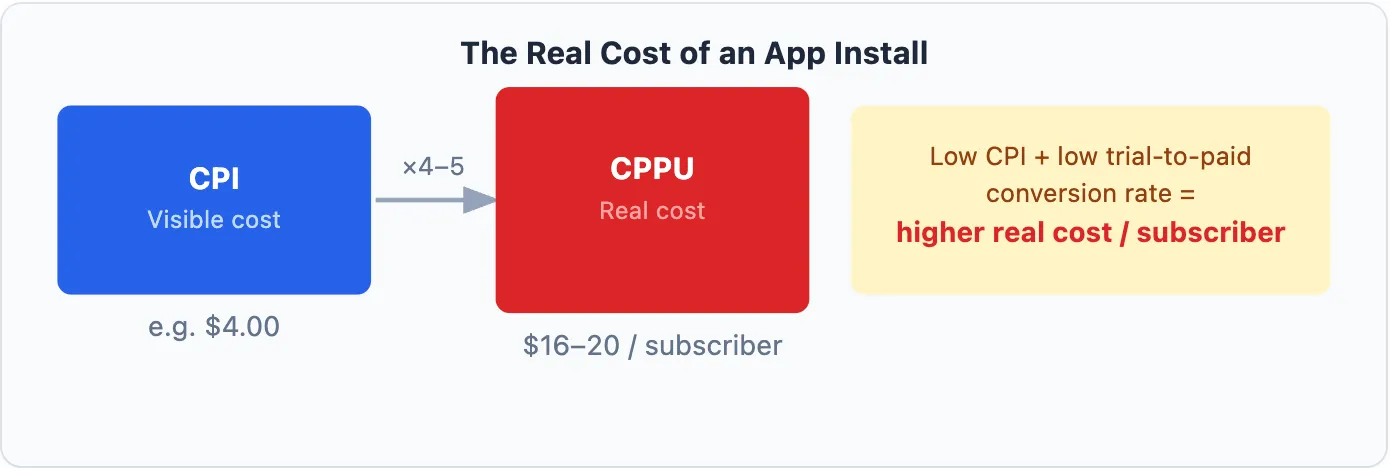
Your visible cost is Cost per Install (CPI). Your real cost is Cost per Paying User (CPPU). Analysis across 75,000+ subscription apps shows CPPU runs 4–5x higher than CPI. A $4 Meta Ads CPI likely means subscribers cost $16–$20, assuming that channel converts to paying users at all. Apps spending under $100K/month consistently outperform split strategies when budget stays concentrated on one channel. It doesn't save money to chase cheaper installs on the wrong channel. It costs more.> Diagram: The Real Cost of an App Install
2. Why trial-to-paid rate matters more than install cost
Trial-to-paid conversion rates vary significantly across subscription app categories. A channel that drives high install volume doesn't help if those users are unlikely to subscribe, which is why knowing your category's conversion baseline matters before setting CPI targets.
What Each Major App Ad Channel Is Built For
1. Meta Ads
Meta Ads is the most common starting channel for subscription apps, and usually for good reason. Its algorithm is the most mature in social advertising, and its interest- and behavior-based targeting, including lookalike audiences, lifestyle signals, and demographic profiles, makes it effective for apps with a clear user signal: fitness, wellness, productivity, finance. Advantage+ campaigns have reduced the manual optimization burden significantly, making Meta Ads accessible without dedicated UA expertise.
2. Google Ads
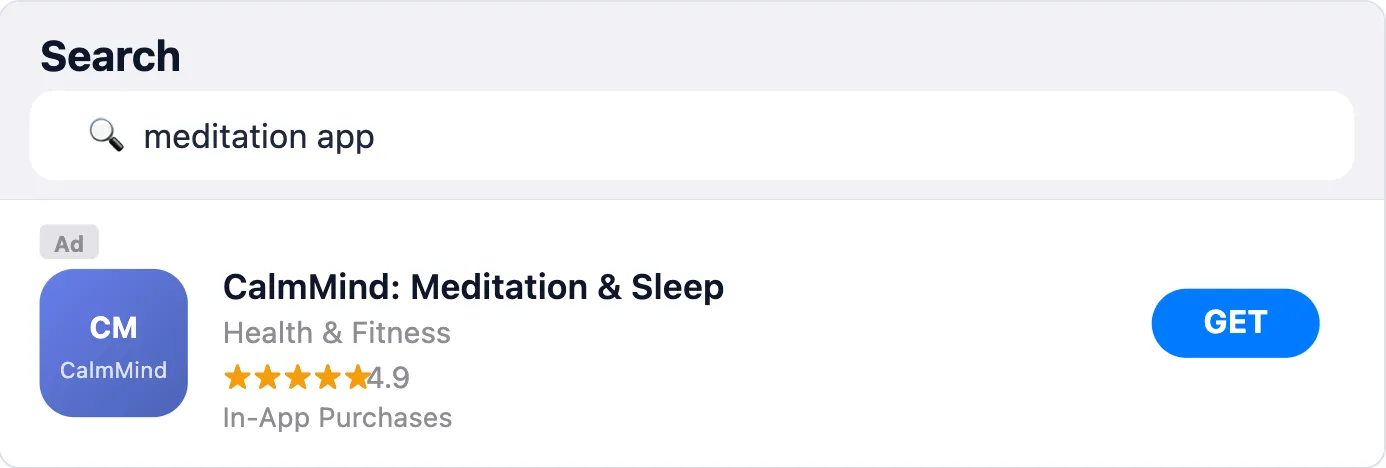
Google Ads runs across Search, Play Store, YouTube, and Display simultaneously. The key differentiator is intent: users searching "meditation app" or "budget tracker" have already expressed a need. For Android apps specifically, Google Ads is effectively required. It provides direct Play Store placement, and Android CPI runs at roughly a third of iOS equivalents. Health & Fitness iOS CPI averages $5.78; Business apps hit $14.08.
One caveat: Google's signal quality on iOS is significantly limited compared to Android. Google performs strongest where it controls the operating system and Play Store data. If your primary revenue comes from iOS subscribers, Meta Ads or Apple Ads will generally outperform Google Ads as a starting channel.
3. TikTok Ads
TikTok Ads excels at discovery. Its algorithm reaches users who didn't search for your app, making it powerful for awareness and top-of-funnel reach. CPM and CPC tend to run lower than Meta Ads equivalents, and the platform's user base skews toward younger demographics. TikTok Ads' attribution is less mature than other channels, and some conversions it registers may complete later through other touchpoints. It requires a consistent pipeline of native-style, short-form video, and will exhaust your creative library quickly, regardless of budget, if production can't keep pace.
4. Apple Ads (formerly Apple Search Ads)
Apple Ads places your app in App Store search results when users search for relevant keywords. It is the highest-intent channel available for iOS. These users are already on Apple's platform, already searching, already in a buying mindset. Apple Ads is also the only major channel unaffected by App Tracking Transparency (ATT), meaning clean attribution without opt-in friction. The trade-off is scale: Apple Ads captures existing demand but cannot create it.
One important constraint: unlike Meta Ads and Google Ads, Apple Ads cannot optimize toward trial starts or subscriptions. It optimizes for taps and installs only, which is why it works as a high-intent closer but hits a ceiling when you try to scale beyond branded and competitor keywords.
Want to see how App ad channel works with your data?
Get hands-on with Airbridge and see real results.
Try It Free →The 4 Factors That Determine Channel Fit
1. App category and LTV
Channel economics only make sense relative to your Lifetime Value (LTV). Health & Fitness apps average $27.21 Y1 LTV per subscriber; Business apps average $27.24. A $5.78 iOS CPI is sustainable for Health & Fitness at $27 LTV. For apps with lower subscriber LTV, that same CPI leaves very little room for payback. Know your category's LTV range before setting CPI targets.
2. Budget level
Below $10,000/month, pick one channel and go deep. Each channel needs enough conversion events per week to exit its learning phase. Splitting $5,000 across two channels gives each too little to learn from. Above $50,000/month, a second channel becomes testable. Above $100,000/month, diversification across multiple self-attributing networks starts making economic sense.
A practical rule: set your daily budget at minimum 10x your target CPA. If your cost-per-trial target is $10, your minimum daily budget is $100. Below that, the algorithm does not receive enough conversion signals to optimize delivery.
3. Creative capability
Each channel requires a different format and refresh cadence. The table below also shows the minimum starting assets needed — a practical filter before committing to any channel.
| Channel | Primary Format | Refresh Needed | Min. Starting Assets |
|---|---|---|---|
| Meta Ads | Static + video (Reels, Stories) | Every 2–3 weeks | 5 creatives per ad group |
| Google Ads | Mixed (images, video, copy) | Monthly | 5 headlines, 5 descriptions, up to 20 images/videos |
| TikTok Ads | Short vertical video (UGC-style) | Weekly | 5–6 ads per ad group |
| Apple Ads | App Store screenshots + metadata | Quarterly | Existing App Store assets only |
4. iOS vs. Android priority
iOS still generates the large majority of global subscription app revenue, but Android has crossed 51% of total paid install volume. For iOS-first apps, prioritize Meta Ads and Apple Ads. For Android-first or dual-platform apps, Google Ads is essential for Play Store placement. For iOS subscription apps focused on conversion, note that TikTok Ads' SKAdNetwork attribution on iOS is more constrained due to platform privacy limits, which can affect measurement accuracy.
When to Add a Second Channel
Add a second channel when your first is working. Adding channels to diagnose why something isn't performing usually spreads the problem thinner rather than solving it. Three questions determine readiness.
Do you have clear unit economics on your primary channel? You need CPPU, subscriber LTV, and D30 ROAS before expanding. Without a baseline, you can't tell whether a second channel is better or worse. You're just adding noise.
Can you produce creative for two formats simultaneously? Adding TikTok Ads to a Meta Ads setup means a different format, refresh rate, and production pipeline. If your team is already stretched, quality drops on both.
Do you have budget to fund both without thinning either? A split at the $5,000–$10,000/month level doesn't produce two winners. It gives you two channels stuck in the learning phase.
A practical approach: adapt your best-performing creative for the new channel's format, allocate 15–20% of total budget as a 30–45 day test, and measure CPPU, not installs. If results match or beat your primary channel, scale. If not, reallocate.
What the first four weeks actually look like
Most founders quit a new channel too early because they don't know what the learning phase looks like from the inside. A channel has not been properly evaluated until it completes all four phases:
-
Week 1 — Anxiety: CPMs spike and can feel alarming. Ads may sit in review. This is normal algorithmic exploration, not failure.
-
Week 2 — Hope: CPMs drop significantly. First real daily purchases appear. Creative optimization becomes possible for the first time.
-
Week 3 — Confidence: Volume becomes consistent. The window opens for refreshing or expanding creatives.
-
Week 4 — Stabilization: Your addressable audience is found. CPA stabilizes. Now you have enough signal to make a scaling or channel-addition decision.
Many subscription apps write off a channel in Week 1 that would have performed well by Week 4. Before adding a second channel, your primary channel should have completed all four phases.
What to Track Once Your Channel Is Live
Ad dashboards report installs. Your billing platform reports subscribers. Neither connects those facts by default, which is where most early-stage apps lose budget without realizing it. The metrics that matter look different from what ad dashboards show.
| Metric | What it measures | Why it matters |
|---|---|---|
| Cost per Subscriber (CPS) | Ad spend ÷ paying subscribers from that channel | Replaces CPI as your actual decision metric |
| Trial-to-Paid Rate by Channel | % of trialists who subscribe, per channel | Reveals which channels send high-intent users |
| LTV by Channel (D30 / D60) | Revenue per subscriber per channel over time | Shows long-term value, not just upfront conversion |
| Attribution Rate | % of subscribers with a known channel source | Shows how complete your tracking setup is |
You need to know your cost per subscriber by channel, not just CPI. Airbridge shows you which campaigns drive actual subscriptions, starting free with 15,000 installs.
The apps that scale fastest on paid UA are not the ones that tested every channel simultaneously. They're the ones that mastered one.
FAQs
Should I run Meta Ads and Google Ads at the same time from the start?
Not if your budget is below $10,000/month. Splitting that across two channels gives each too little data to exit the learning phase. Pick one, run for 30–45 days, and expand only once you have unit economics to compare a second channel against.
Is TikTok Ads worth testing for a subscription app?
TikTok Ads can work well for subscription apps, particularly in lifestyle, health, and wellness verticals where short-form video content resonates. It offers broad reach and competitive CPMs. However, it requires a consistent pipeline of native-style video, and performance tends to be more volatile than Meta Ads, making it a harder place to validate product-market fit or stretch an early budget.
For most subscription apps, the practical approach is to establish a primary channel first, then test TikTok Ads with a portion of budget once your core unit economics are stable. For a deeper guide, see The Essential Guide to TikTok Ads for Subscription Apps by RevenueCat.
Do I need Apple Ads if I'm already running Meta Ads?
For iOS subscription apps, Apple Ads is worth adding once your Meta Ads budget is established. It captures high-intent users who are actively searching for apps like yours, a segment that Meta Ads doesn't typically reach. Apple Ads doesn't replace Meta Ads. It closes a different part of the funnel. Use it alongside Meta Ads rather than instead of it.

Ready to transform your mobile growth?
Learn how Airbridge helps leading brands measure and optimize every touchpoint.