Trial to Paid Conversion Rate by Channel: A Setup Guide
Trial to paid conversion rate by channel compares mature cohorts with consistent attribution and timing; learn the formula and how Airbridge reports results.
How to compare trial-to-paid conversion by channel
- Group trial starts by one consistent acquisition-attribution rule.
- Divide paid conversions within a chosen window by the eligible trial starts in that cohort.
- Compare cohorts only after each has had the full window to convert.
- Use a report that connects subscription events to channel, campaign, and creative.
Trial to paid conversion rate by channel shows what share of each acquisition channel’s trial starters become paying subscribers within the same time window. To calculate it fairly, define the trial-start cohort, use a consistent channel attribution rule, and count paid conversions within a fixed period after trial start. Airbridge publishes this guide. Its Core Plan connects subscription outcomes from supported billing platforms to acquisition reporting, and its Funnel Report shows subscription rate and cost by channel, campaign, and creative.
1. Assign trial starts to an acquisition channel
A channel comparison begins with a trial-start cohort: the set of users whose eligible free trials began during a defined period. For every trial start, keep the start timestamp and the acquisition channel assigned to that user under your attribution provider’s rules. Use the same rules for every channel and every cohort in the comparison.
Attribution rules decide which eligible acquisition touchpoint receives credit. Record your chosen channel-assignment rule with the report definition. Keep that rule separate from the trial-to-paid window, which sets how long after trial start a payment counts.
Use one acquisition record per trial start. If your reporting system offers first-touch and last-touch views, select one for the comparison and keep it fixed. A user who saw an ad, clicked another ad, and later installed the app should receive the channel label the selected attribution model assigns, rather than being counted once in every channel.
Define which starts qualify before comparing results. For a standard free-trial metric, count trial-start events for new subscription trials, and apply the same rule to each channel. If you count a delayed “qualified trial” after a user remains active for several hours, use that event in every channel cohort instead of mixing it with immediate trial starts. In RevenueCat’s 2025 State of Subscription Apps, a qualified-trial event fires a few hours into the trial only for users still active at that point. That definition measures a narrower group than all trial starts, so label the metric clearly.
2. Set the denominator and conversion window
Use eligible trial starts as the denominator and those same trial starters who become paid within the selected number of days as the numerator. The formula is: trial-to-paid rate = trial starters who convert within the window ÷ eligible trial starts in the cohort. Count each trial starter once, even if that person later has multiple payments or renewals.
| Measure | Count | Keep it consistent |
|---|---|---|
| Trial-start cohort | Eligible users whose trial began in the selected period | Trial event, eligibility rule, and cohort dates |
| Paid conversion | Cohort members whose first paid subscription begins within the selected window | Paid event and time counted from trial start |
| Trial-to-paid rate | Paid conversions divided by eligible trial starts | Window length and attribution rule |
A fixed window makes newer and older channel cohorts comparable. If you choose 30 days, include a cohort only after every trial in it has had 30 days to convert. A January cohort with 200 eligible trial starts and 54 paid conversions within 30 days has a 27% trial-to-paid rate. The 30-day period is an example; choose a period suited to your trial length and reporting decision, then apply it across channels.
In ChartMogul’s trial-to-paid report, the rate divides customers who started both a trial and a paid subscription in a given period by customers who started a trial during that period. Its “Trial-to-paid in days” filter measures the share of trials that convert to paid subscribers within the selected number of days. Trial-to-paid cohort results can change retroactively as trial starters subscribe later, according to ChartMogul’s report guidance.
Keep trial-to-paid rate separate from trial-start rate and return on ad spend. Trial-start rate counts users who begin a trial; trial-to-paid rate counts trial starters who become paying subscribers. Revenue or return on ad spend adds the value of paid subscriptions and spend, which the conversion percentage alone does not measure.
3. Connect the channel to the later paid event
The data path has three linked records: an acquisition attribution, a trial-start event, and a first-paid-subscription event. Preserve the user or customer key and event time through the path so you can verify that the later paid event belongs to a member of the original trial cohort. Keep renewals and refunds available as separate subscription outcomes, because they answer follow-up questions about revenue and retention rather than the initial conversion rate.
Use this short audit before trusting the channel breakdown:
- Confirm that the acquisition record assigns the app user to one channel using your chosen attribution rule.
- A trial-start event and timestamp are needed to place each user in the trial cohort.
- Confirm that the first paid event maps to the same customer and includes its event time.
- Confirm that your analysis counts the paid event only when it falls inside the chosen window after trial start.
Airbridge Core connects trial conversions, first payments, renewals, and refunds from RevenueCat, Adapty, and Superwall to acquisition reporting. Map the trial event and first paid outcome to the same customer journey in your report, using the event names and identity setup your app sends.
4. Choose a report with channel context
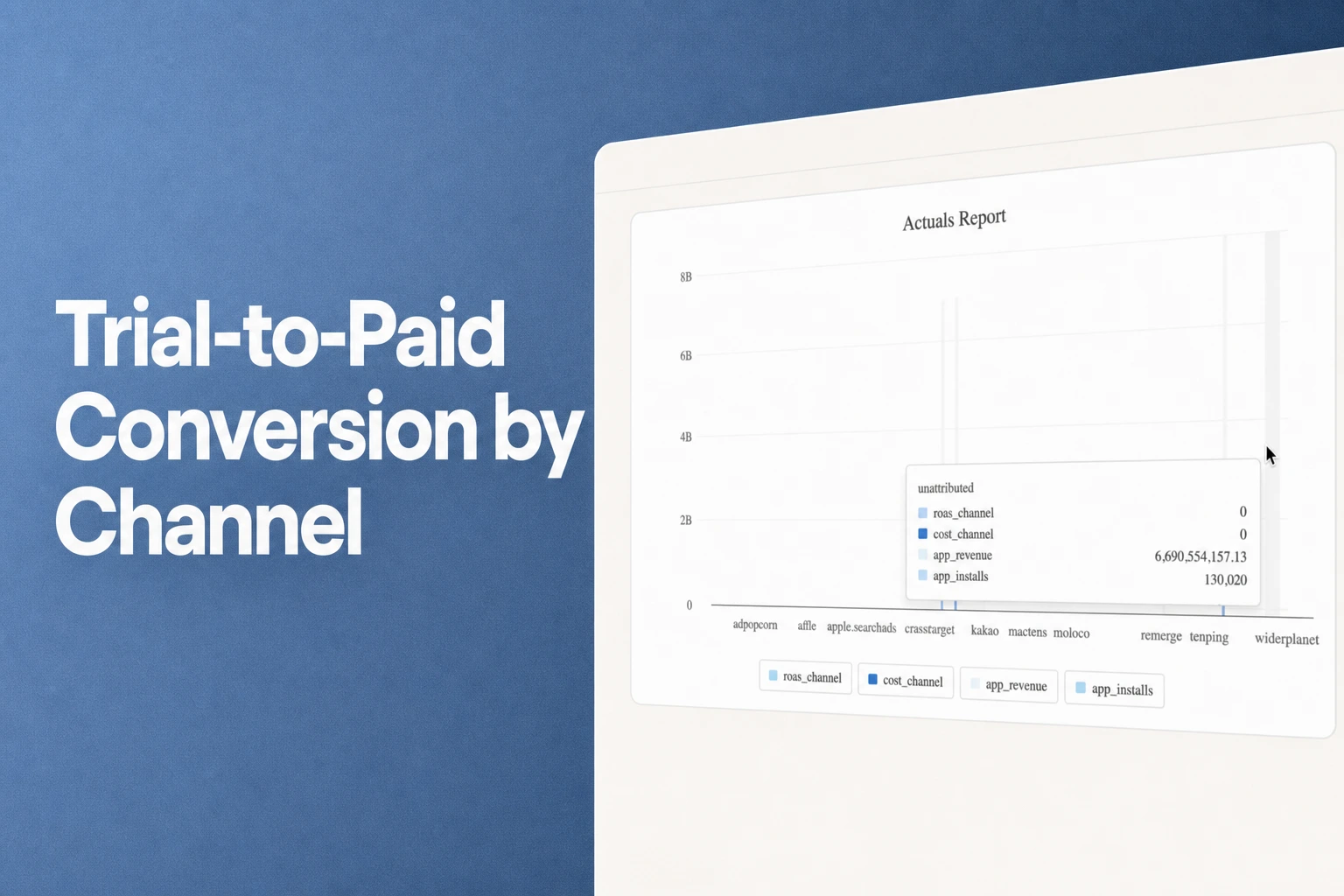
A useful report should group subscription outcomes by acquisition channel and show the underlying metric’s event definition and time window. It should let you inspect the trial-start cohort and paid conversion count, or let you calculate those counts from event data. Campaign and creative breakdowns help narrow a channel-level gap to the ads that brought those users in.
Airbridge Core’s Funnel Report shows subscription rate and cost by channel, campaign, and creative. Airbridge Subscription Attribution supports funnels from install and onboarding through free-trial start, trial-to-paid conversion, and renewal.
Before using any displayed rate as your fixed-window trial-to-paid metric, align its trial-start event, paid event, cohort dates, and conversion window with the definition above. If your report presents a broader subscription rate, use it to locate channel, campaign, or creative patterns, then calculate the fixed-window figure from the same cohort’s trial and first-payment events. Keep the event definition beside the result so the next report uses the same metric.
5. Read a channel gap as a prompt for investigation
A higher rate identifies a channel whose observed trial cohort converted more often under your stated attribution and time-window rules. Treat the observed gap as a prompt to compare campaign, creative, trial offer, geography, and paywall experience across the cohorts. Channels can bring users with different intentions, and the cohorts can also differ in campaign, creative, trial offer, geography, or paywall experience.
The RevenueCat 2026 State of Subscription Apps reports median trial-to-paid conversion of 19.5% in MEA and 34.2% in North America, illustrating how geography mix can shift a channel cohort’s rate. Apply the same discipline to trial-to-paid comparisons: note changes in audience mix, trial length, paywall, price, and campaign composition before treating a rate shift as a channel effect. The 2025 State of Subscription Apps identifies early cancellations as a signal of cohort quality that can inform user-acquisition decisions. If one channel has more trial starts but fewer paid conversions, compare its cancellations and conversion timing as well as its final rate.
If channel rates differ while the offer and paywall stayed stable, inspect campaign and creative cohorts for a concentration of the difference. If the trial length, price, or onboarding changed during the comparison, separate those periods before changing spend. To test whether a channel or campaign change caused an improvement, run a controlled experiment that keeps the offer and conversion window consistent; use the channel report to decide what to test next, not as a standalone causal verdict.
A usable channel-level rate comes down to a repeatable definition: one eligible trial-start cohort, one attribution rule, one paid-conversion event, and one conversion window. With those choices held steady, channel reports can show where trial starters become subscribers and where a closer campaign-level check is worth the time.
Get Started Free
See how these criteria hold up on the real thing.
Related reading