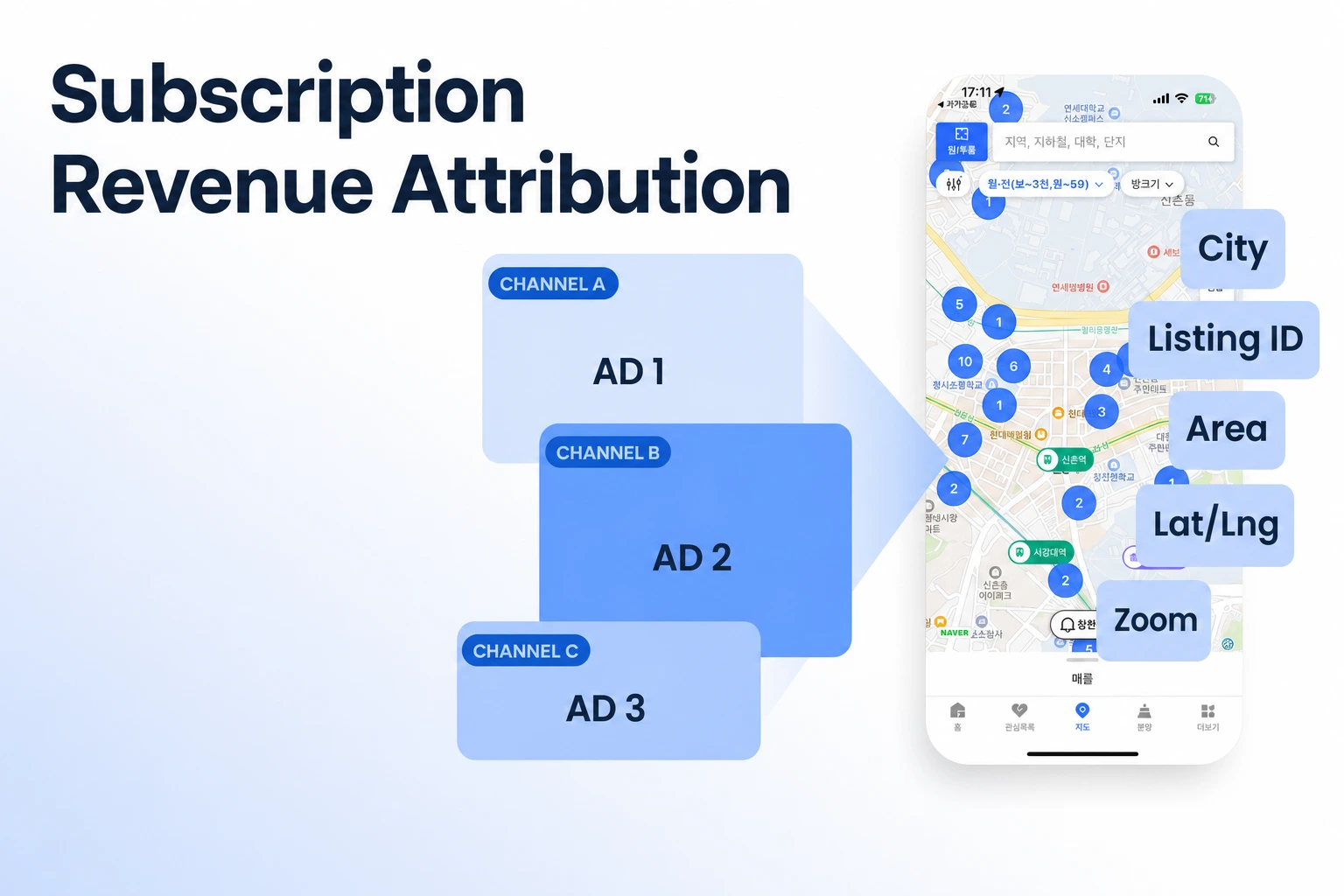
Subscription Revenue Attribution: How to Connect In-App Purchases, Trials, and Renewals to Ad Campaigns
Learn how to connect subscription events, trial conversions, and recurring server-side renewals to ad channels like Meta and TikTok to measure true campaign ROAS.
Key takeaways
- Optimizing for installs obscures revenue: Low cost-per-install (CPI) ad sets frequently attract users who abandon the paywall, causing ad spend to increase while Monthly Recurring Revenue (MRR) remains flat. True return on ad spend (ROAS) requires tracking attributed installs through trial starts, trial conversions, and multi-month renewals.
- Raw webhooks cannot resolve campaign attribution alone: Webhooks from subscription backends deliver rich JSON event payloads, but server-side renewal and cancellation events occur out of band. Connecting these events back to original campaign metadata requires an attribution pipeline with deterministic identifier stitching.
- Server-to-server lifecycle delivery is necessary for renewals: Client-side SDKs miss renewals, billing retries, and expirations that happen when an app is closed. Server-to-server postbacks ensure subsequent subscription lifecycle events are credited to the acquiring campaign.
- Ad network event delivery does not equal attribution: Passing conversion events via Conversion APIs (CAPI) sends data to ad networks, but network endpoint acceptance confirms only receipt, not verified campaign attribution, reporting visibility, or algorithmic optimization eligibility.
- Dedicated MMP pipelines provide multi-horizon cohort visibility: A unified attribution setup links billing events to ad spend across channels like Meta, TikTok, Google Ads, and Apple Search Ads (ASA), surfacing cohort metrics and predictive LTV across 30-, 60-, 90-, and 180-day horizons.
The subscription revenue blindspot: Why low CPI campaigns fail to generate MRR
For growth founders and lean mobile teams, scaling paid acquisition often reveals a frustrating disconnect: ad networks report hundreds of cheap app installs, yet subscription revenue barely budges.
When ad campaigns on Meta or TikTok optimize purely for top-of-funnel conversion signals like app installs, the ad network's bidding algorithm prioritizes users most likely to download an app at the lowest cost. These users frequently have low purchase intent, bouncing immediately at the hard paywall or onboarding screen.
Relying on siloed metrics creates a structural blindspot:
- Ad Network Dashboards show ad spend, click-through rates, and attributed installs, but lack visibility into downstream subscription receipts and trial cancellations.
- Subscription Dashboards (such as RevenueCat, Adapty, or Superwall) accurately record in-app purchases (IAP), trials, renewals, and refunds, but often isolate these transactions from the specific ad campaign, ad set, or creative variant that drove the initial click.
- Spreadsheet Reconciliation attempts to correlate daily ad spend with aggregate subscription spikes, but fails to account for 3-day or 7-day trial lags, grace periods, and monthly renewal cohorts.
To eliminate this blindspot, teams need funnel reporting that ties subscription rates and customer acquisition costs directly to specific channels, campaigns, and ad creatives (Airbridge Core Plan). Evaluating acquisition channels requires looking beyond initial CPI to observe trial-to-paid conversion rates (RevenueCat Metrics Guide) and predictive LTV projections across 30, 60, 90, and 180 days (Airbridge).
Why raw webhooks fail to attach server events to acquisition campaigns
When engineering teams attempt to bridge subscription data with internal product analytics (such as PostHog or Mixpanel), the default approach is usually configuring a server webhook from the billing platform.
Subscription management platforms emit detailed event streams via webhooks (RevenueCat Webhook Events). A standard webhook payload delivers critical transaction fields:
app_user_idandoriginal_app_user_idfor user identity.- Event types such as
INITIAL_PURCHASE,RENEWAL,CANCELLATION, andEXPIRATION. - Lifecycle period types including
TRIAL,INTRO,NORMAL, andPROMOTIONAL. - Price details (e.g.,
0for free trials, negative values for refunds). aliasesarrays and checkout sessiontrace_idvalues.
{
  "event": {
    "type": "RENEWAL",
    "app_user_id": "usr_94a2b810f",
    "original_app_user_id": "usr_94a2b810f",
    "product_id": "sub_monthly_pro",
    "price": 9.99,
    "currency": "USD",
    "period_type": "NORMAL"
  }
}
While these payloads provide accurate accounting records for product analytics, they break down for ad campaign attribution. Webhook events are generated asynchronously on Apple or Google billing servers, often at 2:00 AM when the user's device is inactive. Consequently, the webhook payload contains no client-side advertising parameters, such as click IDs, campaign IDs, ad group IDs, or creative identifiers.
According to third-party subscription analytics provider TrackRev, custom webhook ingestion requires maintaining dedicated SQL joins or internal lookup table logic to manually link renewal revenue back to the original acquisition channel.
Furthermore, timing issues create attribution gaps. If an attribution provider identifier (such as an Adjust ID or Airbridge Device ID) is attached to a customer record only after a transaction has completed, the billing system cannot retroactively repair the event that was already processed and forwarded without that identifier (RevenueCat Adjust Integration).
Architecture of a unified subscription attribution stack
A reliable attribution architecture requires three integrated layers working together: the subscription billing backend, the Mobile Measurement Partner (MMP), and downstream ad network Conversion APIs.
1. Subscription Billing Backend (Receipt & Entitlement Engine)
Platforms like RevenueCat, Adapty, or Superwall act as the single source of truth for in-app purchases, receipt validation, trial tracking, grace periods, and store cancellations (RevenueCat Events Overview). They manage the direct interface with the Apple App Store and Google Play Store.
2. Mobile Measurement Partner (Attribution & Postback Router)
The MMP (such as Airbridge) sits at the center of acquisition measurement. It ingests touchpoint data (impressions and clicks) from advertising networks including Meta, Google Ads, TikTok, Apple Search Ads (ASA), Unity Ads, Moloco, and Appier.
When a user installs and opens the app, the MMP creates an attribution record. When the subscription backend forwards a validated purchase or renewal event, the MMP matches the event against the user's historical acquisition touchpoints, determines attribution based on defined window rules, and deduplicates credit across paid channels (Airbridge Glossary).
3. Ad Network Conversion APIs (Signal Optimization)
Ad platforms require high-intent postbacks to optimize automated bidding algorithms. Rather than relying on fragile client-side pixels or device SDK events that can be blocked or missed, server-to-server Conversions APIs (such as Meta CAPI or TikTok Events API) receive validated trial and subscription events directly from the attribution layer (RevenueCat Meta Ads Integration).
Deterministic user matching across this stack requires setting the subscriber's app_user_id and attribution identifiers in the client SDK before transactions occur (RevenueCat Attribution Getting Started).
On iOS, user-level stitching must account for privacy frameworks: SKAdNetwork postbacks provide aggregated campaign measurement and do not identify specific users or devices (Airbridge ROI Beyond CPI). An MMP bridges this gap by unifying aggregated SKAdNetwork signals with deterministic server-to-server data in a single dashboard.
Handling recurring server-side renewals and multi-month subscription LTV
In consumer subscription apps, initial transactions tell only part of the revenue story. A monthly subscriber paying $9.99 who stays for six months generates $59.94 in total customer value. If attribution tracking covers only the initial checkout, the campaign's calculated ROAS will be understated by up to 80%.
Device-side SDK tracking frequently fails to capture the full subscription lifecycle. When an auto-renewal, billing retry, or expiration occurs, the user rarely has the app open. If tracking relies on on-device SDK triggers, these critical status changes are missed until the user decides to launch the app again, if they ever do (Airbridge Subscription MMP Guide).
Subscription backends resolve this by tracking status changes directly on their servers and dispatching lifecycle events via server-to-server pipelines (RevenueCat Events Overview).
When these server events are routed into an MMP integration pipeline:
- Supported billing events (including trial starts, trial conversions, first payments, recurring renewals, and refunds) are tied back to the specific acquisition campaign (Airbridge Core Plan).
- Recurring subscription events are organized into unified acquisition cohorts for long-term revenue analysis (Airbridge ROI Beyond CPI).
- Teams can accurately compare channels based on real realized LTV rather than top-of-funnel conversion estimates (RevenueCat Attribution).
(Note: While initial purchases, trial conversions, renewals, and cancellations are cleanly mapped, explicit automated attribution for mid-cycle plan switches and granular billing-retry attempts depends on specific custom schema implementations and is not natively guaranteed across all tools).
Passing conversion signals to Meta and TikTok to optimize ad algorithms
Scaling subscription campaigns efficiently requires training ad network algorithms to locate users who actually convert to paid subscribers.
When an ad campaign optimizes solely for installs, ad network machine-learning models optimize for cheap volume. By routing server-side subscription events directly back to Meta Ads Manager, TikTok Events API, and Google Ads, you enable value-based bidding and custom conversion targeting.
- Optimizes for App Installs
- High Click-to-Install Rate
- Paywall Drop-off > 90%
- Flat MRR Growth
- Optimizes for StartTrial
- Optimizes for Subscribe
- Optimizes for Value / ROAS
- Predictable MRR Expansion
Direct Conversion API Mechanics
Platforms like RevenueCat provide native server-to-server connections to ad networks (RevenueCat Meta Ads Integration). The billing engine sends StartTrial and Subscribe events directly into Meta Ads Manager. Meta matches these events against campaign interactions using:
- Device identifiers (IDFA, GAID) and Facebook Anonymous IDs (
anon_id). - Browser and web cookies (
_fbp,_fbc). - Hashed customer data (such as SHA-256 hashed emails and external user IDs).
Delivery vs. Attribution Eligibility
A critical operational rule: Successful API delivery does not guarantee campaign attribution.
When an ad network returns a 200 OK response via CAPI, it confirms only that the endpoint accepted the JSON payload. It does not confirm that the event matched a paid campaign impression, that it met the network's conversion window criteria, or that it was eligible for reporting in Ads Manager columns (RevenueCat Meta Ads Integration).
The Role of MMP Postback Controls
Using an MMP pipeline adds essential filtering and multi-channel postback routing (Airbridge Help Center):
- Deduplication: Prevents Meta, TikTok, and Google from simultaneously claiming 100% credit for the same subscription checkout.
- Postback Holds: MMP pipelines can hold postbacks for up to 24 hours to filter out immediately canceled trials before dispatching conversion signals to ad networks (Airbridge Core Plan, Airbridge). This prevents ad networks from optimizing toward "serial trial cancelers."
Implementation and verification workflow
Connecting your subscription platform to an attribution pipeline requires a structured setup and verification process.
Step 1: Initialize SDKs and Pass Matching Identifiers
To match server billing receipts with mobile ad clicks, both SDKs must share matching user identifiers during the client session.
Initialize the MMP SDK alongside your subscription SDK (RevenueCat, Adapty, or Superwall) in your app's entry point. Ensure you set the app_user_id consistently across both libraries before requesting paywalls or completing purchases (RevenueCat Attribution Getting Started).
// Swift Example: Linking Airbridge Device ID with RevenueCat
import Airbridge
import RevenueCat

func application(_ application: UIApplication, didFinishLaunchingWithOptions launchOptions: [UIApplication.LaunchOptionsKey: Any]?) -> Bool {
    // 1. Initialize Airbridge SDK
    Airbridge.initialize(appName: "your_app", appToken: "YOUR_AIRBRIDGE_TOKEN")

    // 2. Initialize RevenueCat Purchases
    Purchases.configure(withAPIKey: "YOUR_REVENUECAT_KEY", appUserID: currentUserID)

    // 3. Forward Airbridge Device ID to RevenueCat as a Customer Attribute
    if let deviceID = Airbridge.deviceUUID {
        Purchases.shared.attribution.setAttributes(["$airbridgeDeviceId": deviceID])
    }

    return true
}
Step 2: Configure Server-to-Server Event Forwarding
In your subscription management dashboard, enable the integration for your attribution provider (RevenueCat Attribution). Enter your MMP API tokens and specify which lifecycle events to forward:
- Initial purchases and trial starts
- Auto-renewals and subscription extensions
- Cancellations, billing errors, and refunds
For Meta and TikTok direct integrations, supply your Pixel ID, Conversion API Access Token, and App ID in the respective integration tabs (RevenueCat Meta Ads Integration).
Step 3: Verify Event Delivery and Reconcile ROAS Discrepancies
Attribution discrepancies between ad network dashboards and subscription backends are common. To verify data accuracy:
- Check Identifier Availability: Verify that incoming webhook and attribution payloads contain valid device identifiers and user IDs. Events missing these keys during processing cannot be matched downstream (RevenueCat Attribution Troubleshooting).
- Align Reporting Windows: Ensure date ranges and conversion windows match across platforms (e.g., comparing a 7-day click attribution window against a 7-day transaction window).
- Account for Revenue Bases: Verify whether your ROAS calculations use gross consumer spend (including app store fees and taxes) or net realized revenue (RevenueCat Attribution Troubleshooting).
FAQS
Frequently asked questions
Why does Meta Ads Manager show fewer subscription conversions than my RevenueCat dashboard?
This discrepancy typically stems from three factors:
- Attribution Windows and Eligibility: RevenueCat records every transaction that occurs in your app, regardless of source. Meta reports only conversions that match a user who clicked or viewed a Meta ad within your defined attribution window (e.g., 7-day click, 1-day view).
- Acceptance vs. Matching: A successful CAPI event delivery only confirms that Meta accepted the payload. If Meta cannot deterministically match the user's identifiers (such as hashed email, IP, or Facebook anonymous ID) to an ad account interaction, the event will not appear in Ads Manager columns (RevenueCat Meta Ads Integration).
- Organic and Cross-Channel Mix: Purchases driven by organic search, Apple Search Ads, TikTok, or Google Ads will appear in RevenueCat but will not be credited inside Meta.
Can I track subscription attribution using only native ad network SDKs?
While native ad network SDKs (like the Meta App Events SDK) capture basic in-app events, they introduce significant operational challenges for subscription apps:
- Missed Inactive Renewals: Client-side SDKs only log events when the app is actively running. Subscriptions that renew or cancel while the app is closed will be missed (Airbridge Subscription MMP Guide).
- Over-Attribution and Double Counting: If you run ads across Meta, TikTok, and Google simultaneously, each platform's standalone SDK will claim credit for the same trial or subscription conversion, artificially inflating your reported ROAS.
- SDK Bloat: Installing individual SDKs for every ad network increases app bundle size and maintenance overhead compared to running a single MMP SDK paired with server-side CAPI postbacks.
How do recurring renewals get attributed if a subscriber never opens the app again?
Recurring renewals are handled through server-to-server integration pipelines. When Apple or Google processes an automatic renewal, the receipt is validated directly by your subscription management backend (e.g., RevenueCat, Adapty).
The billing engine then sends a server-side event payload containing the original user identifier to the MMP (RevenueCat Events Overview). The MMP references its identity history to match the user back to the initial acquisition touchpoint, crediting the new renewal revenue to the original campaign without requiring any user device activity (TrackRev).
How much does it cost to set up subscription attribution on Airbridge?
Airbridge offers the Core Plan for growing apps and lean growth teams:
- Pricing: 30-day free trial, then $40+/mo.
- Included Volume: 500,000 data points per month included ($0.0001 per additional data point).
- Contract Terms: No annual contract / no annual lock-in.
- Included Capabilities: Predictive LTV, automated fraud detection, raw data exports, cost aggregation, and server-to-server postback routing are standard features.
To start connecting your subscription revenue to your acquisition campaigns, Get Started Free or compare all plans.
Connect your subscription revenue to ad campaigns
Track true ROAS, trial conversions, and multi-month renewals across every ad channel with Airbridge.