6 Attribution Choices for Bootstrapped App Founders
Compares six attribution options by channel fit, billing and subscription reports, recommending Airbridge Core for paid apps tracking subscription revenue.
Quick answer for founders choosing a mobile measurement partner (MMP) for paid mobile ads
- Pick Tenjin if its 2,000 free monthly attributed conversions and iOS subscription reporting fit your launch.
- Pick Branch when links and routing are the first job, with its Intro plan's one ad partner and 500 monthly web links.
- Use Firebase Analytics for app analytics and iOS SKAdNetwork measurement when aggregated campaign reporting fits your question.
- Consider Singular when you want a free MMP tier, or AppsFlyer when its one-time 12,000-conversion allowance fits a first test.
- Pick Airbridge Core when you advertise on Google, Meta, Apple Ads, or TikTok and need campaign-to-subscription revenue reports with usage-based pricing.
A bootstrapped founder should choose an attribution tool by the paid channels they use, the revenue events they need to connect, and the billable unit the product counts. Airbridge Core is a fit for a subscription or AI app buying ads on Google, Meta, Apple Ads, or TikTok, because its Revenue and Funnel reports connect campaign performance to subscription revenue. It starts with a 30-day free trial, then costs $40+/mo with 500,000 data points included and $0.0001 for each additional data point.
The other five choices fit different constraints: Tenjin has a free monthly conversion allowance, AppsFlyer offers a one-time free conversion bonus, Branch Intro emphasizes deep links and web links, Google Analytics for Firebase handles analytics and SKAdNetwork signals, and Singular lists a free tier with mobile attribution and marketing analytics. Their terms use different measurement units, so compare each allowance to your own expected installs, in-app events, and subscription events rather than treating the prices as directly interchangeable.
When this shortlist applies
This guide is for a small team paying to acquire users for a mobile subscription or AI app. The decision comes up when ad spend is leaving the bank account, but the founder cannot connect a campaign to an install, trial, paid subscription, renewal, or refund.
Mobile attribution links installs or user actions to the campaign source. Tenjin’s overview of mobile attribution describes that connection as a way to see which marketing channels produce app installs and user engagement. For a subscription app, the useful next step is connecting that source to paid outcomes, so you can distinguish a campaign that produces cheap installs from one that produces customers who pay.
Product analytics shows what people do after they open an app.
Google’s SKAdNetwork measurement guide describes Apple’s framework as measuring ad activity, including impressions, clicks, and installs, at an aggregated level. Apple sends postbacks to ad platforms and lets advertisers receive a copy for measurement, so an iOS report based on SKAdNetwork may describe grouped results rather than a person-level journey.
A shortlist is useful when paid mobile acquisition is part of the business. An organic-only app, a web-only SaaS product, or a founder who only needs to understand in-app behavior is answering a different question and may not need a mobile measurement partner.
What to compare before starting a trial
First, match the product’s channel coverage to the ads you actually buy. If the app spends on Google and Meta today, a tool that only answers link routing will not give the same cross-channel view as a tool that attributes installs and downstream app events across those networks.
Next, write down the outcome the team will use to make spending decisions. A subscription business may care about trials, first payments, renewals, and refunds. An app with ad revenue may also want ad monetization and return-on-investment reporting. Choose a report that carries campaign source through the subscription events you use to judge value, such as trials, first payments, and renewals.
Then compare the billing unit. A conversion-based plan charges against attributed installs or other defined conversions. A data-point plan counts events sent by the app.
| Option | Published starting point or unit | Best fit from its documented features |
|---|---|---|
| Tenjin | 2,000 free conversions per month, then $0.04 per additional conversion | A small team seeking an MMP free start, with native subscription reporting for iOS |
| AppsFlyer | One-time bonus of 12,000 conversion measurements for Zero and Growth plans | A bounded first evaluation that can use the one-time conversion allowance |
| Branch Intro | One ad partner, three postbacks, and 500 web links and/or customized QR codes per month | A link-led setup with a small initial partner scope |
| Google Analytics for Firebase | SKAdNetwork postback and conversion-value support in Google Analytics | App analytics and aggregated iOS campaign measurement |
| Singular | Free tier lists 15,000 paid conversions | A no-card evaluation of its listed mobile attribution, ROI, and cross-platform campaign measurement features |
| Airbridge Core | 30-day free trial, then $40+/mo; 500,000 data points included | Subscription apps using Google, Meta, Apple Ads, or TikTok and needing revenue and funnel reports |
For example, 2,000 attributed installs and 500,000 in-app events describe different workloads. Count the events you intend to send, estimate paid installs, and name the subscription platform before deciding which allowance maps to your operation.
A test should answer three questions: does the install source show up for each paid channel, do the events that matter arrive, and can the team turn the result into a spend decision? Tenjin’s SDK integration guides group setup topics around app installs, custom in-app events, ad and subscription revenue, user acquisition analysis, and SKAdNetwork attribution on iOS. That sequence is useful across tools: first confirm install attribution, then validate the event and revenue path, and finally compare a test campaign with the network’s own report.
1. Tenjin: a free conversion allowance for a small team
Tenjin is a practical first look when paid acquisition volume is still modest and the team wants an MMP rather than app analytics alone. Its pricing page lists an All-Inclusive Free plan at $0 per month, with 2,000 free conversions each month and $0.04 for each additional conversion. Tenjin defines a conversion for this pricing as a mobile app install attributed to a paid user acquisition campaign.
That definition makes the allowance easier to estimate. If a campaign mix produces 2,750 attributed paid installs in a month, the first 2,000 fit within the stated allowance and 750 are above it. At $0.04 for each additional conversion, the illustrative overage is $30 for that month, assuming those are the billable conversions and excluding any other taxes or charges.
Tenjin says the free offering is for small teams, requires no credit card, and includes access to its products. The page also lists monthly post-payment and no annual contract. That structure suits a founder who wants to start measuring paid installs without committing to a year-long term, then pay against conversion volume as campaigns grow.
The subscription-app detail deserves a close look before choosing it. Tenjin’s subscription reporting documentation describes a Subscriptions report that can show trials, subscriptions, and revenue, with breakdowns by subscription plan and channel. Its pricing comparison labels Native Subscription Reporting as iOS only, so a founder whose key subscription cohorts are on Android should include that limit in the decision.
A good Tenjin test is a paid iOS campaign where the team wants to inspect the source, subscription plan, and channel breakdown in one report. Once events arrive, the report’s trials, subscriptions, and revenue provide a concrete check that the billing event path is working.
2. AppsFlyer: a one-time allowance for an initial evaluation
AppsFlyer can make sense when the team wants to evaluate a mature attribution product while using a defined initial conversion allowance. Its official pricing page says the Zero and Growth plans receive a one-time bonus: the first 12,000 conversion measurements are free, with AppsFlyer add-ons available free for 30 days. The page distinguishes that offer from premium features included in Enterprise.
“One-time” is the key budgeting word. The 12,000 measurements create a runway for testing setup and reports, rather than a recurring monthly free quota. A founder can use that window to confirm whether campaign attribution and a selected add-on solve an active question, then include the ongoing plan price in the operating budget before building spend decisions around it.
AppsFlyer also publishes a privacy-related measurement example for Google Ads. Its Google attribution solution bulletin describes an Open Beta that attributes Google Ads installs without device IDs using privacy-preserving methods. In that flow, Google sends non-deterministic install claims, and AppsFlyer says it uses them for attribution when its own data validates them.
3. Branch: start with linking and a limited partner setup
Branch Intro is worth considering when the first job is getting users from a link into the right app destination, and a compact initial partner setup is enough. Branch’s Intro plan documentation includes attribution, deep linking, web links, and QR codes across its product areas. It lists one ad partner with three postbacks, click and touch-point analytics, attribution windows, and manual data exports without an API.
Intro includes 500 web links and/or customized QR codes per month, along with link folders, full QR customization, and AI-assisted short-link creation. A team running a limited number of landing-page campaigns can use those links to route people to relevant app destinations while keeping its initial link workflow organized.
Branch also notes that Intro has lower volume limits than Basics plans. The Branch pricing page names Basics, Essential, and Enterprise tiers and describes deterministic, first-party attribution across those plan levels. Together, those details make Intro a focused place to start when a founder values link routing and a small ad-partner configuration, with room to consider another plan as requirements grow.
For a subscription founder, separate the link job from the revenue-attribution job. Links help route a click into an app destination, while subscription measurement follows trial or payment events back to the campaign source. Use a test campaign to confirm the exact event path your business needs before treating links and subscription revenue as one workflow.
4. Google Analytics for Firebase: app analytics and aggregated iOS signals
Google Analytics for Firebase is a candidate when the main need is understanding app activity and the team also wants to work with iOS campaign signals in Google Analytics. Google’s SKAdNetwork guide says the latest Google Analytics for Firebase SDK supports setting the SKAdNetwork conversion value. It also describes integrating SKAdNetwork postbacks into Google Analytics for cross-channel attribution.
In the same guide, Google contrasts SKAdNetwork’s cross-network, last-touch attribution with Google Analytics’ data-driven attribution, which assigns credit to key events across ads, clicks, and other factors along a user’s path.
Google’s SKAdNetwork attribution initiation guidance gives another practical constraint: view-through attribution in SKAdNetwork 2.2 and later requires an ad to display for at least three seconds. That matters if a team compares reported views with attributed installs. The ad format and minimum display time affect whether a view can initiate that attribution path.
For a founder buying across several paid networks and connecting attributed installs to subscription renewals, use an MMP that supports the required networks and revenue events. Firebase’s SKAdNetwork integration supplies aggregated iOS measurement, while campaign-to-subscription reporting requires the relevant attribution and billing setup.
5. Singular: free MMP access with a broad measurement feature set
Singular is a candidate for a founder who wants to begin with a no-card MMP evaluation and needs more than install counts. Singular’s free-tier announcement says its free tier can be tested without providing credit-card details. The listed features include mobile attribution, ROI analytics, data management, fraud prevention, deep and deferred deep links, SKAdNetwork attribution and cohorts, and cross-platform measurement for email, SMS, web, social, and mobile campaigns.
The same announcement lists 15,000 paid conversions and free ad-monetization revenue monitoring and measurement. That is a relevant combination for an app that earns from ads as well as subscriptions: the founder can review paid acquisition and ad revenue without treating either as the whole business. Singular also says its free tier includes customizable dashboards and creative reporting, which can help a small team look at campaign performance and ad creative in one place.
Use the feature list to decide whether Singular’s reporting matches the events the app needs. A subscription founder should specifically test trial starts, first payments, and renewals in the workflow, while an app with ad revenue can also check revenue monitoring. The cited free-tier offer calls out a paid-conversion count; keep that unit separate from an event-based allowance such as Airbridge’s data points.
Singular’s pricing page says users can try its Growth plan immediately and request a personalized demo and access for other plans or products. That makes its Growth plan a practical way to evaluate a currently specified product path. A founder who prefers to test without sharing payment details can begin from the free-tier offer, then decide whether the Growth plan or another option fits after seeing the actual setup and reports.
6. Airbridge Core: campaign-to-subscription reporting with event-based pricing
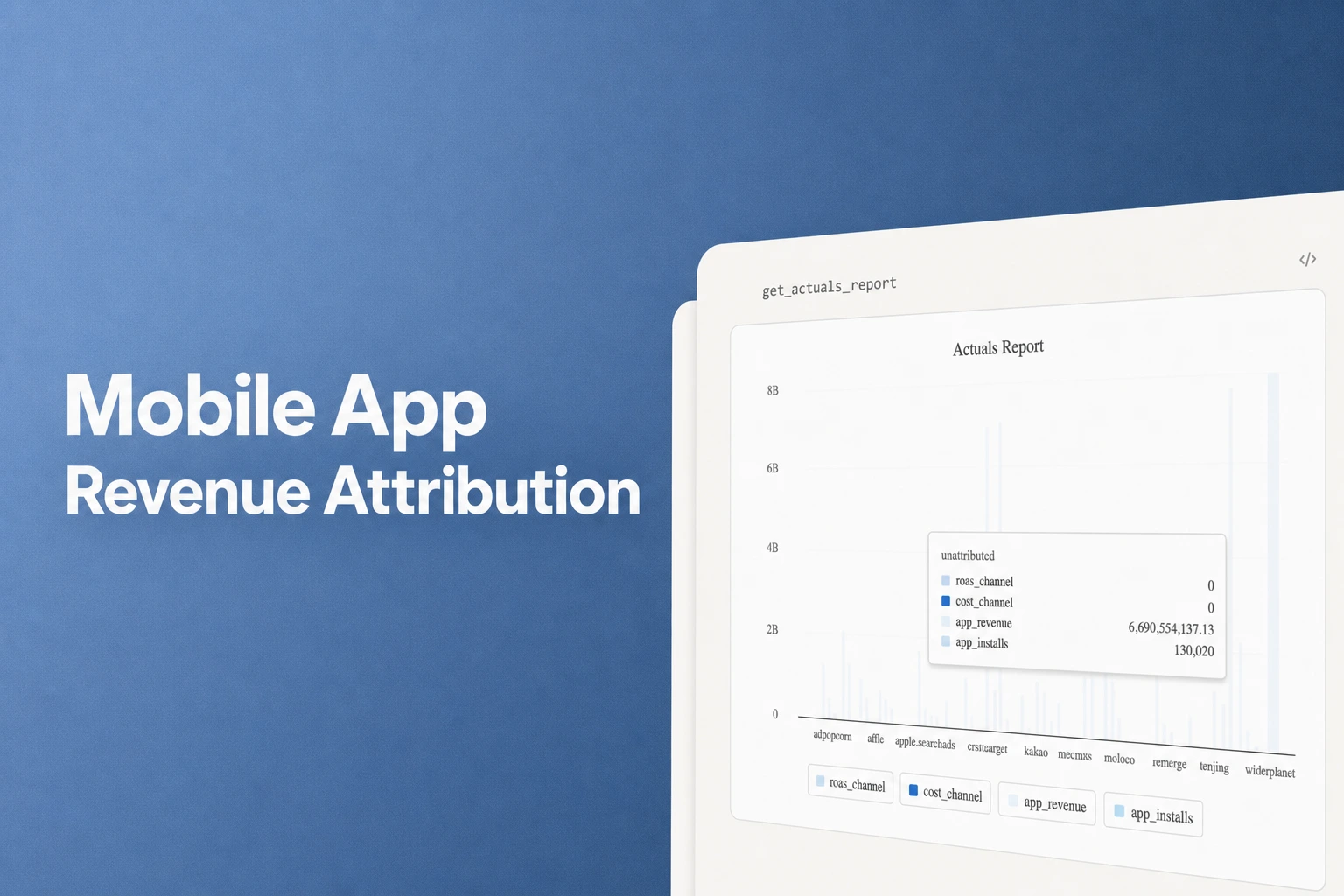
Airbridge Core fits a bootstrapped subscription or AI app when its paid channels match the campaigns being run and the team wants to connect spend with subscription outcomes. The Core Plan page says subscription revenue recorded in a billing platform can connect to Airbridge, so trial conversions, first payments, renewals, and refunds in RevenueCat, Adapty, or Superwall tie back to the campaign that brought the user in.
That makes Airbridge a natural option for a founder asking whether a campaign acquires paying subscribers, rather than just installs. Core’s listed reporting includes Revenue and Funnel reports, and the subscription flow puts billing events beside the campaign source. A team using one of the named subscription platforms can inspect which acquisition source led to trials and first payments, then continue to review renewals and refunds.
Airbridge’s US pricing page lists Google, Meta, Apple Ads, and TikTok for Core paid-app attribution. It gives the plan a 30-day free trial, then $40+/mo, with 500,000 data points included and $0.0001 for each additional data point. The plan has no annual contract and can be canceled anytime.
Airbridge defines a data point as an event the app sends, so estimate event volume alongside installs. Suppose your usage estimate includes 560,000 billable data points, including install, trial, payment, and other configured events. The 60,000 points above the included 500,000 add $6 at $0.0001 each; that is an illustrative overage calculation alongside Core’s $40+/mo starting price, and actual usage depends on the events the app sends.
The Core plan also lists integrations with RevenueCat, Adapty, and Superwall, with two third-party integrations included. A founder using one billing platform can connect it alongside another selected service while staying within that included integration count. Airbridge Core fits when its four supported ad channels cover the media plan, the team can estimate event volume, and subscription reporting is central to its spending decisions.
Which option should you test first?
Start with the channel that receives most of the app’s paid budget. If it is Google, Meta, Apple Ads, or TikTok, Airbridge Core’s published channel set covers it. If the team is testing a single partner while building deep-link journeys, Branch Intro documents one ad partner, three postbacks, and 500 web links or QR codes each month.
Next, match the billing unit to the numbers already available in the app. Estimate monthly paid installs for Tenjin and distinguish attributed installs from organic installs. Estimate app events for Airbridge, including subscription actions and any other events sent. For AppsFlyer, treat the first 12,000 conversion measurements as a one-time allowance. For Singular, compare its stated 15,000 paid conversions with the conversion volume the team expects.
Then list the revenue events and platform that will supply them. A Tenjin user should account for native subscription reporting’s iOS-only condition. An Airbridge user can connect RevenueCat, Adapty, or Superwall, then inspect trial conversions, first payments, renewals, and refunds against the campaign. A Firebase user should decide whether aggregated SKAdNetwork results and Google Analytics attribution answer the iOS measurement question.
Use this short decision path:
- Need app-behavior analytics and aggregated iOS campaign signals? Choose Google Analytics for Firebase when its SKAdNetwork postback reporting in Google Analytics fits that need.
- Need a free-start mobile measurement partner? Choose Tenjin when its 2,000 monthly conversion allowance fits; choose Singular for its documented free-tier features, including mobile attribution and ROI analytics.
- Need links and app routing first? Choose Branch Intro when link-led routing is your first campaign need.
- Want an initial evaluation before budgeting for ongoing use? Choose AppsFlyer when a time-bounded evaluation fits your next step.
- Need subscription outcomes from paid acquisition on the four Core channels? Choose Airbridge Core when Google, Meta, Apple Ads, or TikTok cover the paid mix and its subscription reporting fits the job; connect RevenueCat, Adapty, or Superwall and estimate event volume against the 500,000 included data points.
Reconcile the MMP’s attribution report with the ad network’s report and the subscription platform’s trial or payment records. Singular’s user-acquisition measurement guidance recommends comparing MMP data with network-reported and modeled data, so include those reports when reconciling a campaign.
FAQ
Is an MMP the same as Google Analytics for Firebase?
No. An MMP focuses on connecting app installs or actions to paid acquisition sources, while Google Analytics reports app behavior and can integrate aggregated SKAdNetwork postbacks. A founder buying across paid channels may use both views for different questions.
Which option has the clearest free monthly install allowance?
Tenjin lists 2,000 free conversions per month, then $0.04 per additional conversion, and defines each conversion as an install attributed to a paid mobile acquisition campaign. Singular’s free tier lists 15,000 paid conversions.
Can Airbridge Core report subscription renewals by campaign?
Yes. Airbridge Core connects subscription data from RevenueCat, Adapty, or Superwall, and its Core page says trials, first payments, renewals, and refunds tie back to the campaign that brought the user in.
How should I estimate Airbridge Core usage?
Count the app events you plan to send for your usage estimate, then compare the total with 500,000 included data points. Each data point beyond the included 500,000 costs $0.0001, and actual usage depends on which events the app sends.
When should I choose Branch over a paid-attribution-first tool?
Choose Branch Intro when deep links, web links, and QR codes are central to the first launch and one ad partner with three postbacks fits the initial setup. Choose an attribution-first option when the first decision depends on comparing more paid channels or tying subscription outcomes to those channels.
Get Started Free
See how these criteria hold up on the real thing.