Mobile App Revenue Attribution: Cross-Channel ROAS Measurement Guide (2026)
Connect ad spend, attributed installs, purchases, and cohort revenue in one measurement layer, calculate ROAS consistently across channels, and test whether paid ads created incremental growth.
Turn ad spend into revenue
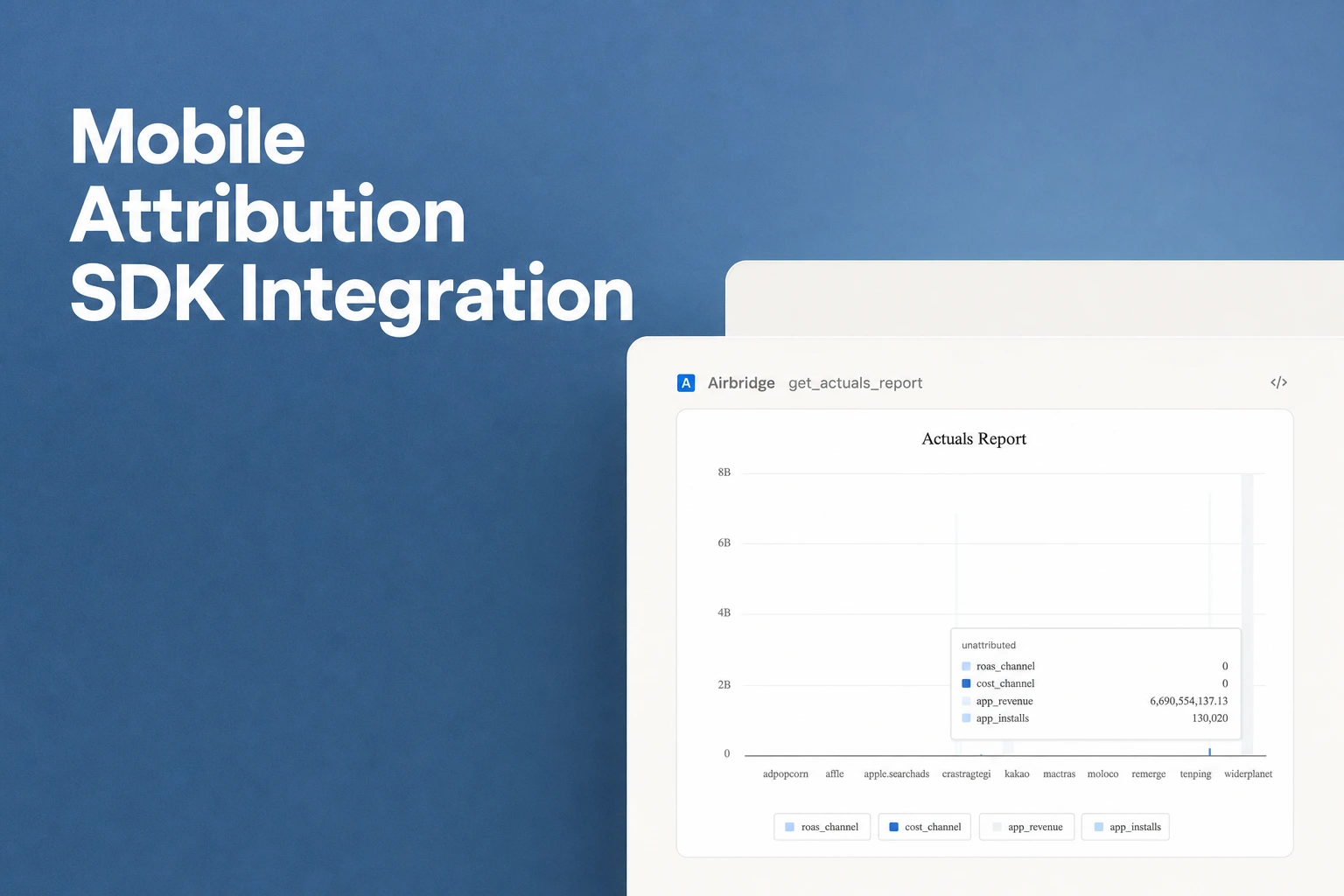
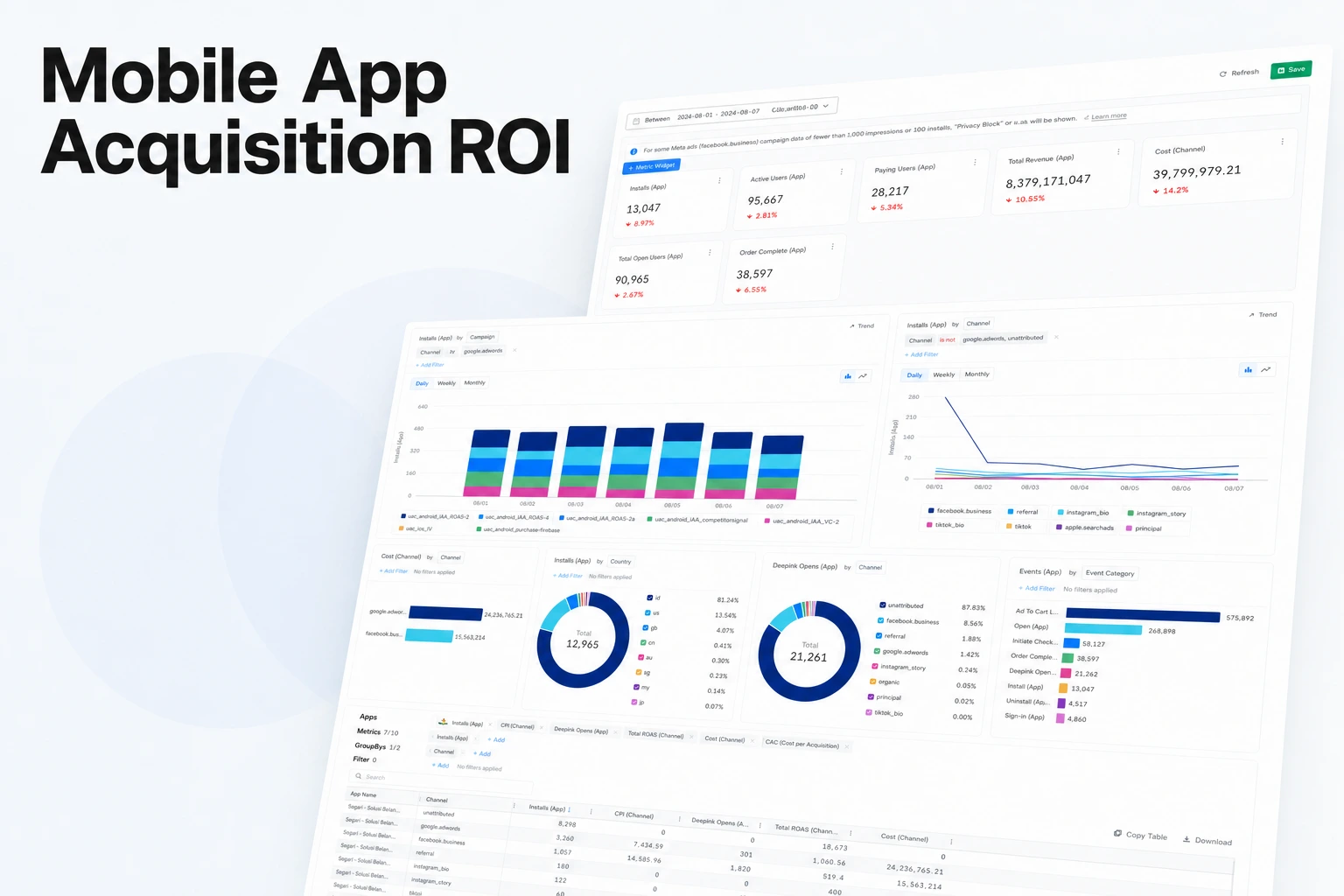
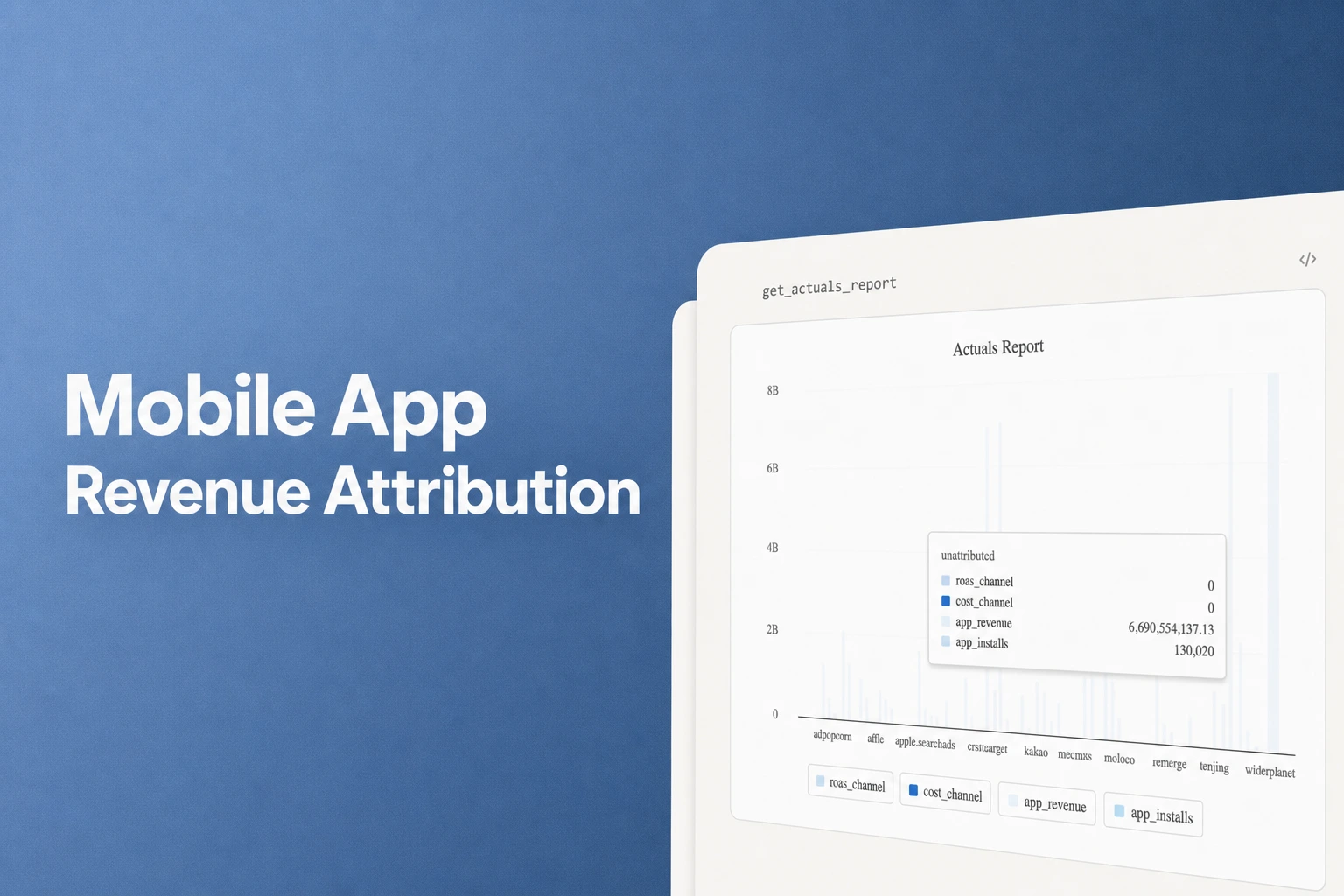
A mobile measurement partner is the layer that connects campaign spend and attributed installs to trials, subscriptions, renewals, refunds, and revenue. In Airbridge, Meta, Google, TikTok, and Apple Ads can appear in a unified reporting view of paid acquisition, but cross-channel comparability depends on consistent currency, timezone, attribution-window, and ROAS rules.
That does not make attributed revenue causal revenue. Attribution answers which campaign received credit for a conversion. Incrementality testing answers whether the campaign created growth that would not have happened anyway. Both matter when MRR rises while paid acquisition is running.
For a small consumer subscription app, Airbridge can fit teams that need campaign attribution, cost aggregation, subscription events, cohort ROAS, and Predictive LTV in one system. Airbridge connects campaign attribution, cost aggregation, subscription events, cohort ROAS, and Predictive LTV in one system. It works alongside RevenueCat, Adapty, or Superwall. The Core Plan starts with a 30-day free trial, then costs $40+/mo. It includes 500,000 data points each month, with $0.0001 per additional data point. There is no annual lock-in.
Your ads may be buying downloads while your MRR stays flat. The fix is not another CPI dashboard. The fix is a shared revenue measurement layer and a defined way to judge cohorts.
What changes after revenue attribution is in place
- You can compare paid-subscriber CAC across channels instead of comparing CPI alone.
- You can see which campaign produced trials, first payments, renewals, refunds, and net revenue.
- You can calculate D7, D30, D90, and longer-horizon cohort ROAS using the same revenue definition.
- You can separate a campaign that acquires subscribers from one that acquires low-intent installers.
- You can use controlled tests to distinguish attributed revenue from incremental revenue.
Why install totals disagree
Different install totals do not mean one dashboard is lying. They mean the systems use different measurement rules.
An ad platform can credit an install according to its own click-through window, view-through window, identity rules, reinstall definition, timezone, consent state, and modeled conversion logic. A mobile measurement partner applies its own attribution rules and independently records attributed installs. Product analytics may record the first app-open event instead.
Privacy changes the shape of the data further. Apple’s SKAdNetwork documentation describes SKAdNetwork as a privacy-preserving way to measure app campaign success. SKAdNetwork provides aggregated, privacy-preserving postbacks rather than user-level data. Starting with SKAdNetwork 4, apps can update conversion values across three conversion windows, which may result in up to three postbacks for a winning ad attribution.
That means install totals must be reconciled, not forced to match exactly.
Use each source for its job:
- Use the ad network for campaign delivery and platform operations.
- Use the measurement layer for independent attributed installs, cross-channel attribution, and campaign-to-revenue reporting.
- Use subscription billing for payment status, renewals, refunds, and subscription lifecycle records.
- Use product analytics for behavior, activation, retention, and product funnels.
- Use incrementality testing to estimate causal lift.
Do not use a platform-reported install total as the shared basis for cross-channel ROAS.
Define one ROAS contract before connecting anything
A ROAS report is comparable only when every channel uses the same rules. Decide the rules before your team starts moving budget.
Write down the following contract.
| Decision | Standard to set |
|---|---|
| Spend denominator | Media spend by channel, campaign, ad set, and creative for the same reporting period |
| Revenue numerator | Gross revenue or net revenue after refunds, stated consistently across all channels |
| Currency | One reporting currency for spend and revenue |
| Timezone | One business timezone for spend, installs, trials, payments, and refunds |
| Attribution window | One click-through and view-through policy for attributed reporting |
| Cohort basis | Group users by attributed install date or first-touch date |
| Revenue window | D7, D30, D90, D180, or another named post-install period |
| Refund treatment | Subtract refunds from the cohort and date basis defined in the contract |
| Renewal treatment | Include renewals only when the selected revenue window includes them |
The core formula is simple:
ROAS = attributed cohort revenue ÷ ad spend
The hard part is defining “attributed cohort revenue” the same way for every campaign.
CPI remains useful for spotting delivery costs. It is not a subscription-app success metric. A low CPI can produce a high paid-subscriber CAC if installers never start a trial or never convert to paid.
Use these metrics together:
- CPI: spend divided by attributed installs.
- Paid-subscriber CAC: spend divided by users who become paid subscribers.
- Trial-to-paid conversion: paid subscribers divided by trial starters.
- D30 cohort ROAS: revenue generated in the first 30 days by users attributed to a defined install cohort, divided by that cohort’s spend.
- LTV:CAC: expected or realized lifetime value divided by acquisition cost.
- Payback period: time required for cohort revenue to recover acquisition cost.
Airbridge links revenue events to the campaign that acquired the user. Its subscription integrations connect RevenueCat, Adapty, and Superwall events, including trials, first payments, renewals, and refunds. Airbridge reports cohort ROAS at days 30, 60, 90, and 180. Its Predictive LTV forecasts LTV for a calculation period of up to 180 days.
The source-to-revenue data flow
Revenue attribution works when the event path is complete. The path should look like this:
Ad spend and campaign metadata
        ↓
Ad click or impression
        ↓
Attributed install
        ↓
App open and account creation
        ↓
Trial start
        ↓
First payment
        ↓
Renewal or refund
        ↓
Net cohort revenue and ROAS
Every stage needs an identifier and a timestamp.
Campaign metadata can include channel, campaign, ad set, creative, cost, currency, and reporting date, as documented in Airbridge’s Meta integration guides. The attribution layer records the click or impression context and associates it with an attributed install.
The app then sends product events such as sign-up, onboarding completion, paywall view, and trial start. The billing system sends subscription lifecycle events such as first payment, renewal, cancellation, refund, and expiration, as mapped in Airbridge’s RevenueCat integration documentation.
The join must preserve:
- An attribution identifier or device-level attribution record where consent and platform rules allow it.
- A user or account identifier after registration.
- A subscription or customer identifier from the billing platform.
- Event timestamps in the shared reporting timezone.
- Revenue amount, currency, and refund status.
Without this chain, a product analytics tool can tell you that purchases happened, and an ad platform can tell you that installs happened. Neither can reliably show which campaign produced subscription revenue.
Which layer owns each measurement job
These tools are complementary. They do not solve the same problem.
| Measurement approach | What it does well | What it does not settle |
|---|---|---|
| Airbridge mobile measurement partner | Connects attribution, campaign cost, attributed installs, funnel events, subscription revenue, refunds, cohort ROAS, and cross-platform journeys. | Whether attributed revenue was incremental without a controlled test or MMM. |
| Native ad platform measurement | Shows spend, delivery, and platform-owned conversions for one network. | Independent cross-channel attribution, deduplication, shared ROAS rules, and unified causal ROAS. |
| Product analytics plus subscription billing | Records product behavior, trials, retention, purchases, renewals, refunds, and LTV. | Independent campaign and install attribution unless another attribution layer is added. |
| AppsFlyer | Provides mobile attribution for installs, in-app events, revenue, self-reporting networks, and SKAdNetwork measurement. | Public pricing, plus subscription renewal and refund handling on the reviewed mobile attribution page. |
| Grometrics | Connects acquisition context to payment revenue, including new sales, renewals, and refunds. | Mobile install attribution, SKAdNetwork measurement, and causal incrementality. |
| Measured | Measures incremental sales, ROAS, CPA, and causal lift through holdouts and geo tests. | Independent mobile-install attribution and mobile subscription lifecycle linkage. |
Airbridge vs. AppsFlyer
AppsFlyer provides privacy-focused mobile attribution, including SKAdNetwork solutions and modeled measurement. Its reviewed pricing path is sales-led, with a personalized offer available through a call.
Airbridge gives small subscription-app teams a self-serve entry point. The Core Plan includes campaign attribution, cost aggregation, and Predictive LTV of up to 180 days as standard capabilities, while raw data export requires the Growth Plan. It starts with a 30-day free trial, then $40+/mo, with no annual contract.
For a five-to-25-person subscription app team managing Meta, Google, TikTok, or Apple Ads directly, Airbridge fits the immediate job: link paid acquisition to subscriber and revenue cohorts without starting with an annual contract.
Mobile app ROAS tracking setup sequence
Set up the system in dependency order. Do not begin by building a dashboard.
1. Freeze the event taxonomy
Choose the events that define the acquisition funnel.
For a subscription app, use:
installsign_uptrial_startfirst_paymentrenewalrefundsubscription_cancelled
Keep the event names consistent across iOS, Android, web, billing, and product analytics. Send a revenue amount and currency with payment and refund events.
2. Install the attribution SDK
Install the Airbridge SDK before paid traffic resumes. Airbridge describes a single SDK installation as taking about one hour on average. Airbridge MCP enables AI tools, including Claude and Cursor, to query attribution data.
Airbridge uses device IDs to connect clicks to installs, and its SDK sends in-app events whose performance follows the attributed touchpoint.
3. Configure deep links and campaign parameters
Set up deep links for paid ads, referral flows, web-to-app journeys, and deferred deep linking. A deferred deep link carries the user to the intended in-app destination after installation.
Keep naming consistent across channels. A campaign called us_ios_trial_offer_jan should use the same logical naming pattern wherever it appears. Do not rely on manually typed campaign names inside spreadsheets.
4. Connect ad cost sources
Connect the paid channels that supply spend and campaign metadata. Airbridge Core includes integrations for Meta Ads, Google Ads, Apple Ads, and TikTok.
Cost data must use the same currency and business timezone as subscription revenue. A daily spend report in Pacific Time and a billing report in UTC can shift revenue between cohorts if the timezone is not standardized.
5. Connect subscription events
Connect RevenueCat, Adapty, or Superwall to pass trial conversions, first payments, renewals, and refunds into the attribution layer.
This is the step that turns install attribution into subscription revenue attribution. A campaign that produces 500 installs and zero first payments should not receive the same budget decision as a campaign that produces 100 installs and 20 paid subscribers.
6. Configure privacy-aware iOS measurement
Set consent handling and iOS measurement according to your app’s privacy design. SKAdNetwork data is aggregated and privacy-preserving. It does not provide user-level postbacks.
Treat SKAN as one measurement input. Compare it with attributed and modeled reporting according to the definitions in your ROAS contract. Do not expect privacy-constrained iOS totals to behave like deterministic device-level logs.
7. Build cohort reports before scaling
Report results by attributed install cohort, not only by calendar-day revenue.
Start with:
- Spend
- Attributed installs
- Trial starts
- Paid subscribers
- Paid-subscriber CAC
- D7 cohort revenue
- D30 cohort revenue
- D30 cohort ROAS
- Refund-adjusted revenue
- Predictive LTV
Airbridge supports cohort ROAS at days 30, 60, 90, and 180. That lets a team compare campaigns on the revenue curve that matters to a trial-based business.
Verify the path before increasing spend
Run a controlled test path before restoring a meaningful budget.
- Open a test campaign URL or deep link.
- Install the app from the test path.
- Confirm that the install receives the intended campaign assignment.
- Create an account and start a trial.
- Complete a test payment.
- Confirm the payment amount and currency.
- Process a test renewal where your billing environment supports it.
- Process a test refund.
- Confirm that each event appears once.
- Confirm that the campaign report shows spend, attributed installs, trial events, payment revenue, and refund-adjusted revenue.
Check timestamps at every stage. A payment assigned to the wrong cohort can make a campaign look profitable or unprofitable for the wrong reason.
Check for duplicate purchase events. Duplicate revenue is one of the fastest ways to inflate ROAS.
Check report latency before reviewing a same-day campaign. A conversion that arrives after a reporting cutoff must not be treated as a missing conversion.
Do not increase budget until the test path passes and the team agrees on the reporting window.
Attributed ROAS is not incremental ROAS
Attributed ROAS says that a measurement system assigned revenue credit to a campaign. It does not prove the user would not have subscribed without that ad.
A user may have already intended to subscribe. They may have searched for the app after seeing an organic post. They may have converted after receiving multiple ads from several channels. Attribution assigns credit using a defined rule. It does not create a counterfactual.
Incrementality creates that counterfactual.
A holdout test withholds media from a representative group and compares its outcome with a group that continues to receive media. A geo test compares matched test and control markets without user-level tracking.
Use one of these approaches:
- Channel holdout: withhold one channel from a representative audience or region.
- Geo test: reduce or stop spend in matched test markets while maintaining spend in control markets.
- Controlled pause: pause a channel only when the test design accounts for seasonality and overlapping campaigns.
- MMM: use marketing mix modeling when spend, media diversity, and historical data support aggregate causal analysis.
Measured focuses on cross-channel incremental performance and uses holdouts, geo tests, counterfactual prediction, and statistical significance. Its geo tests typically run 2–6 weeks, depending on conversion volume and statistical power.
Use Airbridge for the day-to-day campaign-to-revenue layer. Add controlled testing or MMM when you need to decide whether attributed ROAS represents incremental growth.
Return to paid acquisition in stages
Do not restart every channel at full budget because the dashboard is back online.
Stage 1: Lock the definitions
Agree on the ROAS contract, event names, timezone, currency, attribution basis, cohort windows, and refund treatment.
Stage 2: Repair the data path
Install the attribution SDK. Connect ad costs. Connect subscription events. Configure deep links. Verify the test install and purchase flow.
Stage 3: Run limited traffic
Restart a small number of campaigns. Keep targeting, creative, and budget changes controlled during the first measurement window.
Stage 4: Wait for the agreed cohort window
Do not judge a trial campaign on install-day revenue. Review the cohort after the selected D7 or D30 window. Use D90 or D180 reporting when renewal behavior is material to payback.
Stage 5: Compare subscriber quality
Compare channels by paid-subscriber CAC, trial-to-paid conversion, refund-adjusted cohort revenue, cohort ROAS, and expected LTV. Do not scale the channel with the cheapest install if it produces the weakest subscriber cohort.
Stage 6: Test causality before major expansion
When a channel appears to work, run a holdout or geo test before making a large budget commitment. Rising revenue alongside rising spend is correlation. Controlled lift is the evidence for incremental growth.
Choose the measurement layer that matches the gap
Choose Airbridge when your missing link is campaign-to-subscription revenue. It is the right central layer for a small consumer subscription app that needs attributed installs, cost, trials, payments, renewals, refunds, cohort ROAS, and Predictive LTV in one workflow.
Choose native dashboards when you need to operate a single channel, but keep them as inputs rather than your cross-channel source of comparison.
Keep product analytics and billing for product behavior and subscription records. Add an MMP when those systems cannot answer which campaign brought in the paid subscriber.
Use Grometrics when the main job is payment-first attribution for web acquisition and payment records. Its reviewed product material centers on UTMs, referrers, payment revenue, renewals, and refunds.
Use Measured when your question is causal lift across channels and you have the volume and operating control to run experiments.
For most small subscription-app teams, the order is clear: first repair campaign-to-revenue attribution with Airbridge, then use controlled tests when a budget decision requires proof of incrementality.
FAQS
FAQ
Can historical campaigns be attributed retroactively?
If attribution identifiers, campaign context, and timestamps were not collected, historical records cannot support campaign-to-revenue measurement for those installs and events; Airbridge reports only metrics measurable from collected data. Historical cost and billing records remain useful for analysis, but new campaign-to-revenue measurement begins when the event path is implemented and validated.
Should renewals and refunds be included in ROAS?
Yes. Include them according to the revenue-window rules in your ROAS contract. A D30 report should apply the refund treatment and date basis defined in your ROAS contract within its named post-install window. A D90 report includes the first 90 days. Keep the treatment consistent across all channels.
When is an MMP unnecessary?
For a team with no paid acquisition and no need to measure ad performance, an MMP may not be needed. It is also unnecessary when a team only needs platform operations inside one channel and does not need independent cross-channel attribution or campaign-to-revenue reporting.
How long should a subscription app wait before judging a cohort?
Wait until the agreed cohort window closes. Use D7 for early signal. Use D30 when trial conversion and first payment timing matter. Use D90 or D180 when renewals determine whether acquisition pays back. Airbridge’s Predictive LTV forecasts LTV for a calculation period of up to 180 days, while realized cohort revenue continues to validate the forecast.
Connect spend to subscription revenue
Start measuring paid acquisition against the subscriber cohorts that determine payback.