What Is the Mobile Equivalent of a Web Tracking Pixel? Mobile Attribution SDK Guide (2026)
Web tracking pixels break at the app store wall. Learn how mobile attribution SDKs replace pixels, reconcile ad networks, handle deep links, and integrate with product analytics.
Key takeaways
- The App Store creates a measurement disconnect: On the web, dropping a JavaScript snippet (like the Meta Pixel or Google tag) sets cookies and passes URL query parameters across pages. On mobile, the App Store and Google Play act as isolated intermediaries that break browser cookies, strip URL parameters, and isolate native app sandboxes from mobile browsers.
- Mobile attribution SDKs serve as the mobile pixel equivalent: A Mobile Measurement Partner (MMP) SDK replaces web pixels by matching pre-install ad touches (clicks and impressions) with post-install app opens, deduplicating competing ad networks, and managing server-to-server Conversions API (CAPI) postbacks.
- Modern stacks require three distinct functional layers: You cannot replace an MMP with product analytics or subscription billing. MMPs measure ad acquisition source and blended return on ad spend (ROAS); product analytics platforms (e.g., Mixpanel, PostHog) analyze in-app user funnels and feature retention; subscription management tools (e.g., RevenueCat, Adapty, or Superwall) handle receipt validation and billing webhooks.
- Routing and measurement can be consolidated: Modern attribution SDKs natively support deferred deep linking, routing new users to specific in-app content after installation while preserving campaign attribution data in a single integration footprint.
- Accessible self-serve onboarding exists: Small teams do not need enterprise contracts with annual lock-ins. With platforms like Airbridge, founders can start on the self-serve Airbridge Core Plan at $40+/mo after a 30-day free trial, including 500,000 monthly data points ($0.0001 per additional data point) with no annual contract.
The App Store gap: why web pixels and cookies cannot track app installs
If you come from web development or e-commerce marketing, tracking user acquisition is straightforward. You place a JavaScript snippet in the site header, configure event triggers on buttons, and read incoming UTM parameters (utm_source, utm_campaign) from the URL query string. When a visitor lands on a checkout page, first-party and third-party cookies maintain session identity across domain paths.
On native mobile applications, this tracking mechanism breaks completely at the app store boundary.
When a user clicks an ad on Meta, TikTok, or Google, they do not navigate to another web page inside your domain. Instead, the operating system routes them to Apple's App Store or the Google Play Store. These app marketplaces are closed operating system environments. They do not execute arbitrary third-party JavaScript tracking tags, nor do they pass standard URL query parameters into the application binary upon download.
Furthermore, mobile operating systems enforce strict application sandboxing. Safari, Chrome, and native apps operate in separate, isolated data containers. An app downloaded from the store cannot read cookies stored within a mobile browser session, and iOS operating system updates routinely strip campaign parameters during store handoffs.
As noted in the Airbridge Guide on MMPs, because the app store handoff separates the ad interaction from installation, a measurement system must reconnect the journey using available platform signals and device-level identifiers. According to discussions on the Mixpanel Community, iOS attribution is particularly constrained because the App Store strips attribution data, preventing standard web analytics scripts from linking the download back to the original campaign click.
Store-native frameworks, such as Apple's AdAttributionKit and SKAdNetwork, provide platform-mediated install measurement without tracking users across third-party apps, as documented by Apple Developer Documentation. However, as explained in the Airbridge Glossary, store-native privacy frameworks return campaign results through aggregated postbacks instead of continuous, user-level identifiers. These postbacks are often delayed by 24 to 48 hours and provide coarse conversion values rather than granular, real-time event streams.
To solve this gap, mobile developers use an MMP SDK as the native equivalent of a web tracking pixel.
The mobile pixel equivalent: what a mobile attribution SDK actually does
A Mobile Attribution SDK acts as a universal bridge connecting ad network touchpoints, app store download events, in-app product engagement, and downstream revenue.
- Ad Networks (Meta, Google, TikTok, ASA): Delivers ad clicks and cost data.
- App Store / Google Play: Stores the application and strips web context during store download.
- Native App Client (Airbridge SDK, RevenueCat SDK): Captures app launches and in-app events.
- Mobile Measurement Partner (MMP) SDK:
- Matches pre-install clicks with post-install opens
- Deduplicates conflicting ad network attribution claims
- Sends server-to-server Conversions API (CAPI) postbacks
- Blends ad spend with in-app purchase and subscription revenue
- Unified Attribution & ROAS Data: Produces consolidated performance reporting across all paid channels.
An attribution SDK manages four primary responsibilities:
1. Matching pre-install interactions with post-install opens
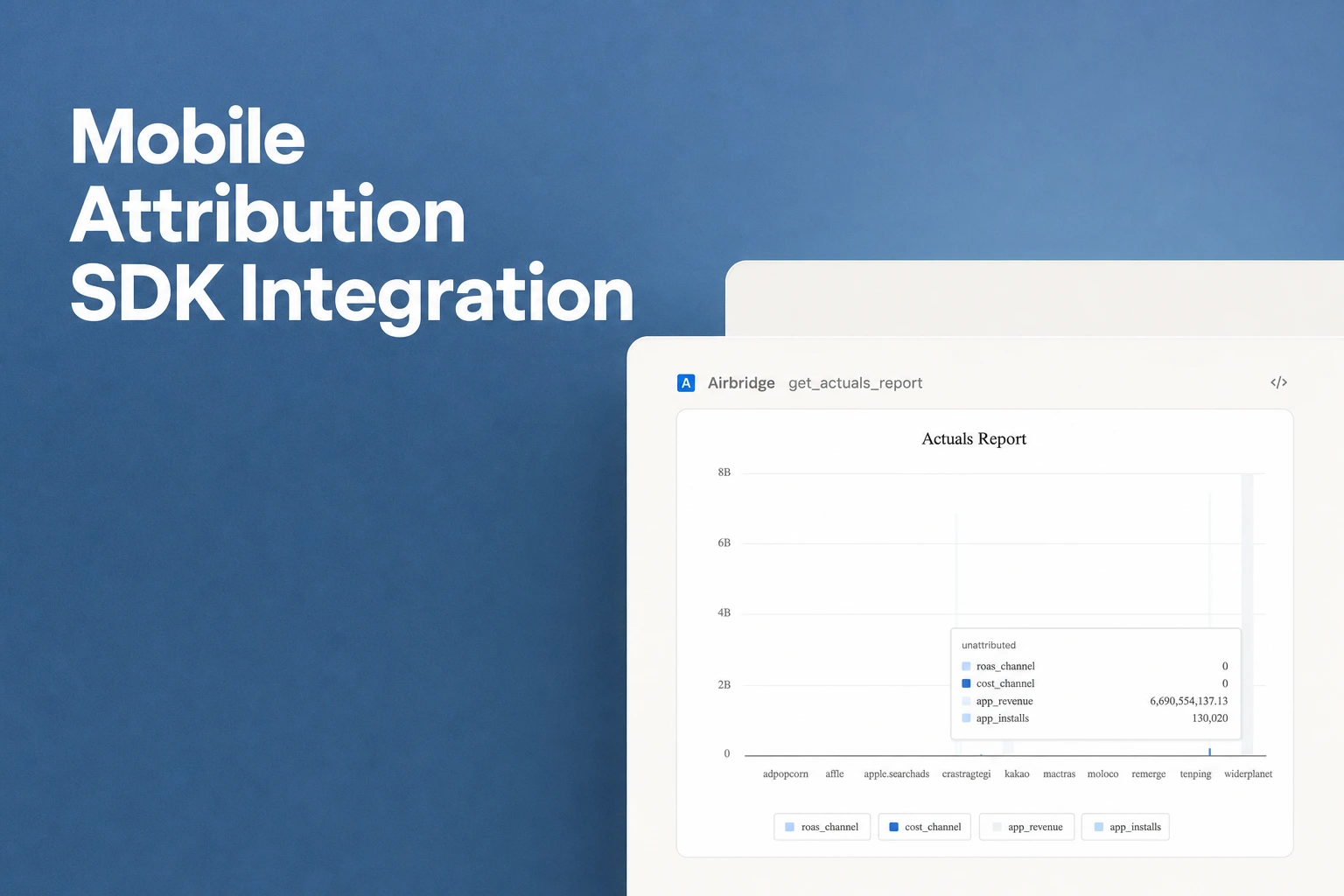
When a user clicks a campaign link or views an ad, the ad network logs a touchpoint. When the user later opens the newly installed app for the first time, the attribution SDK initializes, gathers platform signals, and communicates with the attribution backend. As described by Deeplinkly Deep Linking Guide, mobile attribution relies on matching a pre-install click with a post-install app open. The MMP connects these disparate signals to determine which campaign generated the attributed installs.
2. Multi-network deduplication
Self-Attributing Networks (SANs) such as Meta, Google Ads, TikTok, and Apple Search Ads do not use traditional redirect tracking links. Instead, they report attribution claims via private API integrations.
If a user clicks an ad on Google, then views an ad on Meta, and subsequently downloads your app, both networks will claim credit for the install in their native dashboards. If you rely solely on individual ad network SDKs, your aggregate reported installs will exceed your actual app downloads. An MMP applies a consistent attribution model across all channels to deduplicate competing claims and assign credit to a single winning touchpoint, as detailed in the Airbridge Guide on MMPs.
3. Server-to-server Conversions API (CAPI) postbacks
Just as modern web setups use the Meta Conversions API alongside browser pixels to bypass ad blockers, mobile ad networks require real-time conversion postbacks to train their bidding algorithms. The MMP receives in-app event notifications (such as trial activations, paywall views, and subscription purchases) and transmits them back to ad networks including Meta, Google, TikTok, Unity Ads, and Moloco via server-to-server CAPI integrations, as outlined in the Airbridge Help Center.
4. Blending acquisition spend with revenue
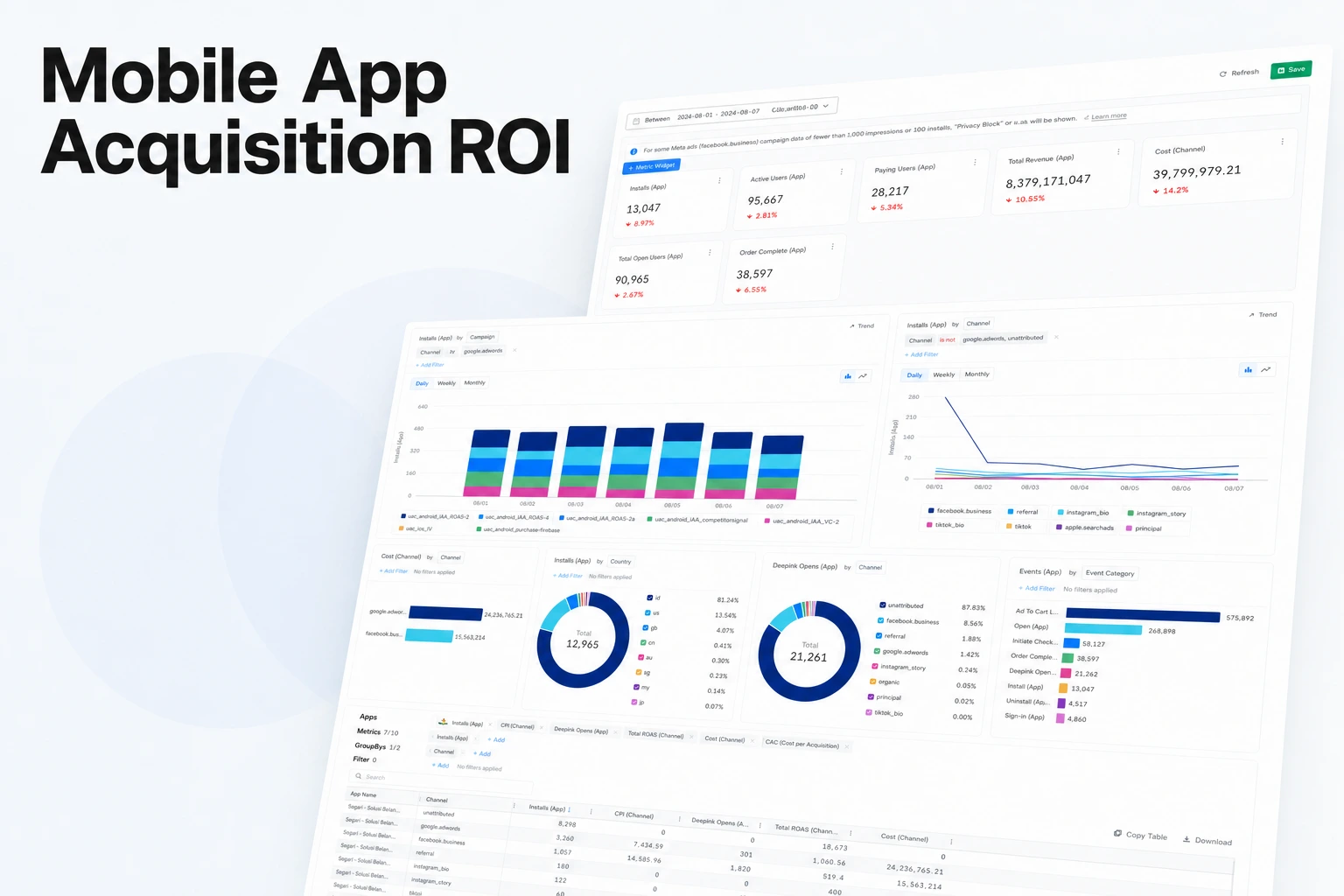
According to the Airbridge Core Plan, paid acquisition for subscription apps requires connecting ad spend, app events, and subscription revenue in one continuous journey. Without an attribution SDK, ad costs sit in ad accounts while revenue sits in App Store Connect or billing dashboards, making campaign-level return on ad spend (ROAS) impossible to compute accurately.
Mobile analytics stack architecture: attribution vs. product analytics vs. subscription billing
Founders frequently ask whether they can use a single analytics tool for their entire mobile stack. In practice, mobile infrastructure divides into three specialized layers.
| 1. Attribution Layer (e.g., Airbridge) | 2. In-App Analytics (e.g., Mixpanel) | 3. Subscription Infrastructure (e.g., RevenueCat, Adapty) |
|---|---|---|
| • SAN & non-SAN ad attribution • Multi-network ad deduplication • Ad spend & ROAS • CAPI postbacks | • User session flows • Funnel conversion • Feature adoption • Retention cohorts • Product experiments | • Store receipt validation • Free trial state tracking • Subscription renewals, upgrades, and refunds • Webhook trigger routing |
Layer 1: Mobile Measurement Partner (attribution)
The MMP SDK (such as Airbridge) sits at the entrance of the funnel. Its job is measuring external ad campaigns across iOS, Android, web, and CTV, calculating customer acquisition cost (CAC) and ROAS, and managing ad network postbacks.
Layer 2: Product analytics
Product analytics platforms (such as Mixpanel) focus on in-app behavior after the user arrives. As detailed in the Mixpanel Event Tracking Guide, product analytics captures in-product actions to show how users navigate features. While Mixpanel Mobile Analytics covers installs, sessions, feature usage, and retention, the Airbridge Guide on MMPs explains that product analytics tools focus on behavioral patterns rather than independently reconciling competing ad-network claims.
Teams connect these layers by having the MMP forward attribution tags (such as campaign_name and ad_set_id) into product analytics when the app launches, as documented in the Mixpanel Mobile Attribution Documentation. Mixpanel can then evaluate how multiple touchpoints contribute to downstream events using multi-touch attribution models, as explained in the Mixpanel Multi-Touch Attribution Guide.
Layer 3: Subscription lifecycle & billing
Subscription management engines (such as RevenueCat, Adapty, or Superwall) validate App Store and Google Play receipts, handle subscription status, and manage edge cases like grace periods and refunds. The Airbridge Guide on MMPs emphasizes that an MMP does not replace subscription infrastructure; instead, it links subscription conversions, payments, renewals, and refunds back to the specific ad campaign that acquired the user.
| Capability / Attribute | Mobile Attribution SDK (MMP, e.g., Airbridge) | Product Analytics SDK (e.g., Mixpanel) | Standalone Deep Linking Tool (e.g., Deeplinkly) | Store Native APIs (e.g., Apple SKAN / AdAttributionKit) |
|---|---|---|---|---|
| Primary Focus | Cross-channel acquisition attribution, CAPI, and ROAS | In-app user behavior, funnels, and retention | Link routing and deferred deep linking | Privacy-preserving aggregate store attribution |
| Store Gap Resolution | Deterministic matching, SAN APIs, and cross-platform signals | Ingests attribution data forwarded by MMP SDKs | Context passing through store install flows | Aggregate OS-level postbacks with conversion values |
| Ad Network Deduplication | Yes (Meta, Google, TikTok, Apple Ads, Unity Ads, and Moloco) | No (relies on upstream attribution data) | Limited touchpoint measurement | No (each network handles its own postbacks) |
| Deferred Deep Linking | Native standard feature | Not natively consolidated | Core specialized functionality | Not supported as a native routing layer |
| Pricing Model | $40+/mo Core Plan (500K data points included); usage tiers | Free up to 1M events/mo; paid plans scale with event volume | Free tier up to 25K installs; then from $0.006/install | No platform usage fee; requires engineering infrastructure |
Deep linking vs. campaign tracking: tool duplication and consolidation
In web marketing, a single URL containing UTM parameters routes a user to a specific landing page while logging campaign parameters. On mobile, deep linking requires handling two distinct operational states:
- Direct Deep Linking: The user already has the app installed. Clicking a campaign link opens the app immediately and directs the user to a specific screen (e.g., a discounted subscription offer).
- Deferred Deep Linking: The user does not have the app installed. Clicking the link sends them to the App Store or Google Play. After downloading and launching the app for the first time, the SDK retrieves the original destination parameters and routes the user to the target screen without losing context, as noted in the Deeplinkly Adjust Alternative Guide.
Some teams adopt separate standalone tools for link routing. For example, Deeplinkly provides deep linking, deferred deep linking, and campaign measurement via client libraries and REST APIs, as outlined on the Deeplinkly Attribution Platform.
However, integrating standalone deep linkers alongside an attribution SDK often introduces duplicate SDK footprints and maintenance overhead. Platforms like Airbridge consolidate deferred deep links, branded short links, QR codes, and web-to-app routing directly into the attribution platform, as documented in the Airbridge Pricing and Airbridge Help Center guides.
Consolidating deep linking within your attribution provider ensures that routing logic and campaign performance data originate from the same verified event source.
Measurement deployment roadmap: what a new app should set up first
To build a clean attribution and analytics pipeline without engineering waste, implement your tracking infrastructure in the following sequence:
Step 1: Install the attribution SDK
Add the MMP SDK to your iOS and Android projects. Initialize the SDK on app launch to capture install events and handle deferred deep link resolution. According to Airbridge Pricing, standard events are available out of the box, establishing baseline attribution without complex custom event mapping.
Step 2: Connect subscription billing webhooks
Integrate your subscription infrastructure (RevenueCat, Adapty, or Superwall) with your MMP backend. Whenever a user starts a free trial, converts to a paid subscription, renews, or cancels, the subscription platform fires a server-to-server webhook to the MMP. This connects subscription events directly to the original acquisition campaign.
Step 3: Configure SAN integrations and Conversions API (CAPI) postbacks
Inside the MMP dashboard, connect your ad network accounts (Meta, Google Ads, TikTok, Apple Search Ads). Enable server-to-server postbacks so that downstream purchases and trial starts flow back to ad platforms in real time. This trains ad delivery algorithms on revenue outcomes rather than low-intent clicks.
Step 4: Stream attribution tags to product analytics
Configure your MMP to pass campaign metadata (source, campaign, ad_set, ad) into your product analytics SDK (such as Mixpanel or PostHog) during app initialization. This allows your product team to analyze retention curves and paywall conversion rates filtered by acquisition channel.
Operational complexity and cost considerations
When choosing your infrastructure, balance setup time against long-term maintenance costs:
- Standalone Deep Linkers: According to Deeplinkly, setup can be completed in under 30 minutes, offering 25,000 free attributed installs followed by pay-as-you-go pricing from $0.006 per install. This is suitable for teams focused strictly on deep linking, but it lacks enterprise-grade SAN deduplication and cross-channel ad spend aggregation.
- Product Analytics: Mixpanel Pricing provides a free tier with up to 1 million monthly events without requiring a credit card, making it accessible for self-serve behavioral analysis without SQL knowledge.
- Store-Native Frameworks: Direct implementation of Apple's AdAttributionKit or SKAdNetwork carries no vendor platform fee, as shown on the Apple Ad Attribution Guide. However, as the AppsFlyer Deep Linking Guide notes, managing and testing native attribution and deep linking requires handling substantial technical complexity and platform-specific nuances.
- Centralized Attribution: The Airbridge Core Plan provides a self-serve entry point starting at $40+/mo following a 30-day free trial. It includes 500,000 monthly data points ($0.0001 per additional data point) with no annual contract, giving subscription app teams ad attribution and deferred deep linking in a single SDK.
FAQS
Frequently asked questions
Can I track mobile app installs using Google Analytics 4 (GA4) or standard web UTM parameters?
Standard web UTM parameters break during the app store redirect because Apple's App Store and Google Play do not forward browser query strings into the native app environment. While GA4 offers app tracking through the Firebase SDK, it lacks automated cross-channel SAN deduplication, native deferred deep linking consolidation, and turnkey subscription revenue attribution across networks like Meta, TikTok, and Apple Search Ads.
Does Mixpanel track which paid ad campaigns generate my app installs?
Mixpanel is designed for product intelligence and behavioral analytics rather than paid acquisition measurement. While Mixpanel Mobile Analytics tracks in-app events, installs, and retention, the Airbridge Guide on MMPs clarifies that product analytics tools do not independently reconcile competing ad network attribution claims. To analyze product funnels by ad source, teams use an MMP SDK to capture attribution data and forward those campaign properties to Mixpanel on app launch, as detailed in the Mixpanel Mobile Attribution Documentation.
Do I need a separate deep linking service if I use an MMP?
In most cases, no. Modern attribution platforms like Airbridge include deep linking features such as deferred deep links, branded short links, QR codes, and web-to-app routing as standard capabilities, as documented in the Airbridge Pricing guide. Using an MMP's native deep linking avoids adding redundant SDKs to your application binary.
How does subscription revenue attribution work with RevenueCat or Adapty?
Subscription platforms validate store receipts and manage the state of active subscribers, free trials, and renewals. When a billing event occurs, the subscription platform sends a webhook to the MMP. The MMP matches the user ID with the original acquisition touchpoint, attributing the exact revenue, renewal, or trial conversion to the specific ad campaign and creative that generated the initial install, as outlined in the Airbridge Core Plan.
What is the minimum SDK setup required to measure paid ad ROAS on day one?
To achieve accurate acquisition attribution and calculate ROAS from day one, you need:
- An MMP SDK (such as Airbridge) integrated into your app to track installs and initialize deferred deep links.
- A subscription billing integration (such as RevenueCat or Adapty) connected to your MMP via webhook to sync purchase and renewal events.
- SAN API connections configured in your MMP dashboard to import ad spend and send server-to-server CAPI postbacks to networks like Meta, Google Ads, and TikTok.
Unify your mobile attribution stack today
Start your 30-day free trial on the Airbridge Core Plan to measure ad spend, ROAS, and subscription revenue with no annual contract.