Which Marketing Attribution Platforms Have an MCP Server? Connecting Claude, Cursor, and AI Assistants (2026)
Compare attribution and analytics platforms with Model Context Protocol (MCP) servers. See which tools connect to Claude, Cursor, and ChatGPT to query campaign ROAS, ad spend, and conversion data in plain English.
Key takeaways
- Model Context Protocol (MCP) standardizes attribution queries: Official MCP servers allow AI assistants like Claude, Cursor, and ChatGPT to pull live marketing metrics directly into developer environments and conversational interfaces without manual CSV exports.
- Airbridge offers beta MCP connectivity on self-serve plans: Airbridge includes its beta MCP server on the self-serve Core Plan ($40+/mo, 30-day free trial, no annual contract), supporting Claude, Cursor, ChatGPT, and Claude Code for querying ad spend, attributed installs, and ROAS.
- Attribution provides deep user-level endpoints with waitlist activation: Attribution provides a native server exposing over 60 live tools covering visitor paths, multi-touch models, and revenue data, though account access requires waitlist approval or account manager contact.
- Able CDP and Google Analytics offer specialized read-only servers: Able CDP provides a three-tool read-only server for first-party customer journey queries in Claude and ChatGPT, while Google Analytics maintains an experimental server installed via GitHub for GA4 reporting.
- Legacy enterprise MMP availability is fragmented: AppsFlyer provides a beta MCP service for marketing analytics, while access across legacy mobile measurement partners (MMPs) is non-uniform and often requires demo requests or referral-based onboarding.
- Dashboard boundaries remain necessary for administrative tasks: AI agents can query performance metrics and verify event telemetry, but deep link routing, SKAdNetwork settings, fraud protection rules, and postback setups still require web dashboard interfaces.
How Model Context Protocol (MCP) works for marketing attribution
For small growth teams and solo developers managing subscription apps, pulling campaign performance usually involves context switching. An engineer building in Cursor or a founder reviewing unit economics in Claude often has to log into a separate web dashboard, configure cohort filters, export a CSV, and upload that file back into an AI prompt.
The Model Context Protocol (MCP), an open standard for connecting AI clients to external data sources, replaces that manual process. MCP uses a client-host-server architecture operating over JSON-RPC. An AI client (such as Claude Desktop, Claude Code, or Cursor IDE) communicates directly with a local or remote attribution MCP server. When you ask a question in plain English, the AI model identifies the appropriate tool exposed by the attribution server, executes the query with your authenticated credentials, and returns structured campaign data inside your current workspace.
According to analysis by data science researchers, client compatibility allows a single MCP connection to serve multiple agentic applications across engineering and marketing workflows. For marketing attribution, this means an AI assistant can retrieve ad spend, attributed installs, and subscription revenue events directly from the attribution data pipeline, evaluating channel performance in real time.
Marketing attribution and analytics MCP server matrix
Attribution and analytics vendors differ in their server maturity, client support, query depth, and pricing accessibility.
| Attribution / Analytics Platform | Native MCP Status | Documented AI Clients | Queryable Data Scope | Pricing & Accessibility |
|---|---|---|---|---|
| Airbridge | Official server (Beta) | Claude, Cursor, ChatGPT, Claude Code | Channel ad spend, attributed installs, orders, MAU, ROAS, and subscription events | Core Plan at $40+/mo; 30-day free trial; no annual contract |
| Attribution | Native server (60+ tools) | Claude, Claude Desktop, Cursor, ChatGPT | User-level conversion paths, touchpoints, visitor lookup, model comparisons, and costs | Plans start at $19/mo; requires waitlist or account manager activation |
| Able CDP | Official server (3 tools) | Claude, ChatGPT (Developer Mode) | First-party customer journeys, conversion events, revenue, and attribution models | Plans from $49/mo; self-serve with OAuth 2.0 PKCE setup |
| Google Analytics (GA4) | Official server (Experimental) | Gemini / LLM clients (Claude Code and Cursor reported) | 200+ GA4 dimensions and metrics, ecommerce events, traffic sources, and funnels | Open-source server via GitHub; requires Google Cloud project |
| Legacy Enterprise MMPs | AppsFlyer Beta MCP service; Adjust and Branch non-uniform | Claude, Claude Code, CLI, and IDE environments | App attribution, campaign performance, cohort ROAS, and retention metrics | Demo request / referral onboarding entry points |
Airbridge
Airbridge includes its official Airbridge MCP integration within its self-serve Core Plan ($40+/mo with a 30-day free trial and no annual contract). Documented in beta, the integration connects with Claude, Cursor, ChatGPT, and Claude Code.
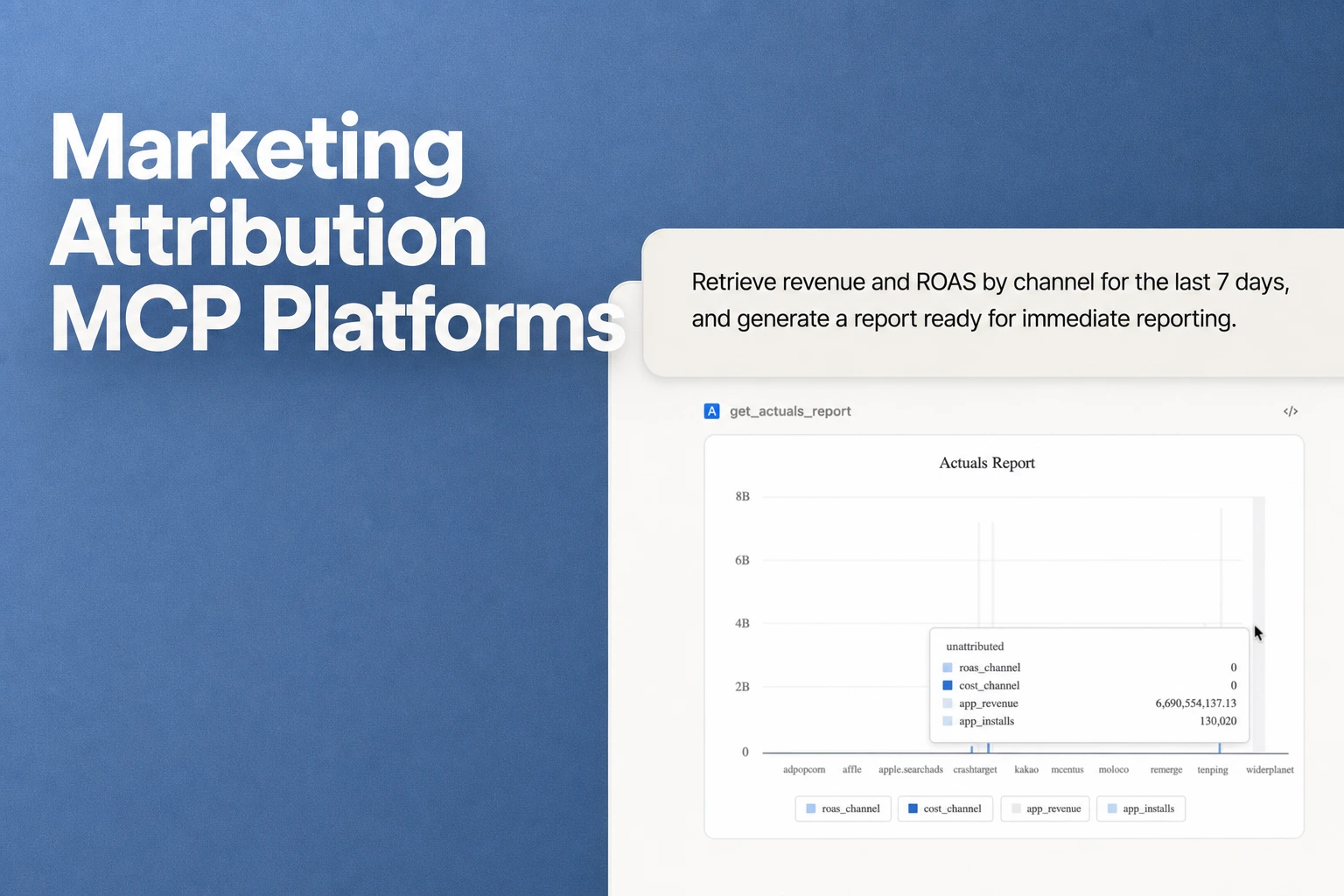
For mobile subscription applications, Airbridge links ad spend, app events, and subscription revenue from initial ad click to paying subscriber. According to Airbridge product documentation, the platform connects subscription lifecycle events, including trials, first payments, renewals, and refunds, to acquisition reporting. In published AI usage data, the MCP workflow supports conversational channel-level analysis covering ad cost, attributed installs, orders, monthly active users (MAU), and return on ad spend (ROAS) across ad networks such as Unity Ads, Moloco, and Appier.
Attribution
Attribution provides a native MCP server built specifically for agentic marketing analytics. Its server exposes more than 60 endpoints and tools covering the platform's multi-touch attribution dataset.
The system tracks marketing performance at the user level, allowing AI assistants to query conversion paths, visitor lookups, company journeys, multi-touch model comparisons, and cost allocations. Documentation on the Attribution MCP Server confirms support for Claude, Claude Desktop, Cursor, and ChatGPT. While Attribution plans start at $19 per month with a free trial, enabling MCP access requires project-level feature activation through a waitlist or by contacting an account manager.
Able CDP
Able CDP operates as a customer data platform focused on tracking full customer journeys and server-side marketing attribution. According to Able CDP documentation, its MCP server provides three read-only tools designed to retrieve marketing and customer data.
Able CDP supports plain-language questions in Claude and ChatGPT covering first-party customer journeys, conversion events, lifetime revenue, and first-touch, last-touch, or all-touch attribution models. Authentication uses OAuth 2.0 with PKCE for rapid connection. While Able CDP offers a free trial and monthly plans starting at $49 per month, its MCP implementation is structured around broad first-party lead and purchase events rather than native mobile app SDK telemetry.
Google Analytics (GA4 MCP Server)
Google provides an official, experimental Google Analytics MCP Server available through GitHub. The server connects Google Analytics data directly to LLM environments and Google Gemini.
According to third-party testing published by Clamp, the GA4 MCP server operates locally via standard input/output (stdio) in read-only mode and can be configured with clients like Claude Code and Cursor. The underlying Data API schema exposes over 200 dimensions and metrics, including active users, event counts, ecommerce purchases, traffic channels, and funnel definitions. However, GA4's MCP server is focused on web and general app analytics rather than mobile measurement partner features like cost aggregation across programmatic ad networks or mobile subscription lifecycle tracking.
Legacy Enterprise MMPs (AppsFlyer, Adjust, Branch)
MCP availability across traditional enterprise mobile measurement partners is fragmented. AppsFlyer provides a beta MCP service intended for testing conversational analytics, performance insights, and configuration retrieval.
In its AI industry report, AppsFlyer details how developers and marketers can query campaign KPIs, attributed installs, ROAS, and cohort retention progression across post-install milestones using Claude and Claude Code. However, native MCP access across the wider enterprise MMP landscape is not uniform; published comparisons in AppsFlyer documentation note varying implementations ranging from custom API scripts to invite-only betas. Furthermore, enterprise MMP onboarding typically routes prospective teams through demo request forms or existing customer referrals.
What marketing data AI assistants can query vs. UI requirements
Connecting an AI assistant to an attribution MCP server unblocks rapid reporting, but understanding the boundary between conversational querying and dashboard administration is critical for operational efficiency.
Reachable metrics via plain-English prompts
When configured with an active attribution server, AI assistants can query numerical performance data across acquisition channels:
- Channel-level spend and attributed installs: You can query daily ad spend, impressions, clicks, and attributed installs across networks like Unity Ads, Moloco, and Appier without opening individual network dashboards.
- Conversion and subscription events: Assistants can report on in-app milestones, including trial starts, paid activations, renewal counts, and refund events, linking revenue outcomes directly to campaign sources.
- Retention and cohort metrics: You can evaluate return on ad spend milestones (such as Day 7 or Day 30 ROAS) and cohort engagement trends to identify underperforming ad sets.
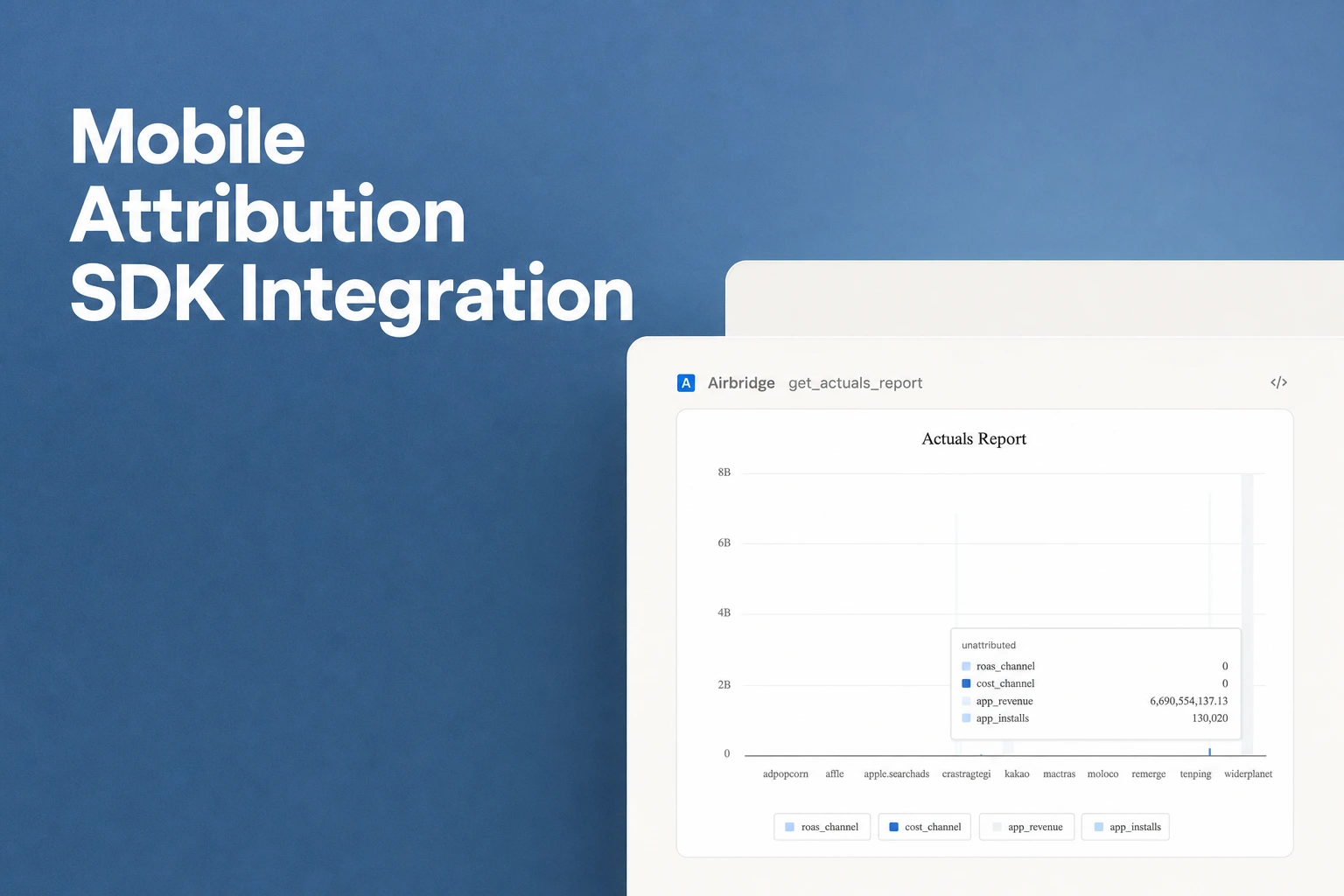
- Real-time telemetry verification: As highlighted in the Mobile Attribution SDK Integration Guide, developers working inside an IDE can query whether install and in-app event data is flowing properly from a development build without navigating to a browser.
Operations strictly requiring the web dashboard
While MCP servers streamline data retrieval, platform administrative tasks remain restricted to the web UI for security, compliance, and structural reasons:
- Deep link configuration: Setting up universal links, App Links, deferred deep linking paths, and routing fallback destinations requires dashboard rule builders.
- Ad network postbacks and partner integration: Configuring server-to-server postback mappings, attribution windows, and network credentials requires administrative permissions. In AppsFlyer documentation, managing Advanced Privacy settings and partner postbacks is explicitly restricted to account administrators in the web interface.
- Fraud detection and SKAdNetwork mapping: Defining automated fraud protection rules, IP blocklists, and Apple SKAdNetwork / Conversion Value schemas must be managed inside dedicated dashboard modules.
- Read-only MCP safeguards: Attribution MCP servers like Attribution and Google Analytics are intentionally designed as read-only endpoints. They prevent LLM agents from inadvertently modifying attribution logic, mutating historical conversions, or altering billing tiers.
Resolving marketer-developer reporting friction
In small growth teams, reporting bottlenecks frequently occur between marketing and engineering. A growth marketer wanting to analyze trial-to-paid conversion rates across campaigns often asks the engineering team to build custom internal dashboards or write SQL queries. Conversely, developers frequently field interruptions to verify whether tracking tags and SDK postbacks are functioning.
Implementing an attribution MCP server resolves this friction by enabling self-serve, conversational data access for both roles.
1. Diagnosing CPI and CAC spikes in Claude
When customer acquisition costs spike, a marketer using Claude Desktop can query the attribution server directly instead of waiting for engineering support:
"Compare our paid acquisition spend, attributed installs, and Day 7 trial-to-paid conversions across Unity Ads and Moloco over the last 30 days. Which ad sets have a CPI above $4.50 with a trial conversion rate below 5%?"
The AI assistant queries the attribution endpoint, aggregates campaign cost data against in-app conversion events, and produces a breakdown highlighting campaigns that are draining budget without delivering subscribers.
2. Verifying event flows in Cursor during development
When an overloaded developer integrates attribution tracking into an iOS or Android app, they no longer need to switch contexts to a web console to confirm event ingestion. Inside Cursor, the developer can prompt the assistant:
"Check the Airbridge event stream for user ID
test_user_882. Did oursubscribe_monthlyevent register with the correct revenue parameters in the staging environment?"
The assistant executes a diagnostic query via MCP, confirming that in-app events, transaction amounts, and currency attributes are registering accurately before the build is submitted for app review.
Configuration walkthrough for Claude and Cursor
Setting up an attribution MCP connection takes only a few minutes. Most implementations connect via local stdio processes or remote server endpoints defined in JSON configuration files.
1. Configuring Claude Desktop and Claude tools
Airbridge uses a remote HTTP MCP endpoint with OAuth authentication. You can connect Claude Desktop, Claude Web, or Claude Code using the remote URL (https://mcp.airbridge.io/mcp):
- Claude Desktop / Claude Web: Navigate to Settings > Connectors > Add custom connector. Set the name to
Airbridgeand the URL tohttps://mcp.airbridge.io/mcp. On first use, an OAuth consent screen will open, inheriting your logged-in Airbridge account permissions. - Claude Code (CLI): Run
claude mcp add --transport http airbridge https://mcp.airbridge.io/mcp. - Configuration file (
claude_desktop_config.json): Alternatively, define the remote HTTP server directly in your local config file:{ "mcpServers": { "airbridge": { "type": "streamable-http", "url": "https://mcp.airbridge.io/mcp" } } }
2. Configuring Cursor IDE
To enable attribution queries directly inside Cursor, use the URL-based remote MCP configuration in ~/.cursor/mcp.json (or project-level .cursor/mcp.json):
{
  "mcpServers": {
    "airbridge": {
      "type": "streamable-http",
      "url": "https://mcp.airbridge.io/mcp"
    }
  }
}
3. Validating the connection
Once connected, run a verification prompt inside your assistant's chat window:
"Fetch our total attributed installs, total ad spend, and top 3 acquisition channels by ROAS for the past 14 days."
The model will trigger the appropriate attribution tool, validate the parameters, and return structured marketing performance metrics directly inside your conversation.
FAQS
Frequently asked questions
Can an AI coding agent install an attribution SDK in half a day?
Yes, AI coding agents like Cursor, Claude Code, and GitHub Copilot can handle SDK dependency installation, initialization boilerplate, and in-app event tracking code within a few hours. However, as outlined in technical integration guides, agents cannot complete the entire lifecycle autonomously. Developers must supply native app credentials, configure Apple App Store and Google Play console certificates, trigger native platform builds, and verify real-device tracking before release.
Which attribution platforms support plain-English queries in Claude?
Airbridge, Attribution, and Able CDP provide official support for querying marketing data through Claude. Airbridge supports Claude and Claude Code on its self-serve Core Plan ($40+/mo). Attribution offers a native integration with over 60 marketing measurement tools via Claude Desktop, while Able CDP supports natural-language reporting for customer journeys in Claude and ChatGPT.
Can Google Analytics (GA4) answer ad spend and ROAS questions over MCP?
The official GA4 MCP server provides conversational access to over 200 GA4 dimensions and metrics, including user counts, traffic sources, page views, and ecommerce transactions. However, GA4's MCP server does not function as a mobile attribution tool for aggregating multi-network ad spend across programmatic mobile networks or computing mobile cohort ROAS across third-party ad channels.
How does an attribution MCP server fit into a stack using RevenueCat or Adapty?
Attribution MCP servers complement subscription payment platforms. While tools like RevenueCat, Adapty, or Superwall manage in-app purchases, billing receipts, and subscriber states, an MMP connects those subscription milestones back to the initial ad network click, campaign ID, and creative. With Airbridge, subscription lifecycle events (trial conversions, renewals, cancellations, and refunds) are attributed to acquisition channels, allowing your AI assistant to evaluate true campaign return on ad spend across your entire marketing stack.
Are MCP connections safe for sensitive marketing and financial data?
Attribution MCP servers apply the same role-based permissions, workspace scoping, and authentication keys as the provider's underlying APIs. Most marketing attribution servers operate in read-only mode, meaning the AI assistant can fetch aggregated reports but cannot alter attribution settings, delete historical event logs, or modify ad network postback endpoints. Personal identifiable information (PII) is protected by standard token authorization, and connections run locally through secure stdio or authenticated OAuth 2.0 PKCE channels.
Query your attribution data directly in AI coding agents
Connect Claude and Cursor to Airbridge on the self-serve Core Plan with a 30-day free trial.