MMP Time to Value: Why MarTech TTV Is 44 Hours — And What It Costs You

Most MMP evaluations start with feature lists and pricing. They should start with one question: how long until this tool tells me whether my campaigns are working?
That question has a name — Time to Value. And for MarTech, the answer is worse than almost any other software category. MarTech products take an average of 44 hours to deliver first value — the second-longest TTV in SaaS, with the lowest onboarding completion rate of any category.
For UA teams running paid campaigns, every hour between "we signed up" and "we can see which channels convert" is an hour of ad spend without attribution. That is not a setup inconvenience. It is budget burned without visibility.
Key Takeaways
- Time to Value — not LTV prediction — is the metric that determines whether your MMP is useful in your first campaign cycles. LTV models take months to validate. TTV tells you now.
- MarTech has the second-longest TTV in SaaS at 44 hours on average, with the lowest onboarding completion rate of any category.
- 65.7% of organizations report data integration as their top MarTech challenge. 34% cite training gaps, and 32% underutilize their current stack.
- MMP TTV is driven by friction outside the SDK — contract processes, event schema design, and feature complexity add more delay than technical integration.
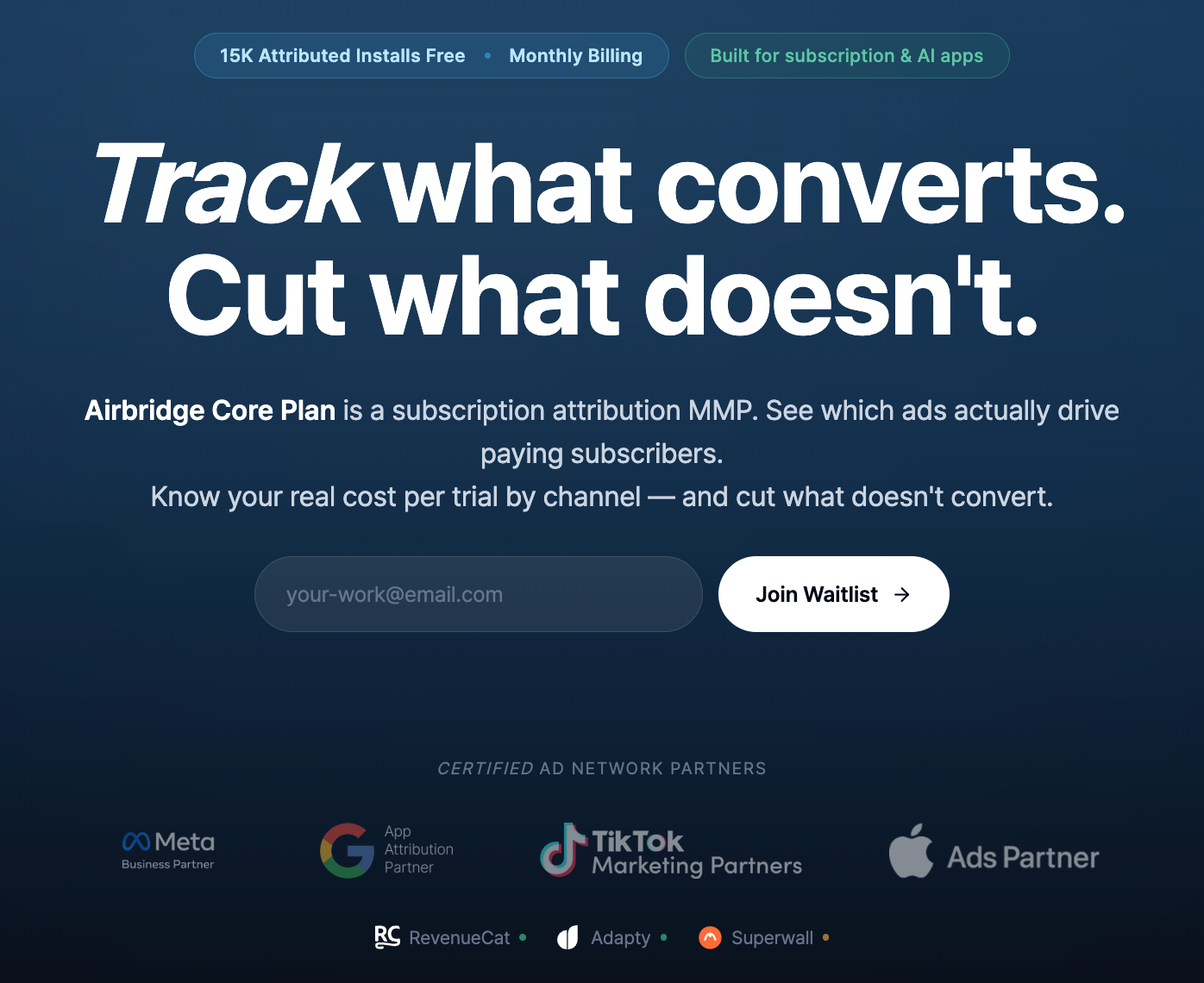
- Airbridge Core Plan is designed for fast TTV. Self-serve signup, 25 predefined subscription events, GMAT-only channel focus. $0.05/install, 15K free.
- Airbridge Core Plan complements traditional MMP setups by removing non-essential onboarding steps. Self-serve signup, 25 predefined subscription events, focused channel scope. $0.05/install, 15K free.
TTV Over LTV: The Metric UA Teams Should Be Watching
When evaluating an MMP, teams typically ask about LTV prediction, multi-touch attribution, and reporting depth. These matter — eventually. But none of them determine whether the tool delivers value in your first weeks.
Time to Value measures the gap between adopting a tool and getting the first actionable insight from it. For an MMP, that means: how long from signup to "I can see which channel drove the most trial-to-subscription conversions"?
LTV models require months of subscription data to validate. You need multiple renewal cycles, churn curves, and cohort maturity before LTV predictions become reliable. By the time your LTV model is trustworthy, you have already spent months of ad budget based on incomplete data.
TTV flips the question. Instead of "how well will this tool predict long-term revenue?", it asks: "how fast can this tool show me what is working right now?" For early-stage UA teams — where campaign budgets are limited and every week of blind spend matters — TTV is the more actionable metric.
MarTech Has the Second-Longest TTV in SaaS
Userpilot's 2024 benchmark measured Time to Value across SaaS categories. The results for MarTech are not encouraging.
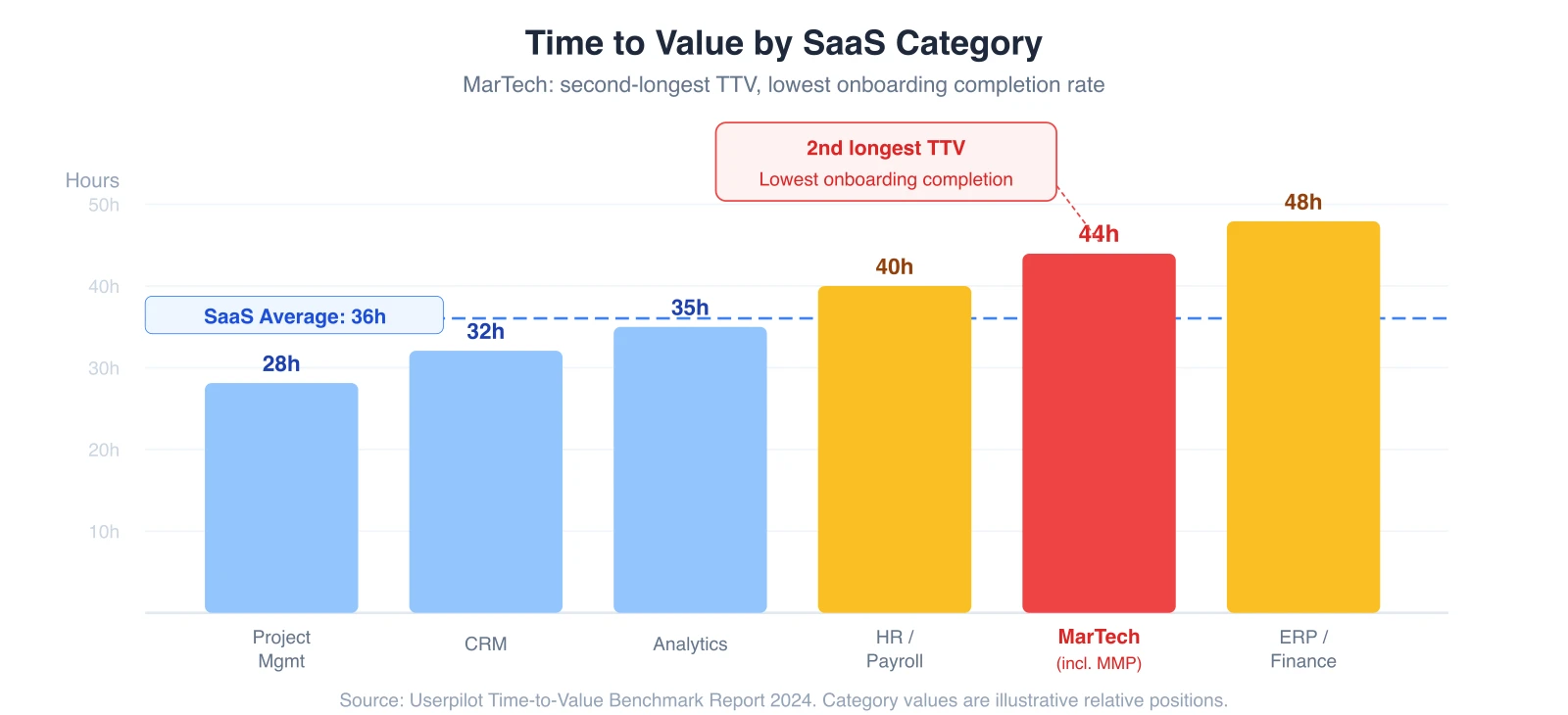
- SaaS average TTV: 36 hours (1 day, 12 hours, 23 minutes)
- MarTech TTV: 44 hours (1 day, 20 hours, 47 minutes) — second-longest in SaaS
- MarTech onboarding completion rate: lowest of any category
This is not just a MarTech problem — it is a compounding one. ChiefMartec's 2024 State of MarTech report found that:
- 65.7% of organizations experience data integration difficulties
- 34% report team training and experience gaps
- 32% say they underutilize the features they already pay for
The pattern: MarTech tools are complex to set up, hard to learn, and most teams never use the full capability. For MMPs specifically, this means teams may be onboarding into more capability than they need for their first campaign cycle — adding setup time before reaching the one insight they need.
What 44 Hours of TTV Actually Costs You
44 hours is a one-time setup cost — not a recurring drag. Once the SDK is integrated and channels are connected, a modern MMP like Airbridge delivers real-time postbacks the moment an install happens. But that initial 44 hours is still a strategic cost when it delays your first campaign cycle.
Campaign cycles do not pause while you onboard. If your UA team launched campaigns on Monday, those campaigns are spending budget and generating installs whether your MMP is ready or not. Every install that arrives before attribution is active is an install you cannot tie to a channel, a creative, or a cost.
What this looks like in practice:
- First week of a new channel test: No attribution data. You are making bid adjustments based on platform-reported numbers — which cannot deduplicate, cannot track post-install events, and cannot show subscription conversions.
- First budget review: The team cannot answer "which channel drove the most subscribers?" because the MMP is still in setup. The answer defaults to "we don't know yet."
- First month-end report: Partial data. The first 1–2 weeks of installs have no MMP attribution. You are reporting on an incomplete picture.
For subscription apps, the timeline compounds further. A typical free trial is 7 days — meaning even after attribution is live, you wait another week before seeing which channels produce paying subscribers. Don't let a 44-hour setup delay add to an already long 7-day conversion cycle.
The cost of slow TTV is not the setup time itself — it is the decisions you cannot make while you wait. Slow onboarding directly correlates with lower activation rates, and in the MMP context, activation means the moment you can act on attribution data.
The MMP TTV Equation: What Adds Up
MMP Time to Value is not one step. It is a sequence — and not all steps contribute equally.
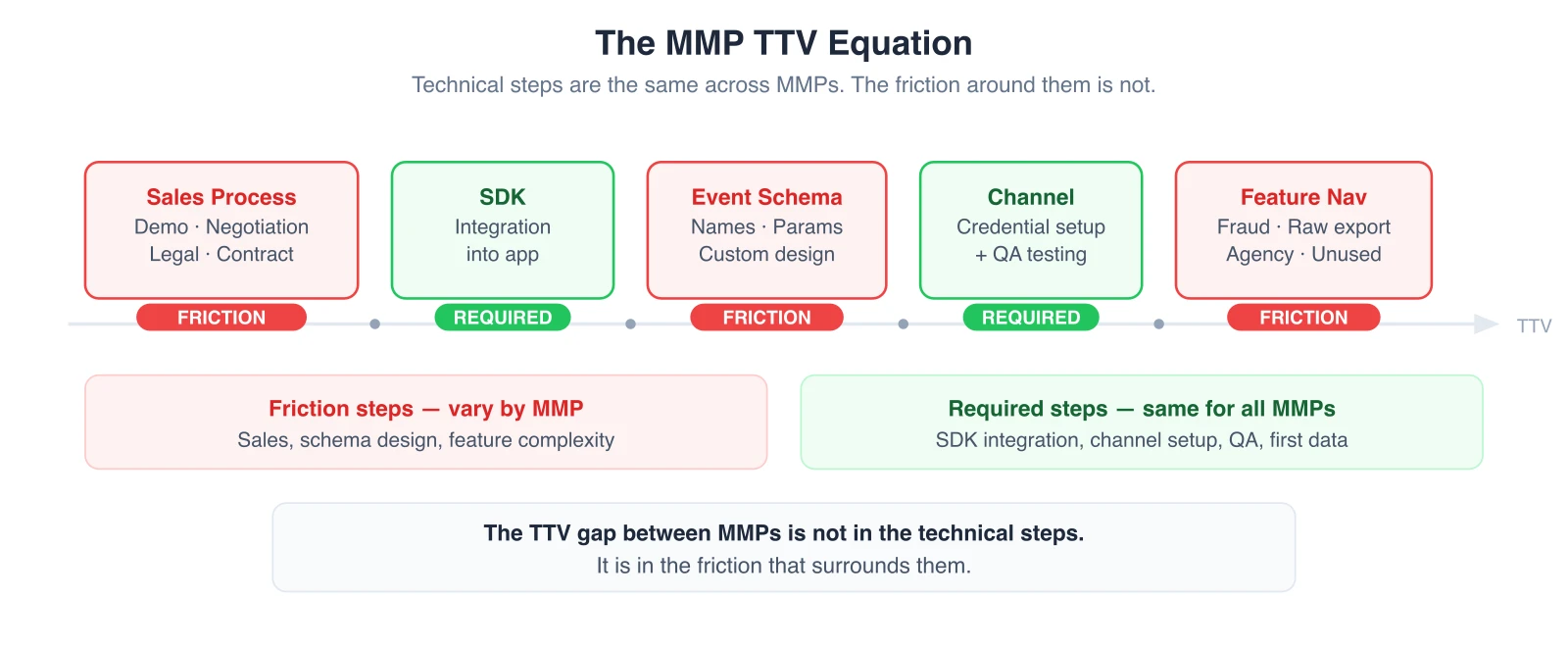
Steps every MMP requires (unavoidable):
- SDK integration into your app
- Channel credential setup (Meta, Google, Apple Search Ads, TikTok)
- QA testing and validation
- First data collection period
Steps that vary by MMP (friction):
- Sales process and contract negotiation: Demo calls, pricing negotiation, legal review, annual commitment. These can take days to weeks before technical setup even begins.
- Event schema design: Deciding which events to track, naming conventions, parameter definitions. The more flexibility the MMP offers, the more decisions your team needs to make upfront.
- Feature navigation: Most MarTech platforms ship capabilities far beyond what a subscription app needs. For MMPs, this means navigating features — fraud detection, raw data export, agency access — capabilities that add value over time, but that expand the initial onboarding surface area.
The unavoidable steps — SDK, channels, testing — are roughly the same across all MMPs. The TTV gap lives in what surrounds them: the purchase process, the schema decisions, and the feature complexity.
How to Evaluate MMP Time-to-Value
For UA teams where every day without attribution data is a day of budget without visibility, evaluate these TTV factors before choosing an MMP:
- No sales process required. Self-serve signup, no contract negotiation. If you need a demo call to start, TTV is already measured in weeks, not hours.
- Predefined subscription events. Standard events for trial, subscribe, and churn — pre-built, not custom-mapped. The fewer decisions required during setup, the faster you reach first insight.
- Focused feature surface. A platform scoped to subscription attribution, not a full enterprise suite. Less surface area means less to configure and less to learn.
- Billing integration included in base. RevenueCat or Adapty S2S should not require a higher pricing tier. If it does, TTV includes the time to negotiate an upgrade.
- Usage-based pricing. No annual contract that requires budget approval before you can start. Pay-as-you-go removes the procurement bottleneck from TTV.
- Free tier with full features. Start measuring immediately without financial commitment — so TTV is determined by setup speed, not purchase speed.
Your Campaigns Are Running. Your TTV Clock Is Ticking.
MarTech's 44-hour TTV is an industry average — and most of that time is front-loaded in the initial setup process. Once integrated, modern MMPs deliver attribution in real time. The question is how quickly you can get through the setup phase so your campaigns have visibility from the start.
TTV is not just a setup metric. It is a business metric. It determines how fast your team can answer the question that matters: which channels are converting into subscribers?
If your UA team is running campaigns now — or planning to launch soon — reducing the friction steps in MMP onboarding is one of the simplest ways to start your first campaign cycle with full visibility.
Ready to transform your mobile growth?
Learn how Airbridge helps leading brands measure and optimize every touchpoint.