AI Fitness App Costs: LLM Inference Drops 10x Per Year — Your MMP Bill Doesn't

The cost of running a frontier-class model dropped from $20 to $0.40 per million tokens in two years. That is a 50x reduction — faster than the PC revolution, faster than dotcom-era bandwidth.
If you are building an AI fitness app, this is the trend powering your product. LLM inference — the single largest new cost layer for AI apps — is falling at a rate the industry has never seen.
But not everything in your cost stack is falling. Your cloud bill scales with usage. Your CDN bill scales with video content. And your MMP bill? It is either a fixed annual contract or a per-conversion fee that scales with success — and it has not dropped at all.
For AI fitness apps where the market is projected to reach $46.1B by 2034, understanding which costs are falling, which are scaling, and which are fixed is the difference between extending your runway and burning through it.
Key Takeaways
- AI fitness app infrastructure has a new cost layer that traditional apps do not: LLM inference. AI-powered coaching, workout generation, and personalization require per-user API costs of $100–$800/month — on top of cloud and CDN.
- Inference costs are dropping at . frontier-class performance went from $20 to $0.40 per million tokens. This cost will keep falling.
- Traditional enterprise MMP pricing is still stuck in the old model. Fixed commitments of $10K–$50K/year that do not scale down when your install volume drops — creating a rigid line item in a stack where everything else is variable.
- AI app subscribers churn 30% faster than non-AI app subscribers despite generating 41% higher revenue per payer. This shortens the payback window — and fixed MMP costs make it harder to hit.
- Airbridge Core Plan turns MMP cost from fixed to variable. $0.05/install, pay-as-you-go, no long-term commitment. 15K free attributed installs. The AI Fitness App Cost Stack
The AI Fitness App Cost Stack
Traditional fitness apps have a straightforward infrastructure cost: cloud hosting, maybe a CDN for video content, and third-party services like billing and attribution.
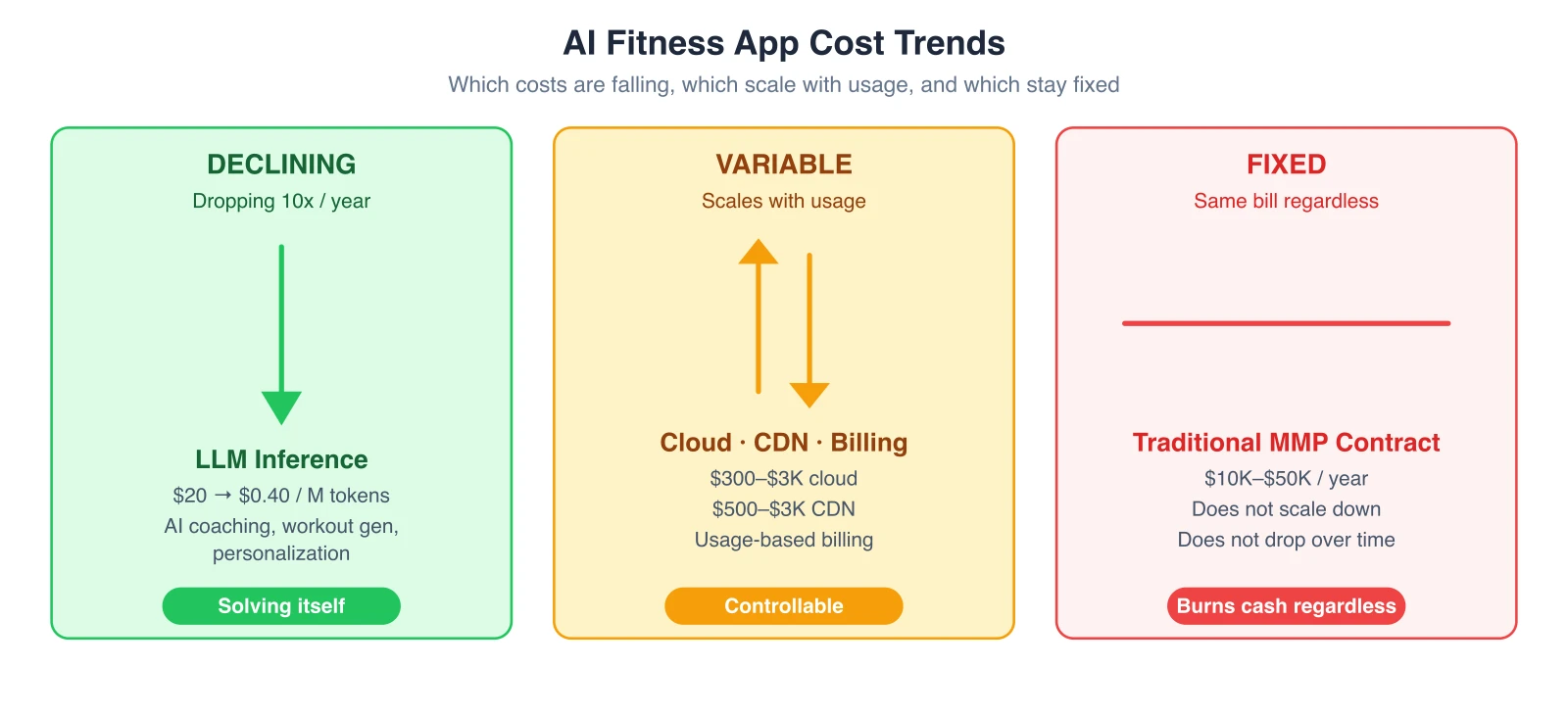
AI fitness apps add a cost layer that did not exist before: LLM inference. Every time a user asks the AI coach for a workout plan, every personalized recommendation, every natural language interaction — it costs money. Not a fixed cost. A per-user, per-session cost that scales with engagement.
A typical AI fitness app's monthly operating costs:

Every cost in this stack except the MMP scales with actual usage. Cloud costs go up when users increase, down when they decrease. LLM API costs follow session volume. CDN costs track content delivery. The MMP — if it is a locked-in commitment — stays the same whether you have 5,000 installs or 50,000.
The Good News: Inference Costs Are in Free Fall
The cost line that AI fitness app founders worry about most — LLM inference — is the one falling fastest.
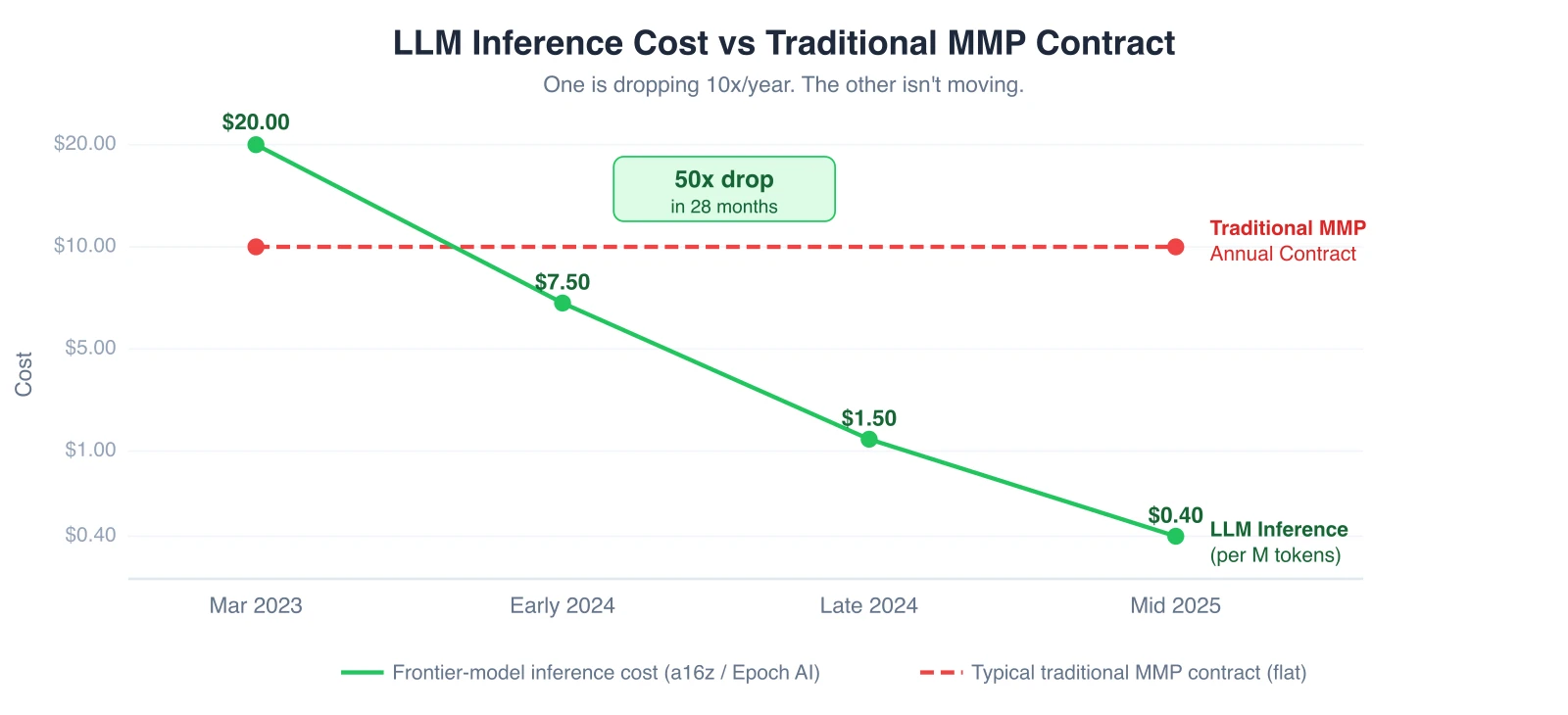
Andreessen Horowitz's analysis shows that the cost of frontier-class inference dropped from $20 to $0.40 per million tokens between March 2023 and July 2025. That is a 50x reduction in 28 months. Epoch AI's data confirms the trend: prices for equivalent model performance are dropping 10x per year, with some benchmarks showing up to 900x annual reduction.
What this means for your cost stack:
- The $100–$800/month AI API line item today will likely be $10–$80 within a year at the same usage level
- Per-user inference cost is approaching a point where it becomes negligible relative to subscription revenue
- The cost layer that makes AI apps structurally different from traditional apps is rapidly becoming a non-issue
This is the tailwind. The technology cost of being an AI fitness app is converging toward zero.
The Problem: Traditional Enterprise MMPs Are Still Stuck in the Old Model
While inference costs drop an order of magnitude annually, traditional enterprise MMPs still price attribution the same way they did five years ago. $20K+ fixed annual contracts, regardless of actual usage — even while the rest of your AI stack is becoming variable and usage-based.
The standard MMP pricing structure:
- Annual contract: $10K–$50K/year. Committed upfront regardless of actual usage. If your app scales faster or slower than projected, the bill stays the same.
- Per-conversion fee: $0.03–$0.07/install. Scales with volume, but the rate does not drop as the industry matures.
- Add-on costs: $10K–$50K/year for fraud detection, raw data export, and premium support — priced separately from the base.
For an AI fitness app spending $1,500/month on LLM inference, a $20K/year MMP commitment represents more than the entire AI cost stack. And unlike inference costs, there is no trend line suggesting MMP pricing will halve next year.
Why This Hits AI Apps Harder: The Payback Window Problem
AI fitness apps have a unique revenue profile. Industry benchmarks show that AI app subscribers generate 41% higher revenue per payer than non-AI app subscribers — but churn 30% faster.
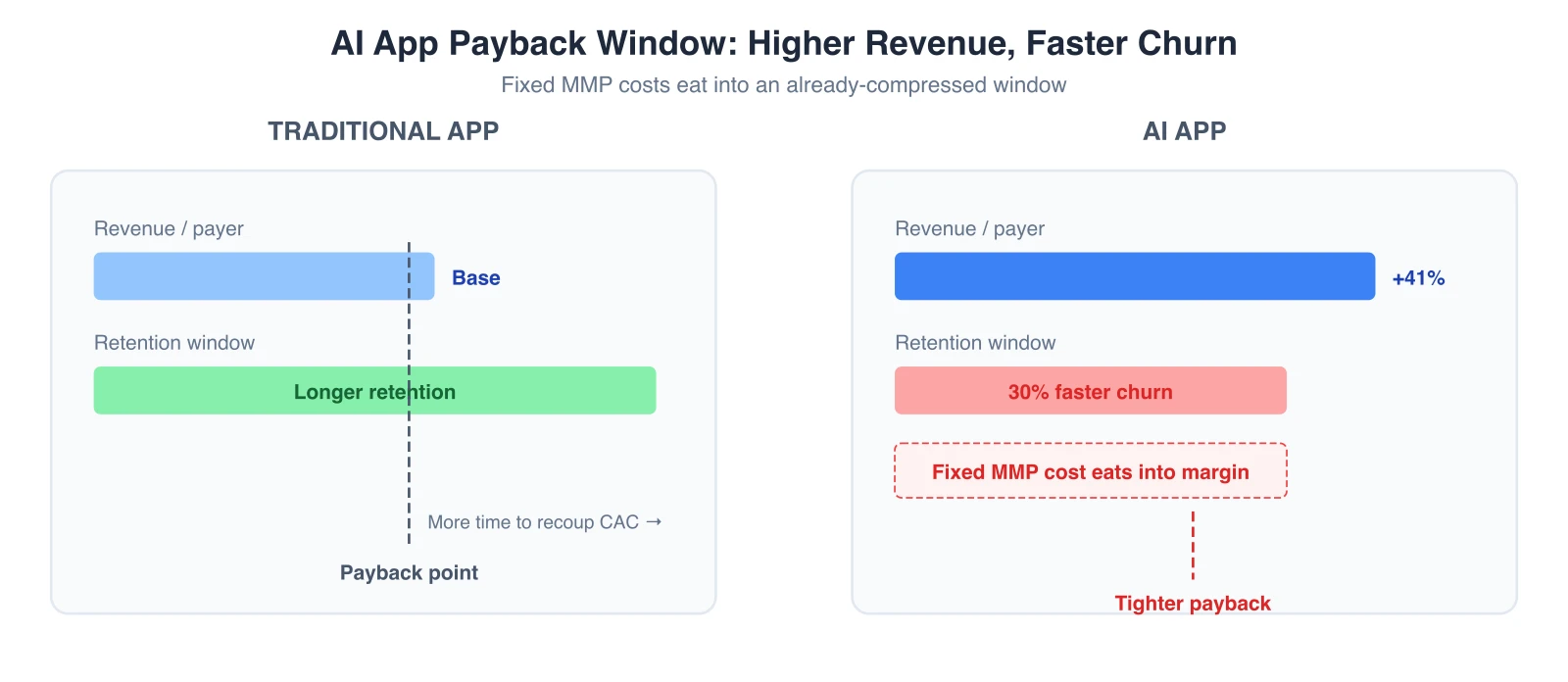
This creates a specific economic constraint: the payback window is shorter. You earn more per subscriber, but you have less time to recoup the acquisition cost before they leave.
When the payback window is tight, every fixed cost matters:
- LLM inference: falling rapidly — this cost is solving itself
- Cloud/CDN: variable, scales with usage — controllable
- MMP (fixed commitment): locked in regardless of performance — not controllable
A fixed MMP cost does not adjust when campaigns underperform, when a channel gets paused, or when seasonal dips reduce install volume. It is a constant burn against a payback window that is already compressed by AI app churn dynamics.
Controllable Costs vs Fixed Costs
The AI fitness app cost stack has three types of costs:
- Declining costs: LLM inference. Falling at historic rates. Will become negligible.
- Variable costs: Cloud, CDN, billing platform. Scale with usage. Go up when you grow, down when you contract.
- Fixed costs: Locked-in MMP commitments. Same bill regardless of performance. Do not benefit from any market trend.
The strategic move is to convert fixed costs into variable costs wherever possible. Variable costs preserve cash when campaigns underperform. Fixed costs burn cash regardless.
You need an MMP — platform dashboards cannot deduplicate conversions or show cost per subscriber by channel. The question is whether your MMP has to be a fixed cost.
What to Look for in MMP Pricing for AI Apps
For AI fitness apps where every dollar of fixed cost compresses an already-tight payback window, evaluate these factors when choosing an MMP:
- Variable pricing that scales with usage. Pay per install, not a fixed annual contract. When installs drop, attribution costs should drop too — not stay locked at a committed rate.
- Free tier with full features. Start measuring before committing budget. A free tier should cover early-stage UA testing without gating reports or integrations.
- Billing integration included in base pricing. RevenueCat or Adapty S2S should not require a higher-tier upgrade. Subscription event tracking is essential, not premium.
- Predefined subscription events. Standard events for trial, subscribe, and churn — pre-built, not requiring custom schema design from your dev team.
- No long-term contract. Month-to-month flexibility. If your payback window tightens or your UA strategy shifts, you should be able to adjust without cancellation penalties.
- Funnel, Retention, and Revenue reports by channel. See which channels produce subscribers who retain long enough to pay back acquisition cost — the metric that matters most when your payback window is compressed.
Your Inference Costs Are Falling. Your MMP Bill Should Not Be the Cost That Stays.
The AI fitness app cost stack is restructuring itself. Inference costs are in free fall. Cloud and CDN costs scale with usage. Attribution is the one cost that does not need to be fixed — but traditional enterprise MMPs have kept it that way.
If your AI fitness app generates $100–$800/month in LLM costs that are falling every quarter, a $20K/year MMP commitment that never drops is the wrong cost structure. Turn it into a variable cost. Pay for what you use. Scale down when you need to.
Attribution at $0.05/install. 15K free. No annual contract. Pay-as-you-go on Airbridge Core Plan.
Ready to transform your mobile growth?
Learn how Airbridge helps leading brands measure and optimize every touchpoint.