Cost per install formula for mobile app channels
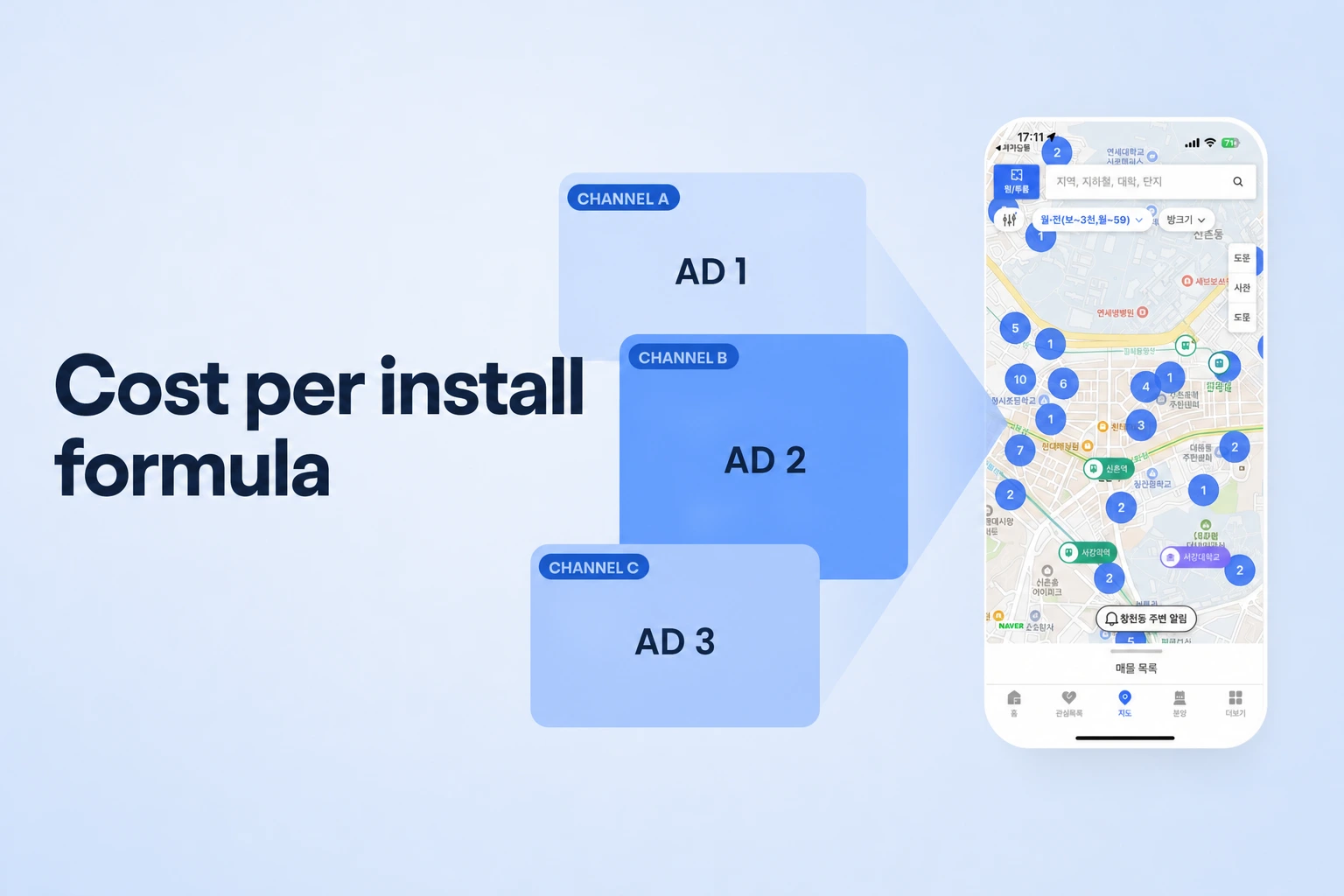
Cost per install formula divides paid spend by attributed installs, while store downloads use a separate count, helping compare channel costs on matching dates.
Answer: choose the denominator that matches the question.
- Paid-channel CPI = same-period ad spend ÷ attributed installs.
- Store-source cost per download = same-period spend ÷ downloads assigned to that store source.
- Keep store downloads, attributed installs, and clicks in separate rows.
- Compare the same dates, currency, platform, and attribution method.
Cost per install formula: divide a paid channel’s spend by its attributed installs for the same reporting period. If your cofounder means store downloads by source, divide spend by the matching store-source download count instead. For a channel-only paid comparison, attributed installs are usually the right denominator because store discovery reports may group paid and unpaid discovery together.
Choose the denominator that answers the question
“Which source brought the downloads?” and “Which paid campaign received credit for installs?” are different questions. A store’s acquisition report follows its own source categories, while an attribution report credits paid activity according to its attribution rules. Label the metric in the comparison so a reader can tell which answer each row gives.
| Measure | What it counts | Use it to answer | Keep separate from |
|---|---|---|---|
| Store-source downloads | Downloads or download events assigned to a store discovery source | How store discovery sources compare under the store’s reporting definitions | Campaign-attributed installs and clicks |
| Paid-attributed installs | Installs credited to a paid campaign by the selected attribution method | What a paid channel costs per credited install | Store downloads, unless the definitions and counts are explicitly aligned |
| Clicks | Ad interactions recorded by the ad platform | What a campaign costs per click | Downloads and installs |
| Total store downloads | All download event types included in the selected store report | How many download events the store recorded | First-time downloads or campaign-attributed installs |
Apple defines an App Store first-time download as the first time a user downloads an app using their Apple ID, counted when they tap “Buy” or “Get.” Redownloads are later installations to a device by that Apple ID, while updates are a separate download type, according to Apple’s App Store Downloads report definitions. For a new-user acquisition comparison, select first-time downloads if that is the outcome you intend to price; include redownloads only when repeat installations belong in your business question.
Google Play distinguishes user acquisitions from device acquisitions. Its Play Console acquisition guidance defines user acquisitions as users who did not already have the app on any of their devices, while device acquisitions count devices and can include a user’s additional device. Choose user acquisitions when you mean new people, and use device acquisitions when installations across devices are the intended outcome.
Match paid spend with attributed installs
Export spend and paid-attributed installs using the same channel, campaign, period, currency, app, and attribution method. Keep the source-report names in the worksheet. A store-source download total can be reported alongside this worksheet, but it is a different denominator and should have its own column and label.
Calculate paid-channel CPI
Use CPI = paid-channel media spend ÷ paid-attributed installs for that same period. For a separate store-download question, label the result cost per store-reported download and specify the store metric. Keep those two ratios out of the same ranked column.
Assume each amount and install count below is an example input.
| Channel | Illustrative spend, Sept. 1–30 | Paid-attributed installs | CPI |
|---|---|---|---|
| Meta | $900 | 300 | $3.00 |
| $1,200 | 300 | $4.00 | |
| TikTok | $750 | 300 | $2.50 |
For example, Meta’s illustrative result is $900 ÷ 300 = $3.00 per attributed install. TikTok has the lowest cost in this example under the shared paid-attribution definition and dates. A store-source download row would need its own clearly identified store source and download count; do not quietly substitute it for an attributed-install count in the same comparison.
If a channel has zero downloads or attributed installs for the chosen period, show the cost as N/A and keep the spend and zero count visible. If you put store-source results and paid-attribution results in the same report, place the denominator label in every row, such as “App Store search downloads” or “paid-attributed installs,” so the calculation stays auditable.
Read the lowest row and decide what to test next
The lowest CPI identifies the lowest observed acquisition cost under the shared attribution and date rules. It does not establish the best subscriber economics; compare downstream paid subscribers and revenue at the same cohort age before reallocating spend.
Start with volume and downstream outcomes. A channel with fewer credited installs can show a sharply changing CPI from a small count, so pair cost with the number of attributed installs and compare the same length of time. Then review sign-ups, trial starts, first purchases, and paying subscribers by acquisition source; for a subscription app, also compare renewal, cancellation, and recurring revenue across matching cohorts.
Before changing budgets, run through these checks:
- One question per comparison: store-source downloads for discovery, or paid-attributed installs for campaign performance.
- One unit of spend: the same currency, timezone, and cost definition for each channel.
- One install definition: first-time users, device installs, or attributed installs, named in the row.
The example is invented arithmetic, not an Airbridge customer result. Keep creator fees and MMP software charges in separate cost columns; include them only when intentionally calculating a broader acquisition cost.
FAQS
FAQ
How is the CPI formula?
CPI = paid-channel spend ÷ paid-attributed installs for the same reporting period. Label the attribution method, dates, and currency with the result.
What is the CPI cost per install?
CPI is paid-channel media spend divided by installs credited to that channel for the matching period. Use the same attribution method across channels. If the question concerns store-reported downloads instead, calculate and label a separate cost-per-download metric.
Get Started Free
See how these criteria hold up on the real thing.