2026 Alternatives to Framework Link Routing for Campaign Tracking
Pushing a routine framework update on a Tuesday morning should not silently wipe out two weeks of paid acquisition data.
Key Takeaway
- Airbridge provides attribution, analytics, and deep linking in a single dashboard. The Core Plan covers mobile apps and web-to-app journeys; PC, console, and CTV attribution are on the Growth Plan.
- Documented Android SDK updates show how we patch link-filtering behavior and native library alignments, though no software release log guarantees zero future routing regressions.
- Every Airbridge deep link is also a tracking link, tying clicks, installs, and in-app events back to the campaign.
Pushing a routine framework update on a Tuesday morning should not silently wipe out two weeks of paid acquisition data. When you are wearing five hats and running growth for a consumer subscription app, you rarely have time to manually test every custom route parameter after each dependency bump. You check your dashboard days later, notice a flatline in conversions, and realize thousands of dollars in ad spend went into a black hole because a routing change dropped incoming campaign parameters. Evaluating Airbridge as a service-level alternative means looking straight at our actual SDK release logs to see what our maintenance covers and what you still need to manage.
Android SDK Link Handling and Maintenance Logs
Looking at the Android SDK Release Notes gives you a concrete view of how our engineering team handles link collection and operating system requirements. A changelog does not prove that a dedicated SDK is immune to regressions or better maintained than an open-source router, but it does show the exact scope of issues we patch and how you can control link collection in your code.
By default, when an app is opened through a deep link, the Android SDK collects deep link events—even if the link that triggered the open is not an Airbridge Deep Link. During local testing or cross-framework development, that broad collection can catch internal tooling traffic, and our Android SDK notes show that v4.10.0 improved deep-link handling to exclude non-trackable deep links from the Expo development client. Setting setTrackAirbridgeDeeplinkOnlyEnabled to true in the Android SDK limits deep link event collection to cases where the app is opened through an Airbridge Deep Link.
System-level build maintenance is also documented alongside link-handling changes in the Android SDK v4 Release Notes. While the Android SDK has supported 16 KB page sizes since v4.6.0, versions v4.6.0 through v4.9.3 had an issue where the PT_GNU_RELRO segment of the SDK's native libraries was not aligned to the 16 KB boundary, which does not affect app behavior on 16 KB page-size devices though the app store console may show a warning. Android SDK v4.9.4 resolves this alignment issue by upgrading the NDK version used to build the SDK. If your team is currently running Android SDK v4.6.0 through v4.9.3, you should update to v4.9.4 or later. Having these version histories in plain sight helps you plan SDK upgrades, though just like any dependency in your stack, you still have to keep your installed version current to get the fixes.
Cross-Platform Deep Linking Beyond App Routers
Relying solely on an in-app framework router only covers what happens after the operating system hands a URI to an already-installed application. We bring deep linking, attribution, and analytics together in a single dashboard. PC, console, and CTV attribution are on the Growth Plan. For founders on the Core Plan, the package includes direct deep linking, deferred deep linking, and a web-to-app CTA banner.
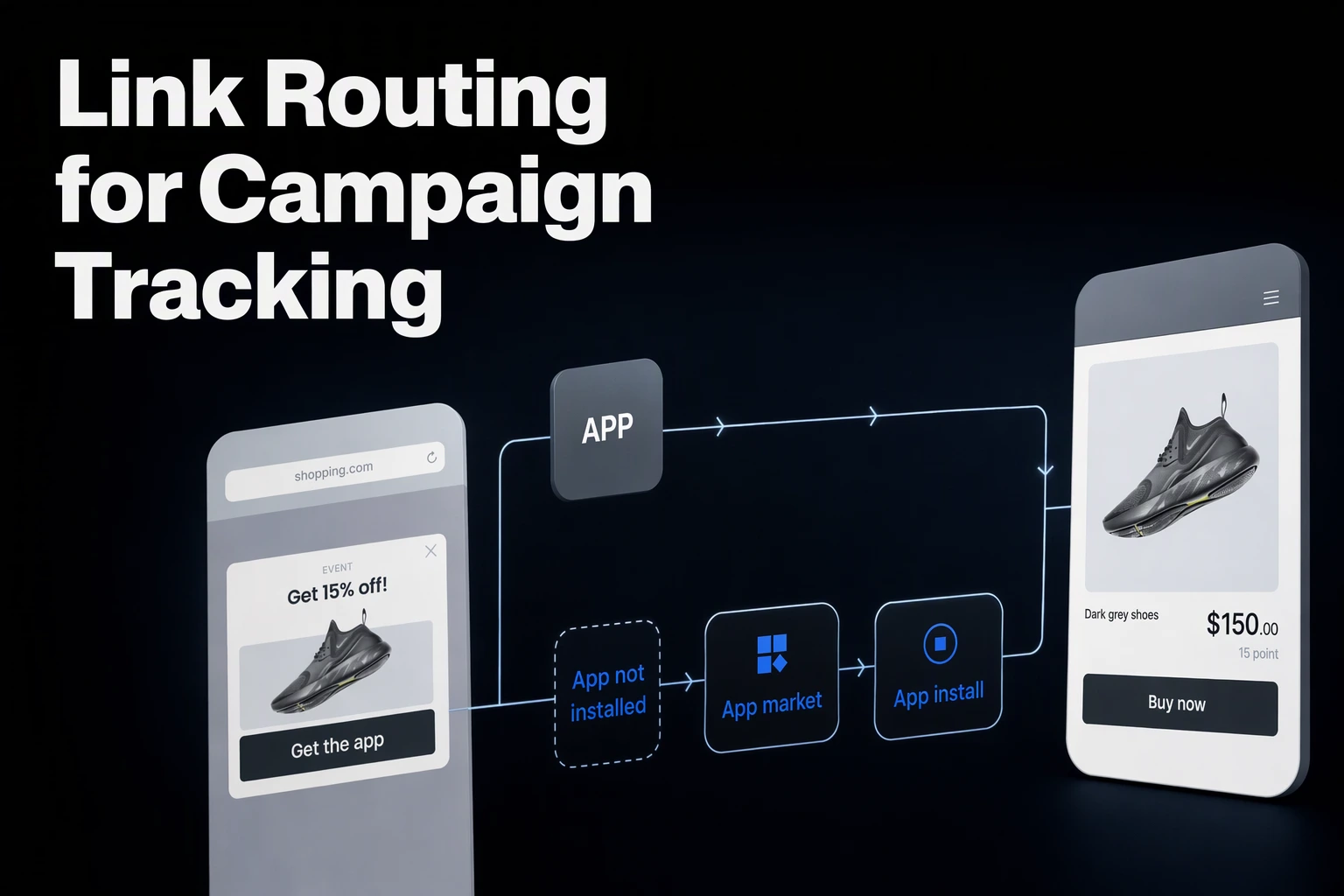
When someone clicks an ad, tracking links send that user to a desired destination. If you run a subscription app that acquires traffic through web landing pages, deep links route web visitors who already have your app installed straight to the relevant in-app screen, and route new users to the app store with context preserved so the app can open to the right screen after installation.
Once deferred deep links are set up in the Airbridge SDK, deferred deep linking is automatically enabled when you apply deep links to your tracking links. When a user without your app clicks the link, deferred deep linking sends them to the app store to install it, and then sends them to the intended app page when they first open the app.
There is a strict time window you need to factor into your user flow: for deferred deep linking to work for a user who does not have the app installed, they must install and open the app within one hour of clicking the tracking link.
Connecting Deep Links to Campaign Measurement
When your routing layer is separate from your analytics tool, a broken redirect severing URL query strings can disrupt how you measure your ad spend. Our deep linking is part of the same SDK as attribution. Every Airbridge deep link is simultaneously a tracking link, tying clicks, installs, and in-app events back to the campaign.
Under the hood, tracking link parameters deliver touchpoint and deep-link information for attribution, user redirection, and other functions. We collect click data through tracking links to measure campaign performance, while Airbridge Attribution measures ad, campaign, and channel performance across installs, sign-ups, and purchases.
To see how this works in a real acquisition workflow, consider running creator or influencer sponsorships alongside your paid social ads:
- You assign each creator their own tracking link on a custom channel, setting the creator as Campaign, the angle or hook as Ad Group, and the video as Ad Creative.
- When viewers tap that link, those parameters deliver the touchpoint and deep-link information needed for user redirection and attribution.
- Inside your Actuals reports, you can then view installs, trials, subscriptions, and revenue grouped across Campaign, Ad Group, and Ad Creative levels.
FAQS
FAQ
If a framework update silently broke our link routing and cost us weeks of campaign data, does switching to an SDK guarantee better maintenance?
No software vendor can guarantee that regressions will never happen, and our release notes simply document how we maintain our own native code rather than proving a better maintenance record than framework routers.
How do we stop non-campaign deep links from polluting our attribution event logs?
By default, our SDK collects deep link events whenever an app is opened through any deep link, but you can restrict this collection strictly to opens triggered by an Airbridge Deep Link by setting setTrackAirbridgeDeeplinkOnlyEnabled to true.
What happens if a user clicks a campaign link, downloads the app, but waits until the next day to open it?
Deferred deep linking will not send them to the intended app page because a user without the app must install and open it within one hour of clicking the tracking link for deferred deep linking to work.
Route and track in one
Tie clicks, installs, and in-app events to your campaigns today.