Blended CAC vs. Paid CAC for Subscription Apps
See why subscription apps should judge ads by paid cost per subscriber and ROAS, not blended CAC, and use Airbridge Predictive LTV and pROAS to guide budgets.
Key Takeaway
- Judge ad performance using paid cost per subscriber and ROAS rather than a blended average across all downloads.
- Organic posts without tracking link clicks are not measured as link-driven traffic, so pooling organic and paid installs masks underperforming ad campaigns.
- Use Predictive LTV in the Core Plan and pROAS calculations to evaluate predicted revenue against total ad spend.
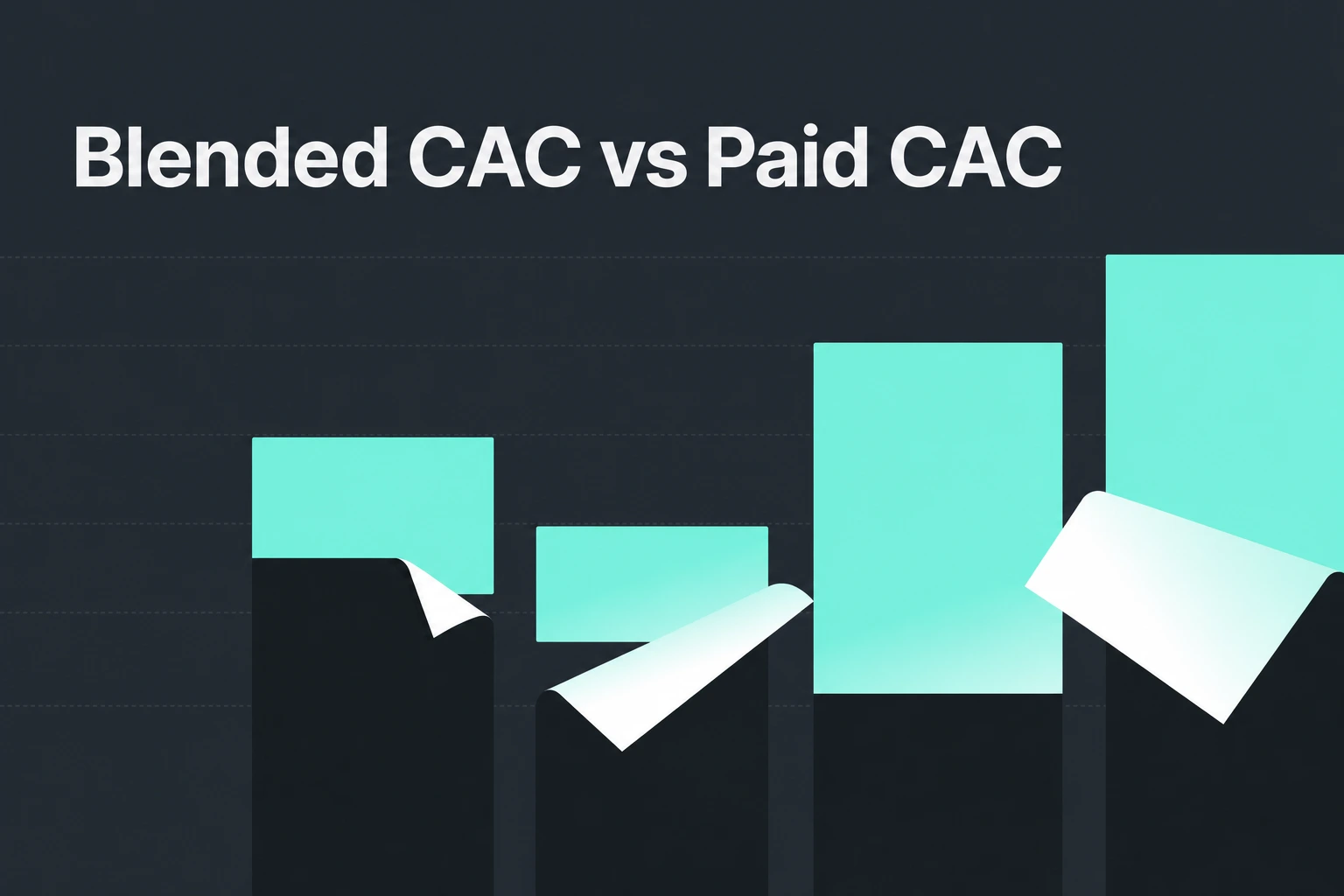
You check your billing dashboard at the end of the month and see your monthly budget gone into ads. When you divide that spend by the paid subscribers attributed to those campaigns, you are paying around $43 for every new subscriber. Then you divide that same ad spend by every new subscriber your app added that month—including organic App Store searches and word-of-mouth—and the number drops sharply. When organic users convert at a much higher rate than paid traffic, looking at a blended number makes a burning ad budget look sustainable. Knowing when to separate paid acquisition costs from total installs keeps you from scaling campaigns that lose money on every click.
Paid vs. Blended Cost
Paid acquisition cost isolates the ad spend from your paid channels and divides it strictly by the users or subscribers attributed to those ads. Blended acquisition cost takes your total marketing spend and divides it by every user who converted during that period, regardless of whether they clicked an ad or found you on their own.
In the Airbridge Revenue Report, CAC appears as a submetric next to pLTV and pROAS once cost integration is complete. In the Actuals Report, you read CPI and ROAS and can add cost per subscription as a custom metric. When you run a consumer subscription app on a $1,000 to $5,000 monthly ad budget, a campaign with a cheap cost per install can still produce a terrible cost per subscriber if nobody makes it past the paywall. Looking at paid cost per subscriber tells you what your ad dollars actually bought, while blended numbers only tell you whether your overall app business stayed afloat that month.
How Organic Skews Math
Pooling organic and paid conversions hides the exact moment an ad channel stops working. If your organic search or creator buzz brings in high-intent users who subscribe right away, that free volume absorbs the dead weight of a paid campaign where $2,000 disappeared without a single new subscriber.
This distortion gets even worse when you run creator marketing or post on social channels alongside paid ads. Airbridge tracks creator traffic that arrives through a tracking link, whereas views or installs coming from organic posts without a link click are not attributed to that post. When you judge paid ads using a blended formula, you end up giving your paid campaigns credit for those unlinked organic subscribers, which tricks you into pouring more budget into broken ad sets.
Splitting Paid and Organic
To trust your paid cost per subscriber, you have to draw a clean line between paid ad networks, tracked non-advertising links, and unlinked organic traffic. On the Core Plan ($40+/mo), you can measure paid campaigns across four major ad channels—Meta Ads, Google Ads, Apple Ads, and TikTok. The Growth Plan expands coverage to more than 330 ad networks.
For non-advertising traffic that still uses a link—such as an influencer bio link, a referral button, or an email newsletter—tracking-link attribution in the Core Plan provides real-time attribution for organic, referral, and deep link traffic. Unattributed Conversion Analysis, an Airbridge AI feature, uses ML-powered estimation to measure iOS install performance for conversions that SKAdNetwork cannot attribute.
Once users install the app, you need their subscription events tied back to those exact acquisition sources without double-counting. Airbridge matches user and device identifiers and avoids collecting the same subscription events twice. Among the 25 preconfigured standard events in the platform, three are dedicated subscription events: Start Trial, Subscribe, and Unsubscribe. Core Plan includes subscription revenue aggregation and up to two third-party integrations, such as RevenueCat, Adapty, or Superwall.
Comparing Cost with LTV
Knowing that a paid subscriber costs $43 only helps if you know what that cohort will eventually pay back. Waiting six months for annual renewals or monthly rebills to trickle in is too slow when you are adjusting ad budgets every week.
Predictive LTV is included by default in the Core Plan at no extra cost. In a Revenue Report, pLTV shows the revenue a single user in a cohort is predicted to generate going forward. Rather than guessing whether a $43 cost per subscriber is too high, you can check Predictive Lifetime Value (pLTV) alongside your ad spend through pROAS, which expresses the predicted total revenue from users who performed the Start Event during your selected date range as a percentage of total ad spend.
Airbridge calculates pROAS using the formula pLTV × Users ÷ Total Cost × 100.
Making Budget Decisions
Blended numbers cannot tell you which creative drove a trial start and which one wasted spend.
Inside Actuals reports, you can group installs, trial starts, Subscribe events, and subscription revenue by Campaign, Ad Group, and Ad Creative. The Core Plan includes both cost and ad spend aggregation and subscription revenue aggregation.
You can set up this entire workflow on the Core Plan starting with a 30-day free trial, followed by $40+/mo with 500,000 data points per month included and $0.0001 per additional data point, with no annual contract and the ability to cancel anytime.
FAQS
FAQ
Which standard events track the subscription lifecycle in Airbridge?
Among the 25 preconfigured standard events in Airbridge, the three subscription events are Start Trial, Subscribe, and Unsubscribe.
Who builds Airbridge and what platforms does it cover?
Airbridge is a Mobile Measurement Partner (MMP) built by AB180, headquartered in Seoul, South Korea, providing cross-platform attribution, analytics, and deep linking across mobile, web, PC, console, and CTV in a single dashboard. PC, console, and CTV attribution are not included in the Core Plan.
See what your ads buy
Separate paid channels from organic conversions on the Core Plan.